
An advanced acoustics technique, ultrasonic dispersion analysis studies material properties through the interaction with high-frequency sound waves.
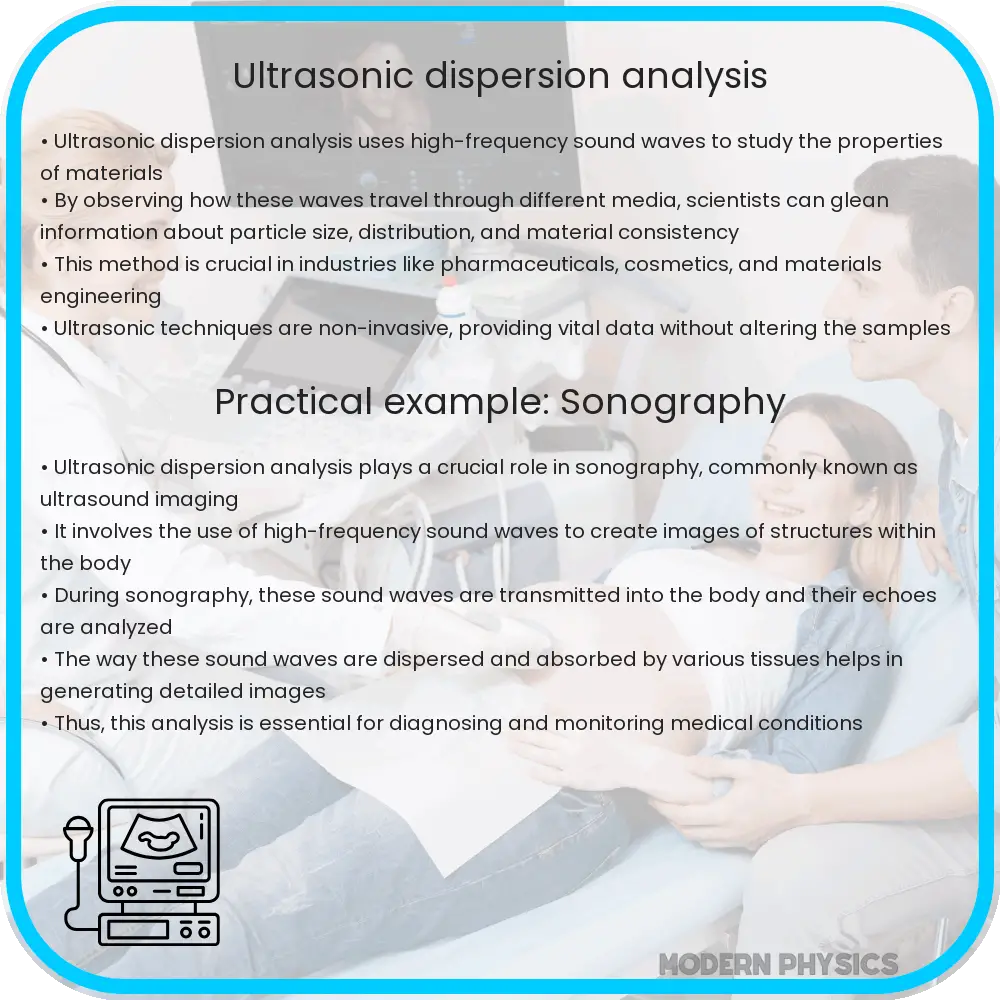
Introduction to Ultrasonic Dispersion Analysis
Ultrasonic dispersion analysis is an advanced technique employed in the field of acoustics to investigate the properties of materials and their interactions with sound waves. This method utilizes ultrasonic waves, which are sound waves with frequencies higher than the upper audible limit of human hearing, typically above 20 kHz. The principle behind this technique is to observe how these waves propagate through different mediums and how their velocity and amplitude change, providing valuable data about the material’s structure and dynamics.
The Core Principles of Ultrasonic Dispersion
At the heart of ultrasonic dispersion analysis lies the concept of wave propagation. When ultrasonic waves travel through a material, they interact with the internal structure, including particles, boundaries, and defects. The characteristics of wave propagation—its speed, attenuation, and scattering—are influenced by the medium’s properties such as density, viscosity, and elastic modulus. By analyzing these changes, scientists can infer material characteristics which are critical in various applications.
Accuracy of Ultrasonic Dispersion Analysis
The accuracy of ultrasonic dispersion analysis is pivotal for its effectiveness. Several factors influence this accuracy:
- Frequency of the Ultrasonic Wave: Higher frequencies provide better resolution but can also lead to increased attenuation.
- Homogeneity of the Material: Materials with uniform properties tend to provide more reliable data, whereas heterogeneous materials might result in complex wave behavior that can be challenging to interpret.
- Equipment Quality and Calibration: The precision of the devices used to generate and detect the ultrasonic waves plays a crucial role. Proper calibration of these devices ensures that measurements are accurate and consistent.
Speed of Analysis
One of the significant advantages of ultrasonic dispersion analysis is its speed. Traditional material testing methods can be time-consuming and often involve destructive testing, while ultrasonic techniques are largely non-invasive and can provide data in real-time. This rapid analysis makes it particularly useful in industrial applications where quick decision-making is essential.
Applications in Acoustics
The applications of ultrasonic dispersion analysis are vast and varied across different industries:
- Medical Imaging: Ultrasonic methods are crucial in medical diagnostics, notably in ultrasonography, allowing for non-invasive imaging of internal body structures.
- Material Science: Engineers and scientists analyze the properties of new materials or inspect the integrity of existing ones, like composites, ceramics, and metals.
- Non-Destructive Testing: This technique is invaluable for detecting flaws or defects in structural components, crucial for maintaining safety in aerospace, automotive, and civil engineering sectors.
In exploring these applications, it’s evident that ultrasonic dispersion analysis not only enhances our understanding of material properties but also serves as an indispensable tool in various technical disciplines. By combining accuracy and speed, it addresses both the quantitative and qualitative needs of contemporary engineering challenges.
Challenges and Limitations
While ultrasonic dispersion analysis offers numerous advantages, it is not without its challenges and limitations. Some of the more prominent obstacles include:
- Depth of Penetration: Ultrasonic waves have a limited penetration depth, particularly in denser materials, which can restrict the scope of internal examination.
- Surface Roughness: The texture of the material’s surface can significantly affect the accuracy of ultrasonic measurements. Rough surfaces might scatter the sound waves, leading to less precise data.
- Temperature Sensitivity: The properties of both the ultrasonic waves and the material might vary with temperature changes, which can complicate the analysis unless carefully managed.
Future Prospects
The field of ultrasonic dispersion analysis continues to evolve with advancements in technology and methodology. Future research and development are likely to focus on enhancing the penetration depth of ultrasonic waves and improving the resolution of data collected, even from materials with complex structures. Moreover, integrating artificial intelligence and machine learning can provide more sophisticated data analysis, increasing the overall efficacy and application of ultrasonic methods in real-time scenarios.
Conclusion
Ultrasonic dispersion analysis stands as a pivotal technique in the acoustics and materials science fields due to its non-invasive nature, speed, and the breadth of information it can provide about a material’s internal properties. Despite facing some challenges like limited penetration depth and sensitivity to surface conditions, ongoing innovations in this field promise to mitigate these issues, making ultrasonic techniques even more valuable. As industries continue to demand faster and more accurate diagnostic methods, the role of ultrasonic dispersion analysis is only expected to grow, reinforcing its importance in scientific and industrial applications worldwide.