
Learn how acoustic delay lines manipulate audio signal timing in signal processing using mediums like metal or fiber optics.
Understanding Acoustic Delay Lines in Signal Processing
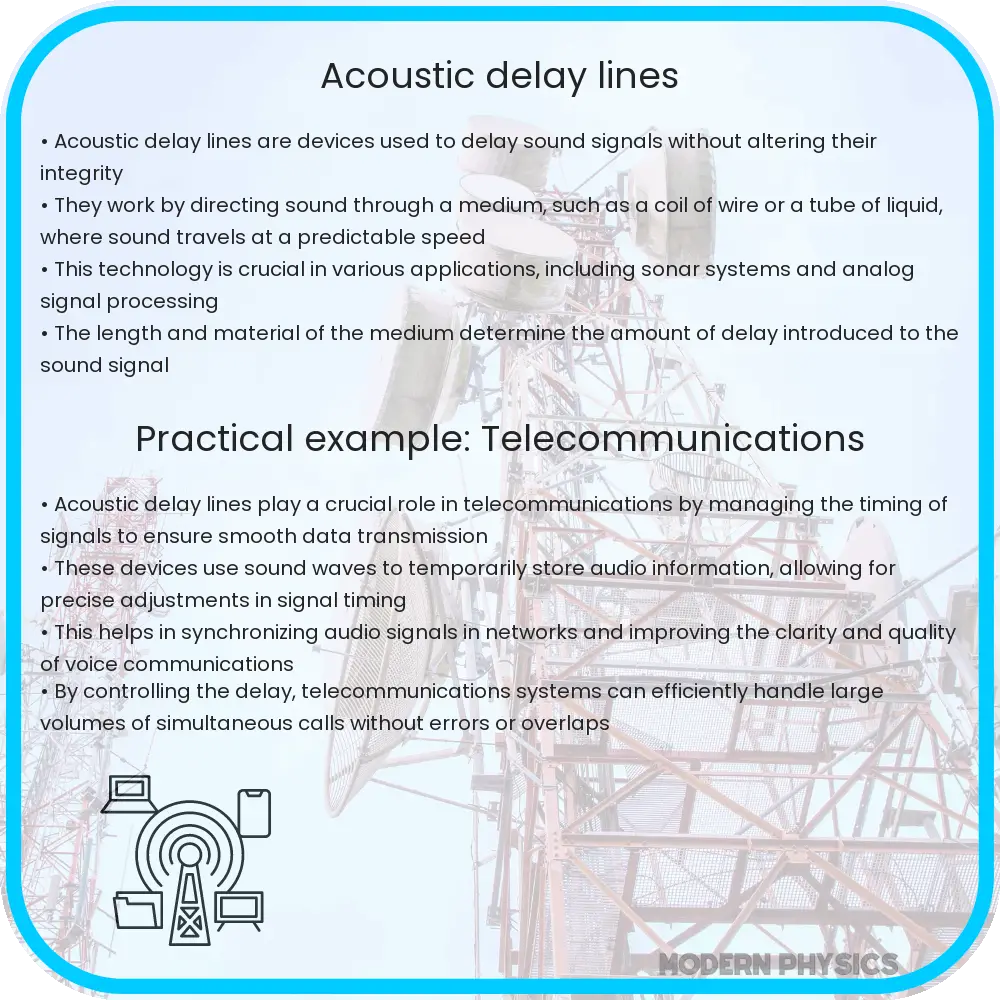
Acoustic delay lines are a fundamental component in the field of signal processing, contributing to the precise timing and manipulation of audio signals. These devices use the physical properties of sound propagation in various media to delay the audio signal by a predictable amount of time. The ability to control the timing of signals with high precision has led to various applications in electronics and communication technology.
How Acoustic Delay Lines Work
At its most basic, an acoustic delay line involves sending a sound wave along a path where it encounters controlled resistance, which slows its progression. This delay is often achieved by passing the audio signal through a medium such as a solid rod or a coil of wire, wherein the sound travels at a slower speed compared to air. The choice of material and the length of the path determine the amount of delay introduced to the signal.
Key Components and Setup
- Medium: The material through which the sound propagates, commonly metals such as aluminum or copper for solid delay lines, or magnetic tape and fiber optics in other types.
- Transducers: Devices that convert the audio signal from electrical to mechanical form and back again. Piezoelectric transducers are frequently used for their efficiency in this role.
- Reflectors: In some designs, reflectors are used at the ends of the transmission medium to bounce the sound wave back and forth, increasing the effective path length and thus the delay.
Mathematical Basis of Signal Delay
The fundamental principle governing the delay (\( \Delta t \)) of a signal in an acoustic delay line can be expressed as:
\[ \Delta t = \frac{L}{v} \]
where:
- \( L \) is the length of the medium through which the sound wave travels,
- \( v \) is the velocity of sound in that medium.
This equation illustrates that the delay is directly proportional to the length of the medium and inversely proportional to the speed of sound within the medium.
Precision in Acoustic Delay Lines
The precision of acoustic delay lines is critical, especially in applications where timing is crucial, such as in radar systems or telecommunications. Factors that affect precision include the homogeneity of the transmission medium and the stability of the environmental conditions such as temperature and pressure, which can alter the speed of sound in the medium.
Common Uses of Acoustic Delay Lines
Acoustic delay lines have a wide range of applications:
- Telecommunications: They help in the accurate timing and synchronization of data transmission over networks.
- Audio Processing: In musical applications, delay lines are used to create echo effects or to harmonize sounds.
- Radar and Sonar Systems: Delay lines can precisely control the timing of the signals emitted, helping in the accurate determination of the position and speed of objects.
This illustrates the importance and versatility of acoustic delay lines in various fields of modern technology.
Challenges and Innovations in Acoustic Delay Lines
Despite their numerous applications, acoustic delay lines face several challenges. For instance, the physical size of these devices can be a limitation, especially in compact or portable technology. Additionally, the quality of materials and precision in manufacturing are crucial in ensuring minimal signal degradation and accurate delay times.
Recent innovations aim to overcome these challenges through the use of advanced materials and digital processing techniques. Materials with better acoustic properties and lower dispersion rates help in improving the performance of delay lines. Digital signal processing (DSP) techniques are also increasingly integrated to complement or even replace traditional acoustic delay lines, providing more flexibility and control over the signal delays.
Future Prospects of Acoustic Delay Lines
The continuous advancements in materials science and digital technology hold promising potential for the future of acoustic delay lines. With ongoing research into nano-materials and microfabrication techniques, there is potential to drastically reduce the size of these components while maintaining or even enhancing their functionality.
Moreover, the integration of acoustic delay lines with other technologies such as optical systems and MEMS (Micro-Electro-Mechanical Systems) can lead to new applications in areas like biomedical devices and advanced computing, where precise timing is increasingly critical.
Conclusion
Acoustic delay lines play a crucial role in the fields of telecommunications, audio processing, and navigation systems. Understanding how these devices work, their components, and their mathematical basis provides insight into their essential function in modern technology. The principles of delaying sound propagation through various media allow for a range of applications that are integral to the functionality of many systems.
While there are challenges associated with their physical characteristics and precision, ongoing innovations and advancements in technology continue to enhance their capabilities and applications. As we look to the future, the evolution of acoustic delay lines promises to bring even more sophisticated and compact solutions, further expanding their uses in science and industry. Thus, the study and development of acoustic delay lines not only enhance our current technologies but also pave the way for future innovations.