
Learn how ultrasonic intermodulation occurs when ultrasonic waves interact, creating new frequencies in materials, crucial for various fields.
Understanding Ultrasonic Intermodulation
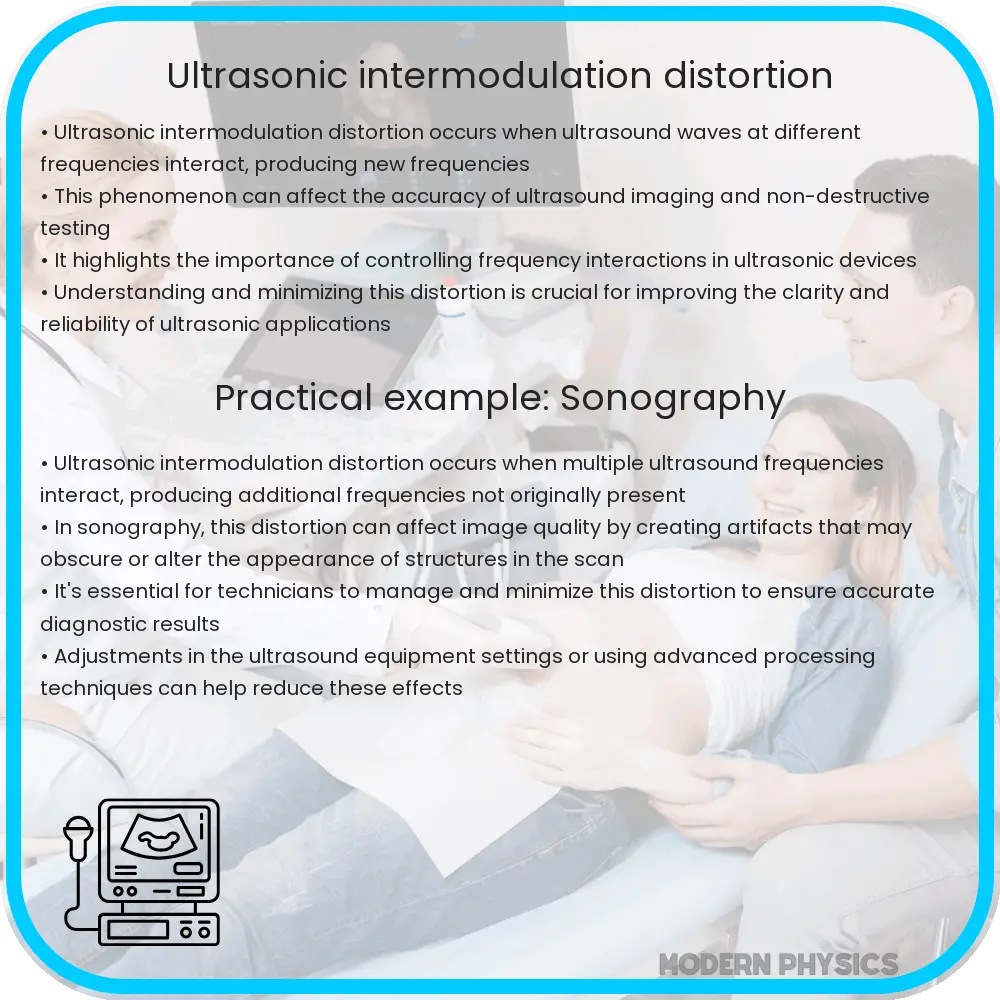
Ultrasonic intermodulation is a phenomenon that occurs when ultrasonic waves interact with each other or with the material through which they are passing. This interaction can lead to the generation of new frequencies that were not originally present in the initiating ultrasonic signals. Understanding this effect is crucial in various fields, such as materials testing, medical imaging, and nonlinear acoustics.
Clarity and Causes of Ultrasonic Intermodulation
At its core, ultrasonic intermodulation arises due to the non-linear properties of the medium where the ultrasonic waves are propagated. Normally, materials exhibit linear behavior, meaning the response of the material is directly proportional to the input. However, under certain conditions, materials can behave non-linearly, which means that the output is not necessarily directly proportional to the input. It is this non-linear behavior that leads to the creation of new frequencies when ultrasonic waves are transmitted through such materials.
Several factors can exacerbate or mitigate the effects of ultrasonic intermodulation, including:
- Material Composition: Different materials exhibit varying degrees of non-linearity based on their molecular and atomic structure.
- Wave Amplitude: Higher amplitudes can enhance non-linear effects, leading to more pronounced intermodulation.
- Frequency of Operation: The frequencies of the interacting ultrasonic waves also play a critical role in how intermodulation occurs.
Measurement of Ultrasonic Intermodulation
To effectively measure ultrasonic intermodulation, sophisticated equipment and techniques are required. These measurements generally involve observing the generated frequencies when two or more ultrasonic waves interact within a medium. The analysis of these frequencies helps in understanding the non-linearity of the medium and the efficiency of the ultrasonic waves in causing intermodulation.
Typically, the measurement process includes:
- Emitting Multiple Ultrasonic Waves: Ultrasonic transducers are used to emit waves at specific frequencies into the material.
- Detection of Resultant Waves: Specialized sensors detect the resultant waveforms that include both the original and intermodulated frequencies.
- Analysis: Advanced signal processing techniques are then employed to analyze these waveforms, isolating and identifying the intermodulation frequencies.
Among the key techniques used in the measurement of ultrasonic intermodulation is the use of spectral analysis. This methodology allows researchers to break down complex waveforms into their constituent frequencies, making it easier to identify and quantify the intermodulation products.
Applications of Ultrasonic Intermodulation
The practical applications of ultrasonic intermodulation are vast and impactful across several industries. By exploiting the phenomenon, engineers and scientists can gain insights not possible through conventional methods. Some notable applications include:
- Material Testing: In material science, ultrasonic intermodulation can help detect flaws and irregularities in materials without causing damage. This is particularly valuable in the inspection of critical structures like aircraft components and bridges.
- Medical Imaging: Enhanced imaging techniques that utilize ultrasonic intermodulation can produce clearer and more detailed images, aiding in more accurate diagnoses.
- Nonlinear Acoustic Research: Researchers can explore the fundamental properties of sound and its interaction with various materials, leading to innovations in acoustic technology and sound manipulation.
Challenges and Future Directions
Despite its advantages, the implementation of ultrasonic intermodulation faces challenges primarily related to complexity and cost. The equipment and expertise required to accurately measure and utilize this phenomenon are significant. Moreover, interpreting the data from ultrasonic intermodulation requires sophisticated models and a deep understanding of wave physics.
Future research is aimed at simplifying these processes and making the technology more accessible. Innovations in sensor technology and signal processing software are expected to lower costs and enhance the usability of ultrasonic intermodulation in everyday applications.
Conclusion
Ultrasonic intermodulation constitutes a crucial area in the field of wave physics, offering transformative potentials across various industries. Whether it improves material testing practices, advances medical diagnostic techniques, or deepens our understanding of acoustic phenomena, this technology harnesses the power of ultrasound in novel and valuable ways. As we tackle the challenges and harness the capabilities of ultrasonic intermodulation, the future looks promising for further integrating this phenomenon in practical applications, potentially revolutionizing how we utilize sound and waves in technology and medicine.