
Learn about ultrasonic plastic assembly, a cutting-edge process utilizing ultrasonic vibrations to fuse plastic parts efficiently and eco-friendly, without traditional fasteners.
Understanding Ultrasonic Plastic Assembly
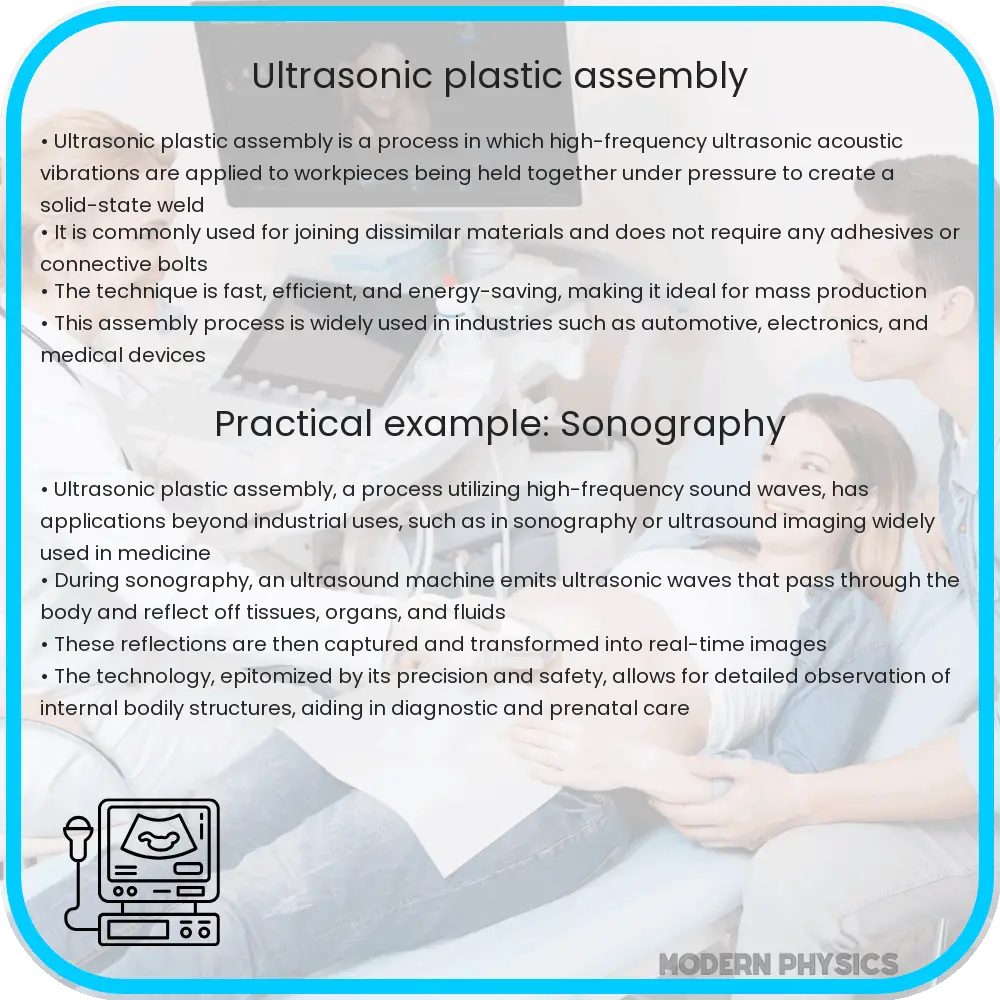
Ultrasonic plastic assembly is a modern manufacturing process used to join multiple pieces of plastic without the need for adhesives, screws, or other traditional fastening techniques. This method uses high-frequency ultrasonic acoustic vibrations to melt and fuse plastic components at their contact points. It’s renowned for its efficiency, precision, and speed, making it a preferred choice in industries ranging from automotive to consumer electronics.
How It Works
The process begins with the positioning of plastic parts in the assembly equipment where a sonotrode, or horn, is brought into contact with the upper part. Once activated, the sonotrode applies ultrasonic vibrations typically ranging from 20 kHz to 40 kHz directly to the parts. The vibrations create localized heat due to friction at the interface of the two pieces, causing the plastic to melt and merge as the sonotrode applies pressure, effectively welding them together.
Key Components of Ultrasonic Plastic Assembly
- Sonotrode: A tool that directly contacts and delivers ultrasonic energy to the plastic parts, designed specifically for each unique application.
- Generator: This unit provides the power that drives the ultrasonic transducer, transforming the electrical energy into mechanical vibrations.
- Anvil or Fixture: Supports the plastic components during the ultrasonic welding process, ensuring that the parts are held firmly in place.
- Transducer: Converts electrical energy into high frequency mechanical vibrations.
Advantages of Ultrasonic Plastic Assembly
The ultrasonic plastic assembly method boasts numerous benefits:
- Efficiency: The process is incredibly fast, typically completed in less than a second, which dramatically reduces cycle times compared to traditional methods.
- Precision: Ultrasonic welding allows for precise control of the energy directed to the joining area, which benefits the assembly of complex and small dimension parts.
- Strength: The joints produced are high in durability and integrity, often stronger than the parent materials being bonded together.
- Energy Saving: It consumes significantly less energy compared to other thermal welding processes as it uses the friction between the parts themselves to generate heat only where needed.
- Eco-Friendly: Ultrasonic welding does not require the use of solvents or adhesives and produces no additional waste or fumes, making it an environmentally friendly option in plastic fabrication.
Ultrasonic plastic assembly offers a highly efficient, precise, and eco-friendly alternative to traditional fabrication methods, providing high-quality joins essential for robust product manufacturing. Industries that require quick assembly and agile production cycles greatly benefit from this technology, leveraging these advantages to improve product outputs and operational efficiencies.
Efficiency, Precision, and Speed Metrics
The efficacy of ultrasonic plastic assembly can also be attributed to its measurable performance metrics. Typically, the time required to weld two plastic parts can range from 200 ms to 800 ms, depending on the material’s nature and the complexity of the join. The process leads to highly repeatable and consistently strong joints, meeting stringent quality control standards.
This innovative method also allows for increased production rates without compromising quality, crucial for high volume manufacturing industries. Continuous advancements in ultrasonic welding equipment technology further improve these metrics, driving wider adoption in various industrial applications.
Applications in Various Industries
Ultrasonic plastic assembly has broad applications across multiple sectors. In the automotive industry, it is used to assemble large and complex components such as dashboards and light housings. Consumer electronics manufacturers employ this technology to assemble small, intricate parts in devices like smartphones and tablets, where precision and reliability are crucial. Additionally, the medical sector benefits from this method’s ability to create sterile, strong welds in disposable medical devices such as catheters and IV tubes without introducing contaminants.
Future Trends and Innovations
As technology progresses, ultrasonic plastic assembly is expected to see significant innovations. Anticipated developments include smarter sonotrodes that can adjust frequencies dynamically to accommodate different plastic materials, enhancing assembly adaptability and efficiency. Moreover, integration with automated and robotic systems is likely to increase, leading to further improvements in precision and reducing human error. These advancements will enhance the capability of ultrasonic welding to meet the evolving demands of modern manufacturing.
Conclusion
In summary, ultrasonic plastic assembly represents a transformative approach to modern manufacturing, characterized by its speed, precision, and eco-friendliness. It eliminates the need for traditional fasteners and adhesives, providing a clean, efficient, and strong method of joining plastic components. With ongoing advancements and broad applications across various industries, ultrasonic plastic assembly continues to stand out as a leading technology in the field of materials engineering. Its future, enriched by technological innovations and wider adoption, promises even greater efficiency and adaptability in manufacturing processes, further solidifying its role in the advancement of industrial production techniques.