
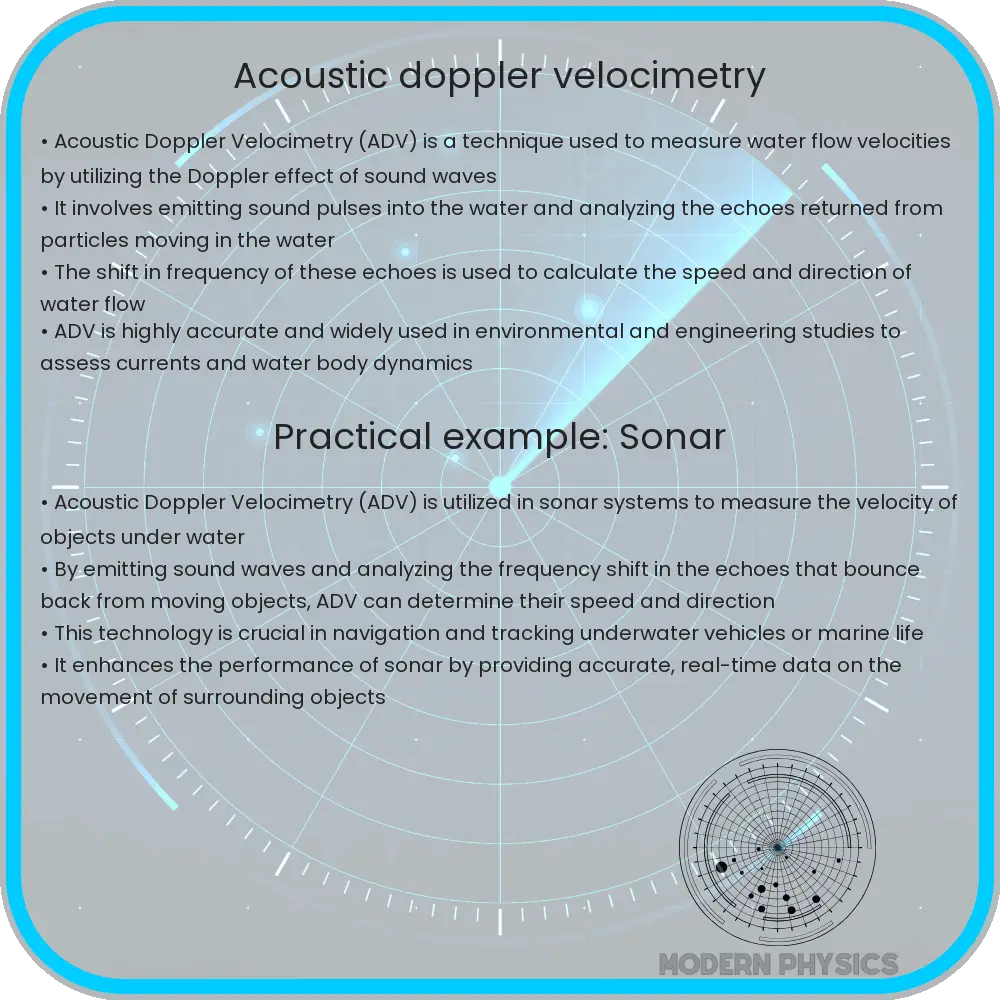
Acoustic Doppler Velocimetry (ADV) is a technique for measuring fluid velocity using the Doppler Effect, essential in hydrology, oceanography, and engineering.
Understanding Acoustic Doppler Velocimetry
Acoustic Doppler Velocimetry (ADV) is a sophisticated technique used to measure the velocity of fluids, typically water, in a wide range of environments and applications. It plays a crucial role in hydrology, oceanography, and engineering, providing precise measurements that help in understanding fluid dynamics, sediment transport, and ecological processes in aquatic systems.
How Does Acoustic Doppler Velocimetry Work?
At its core, ADV utilizes the Doppler Effect, which describes the change in frequency or wavelength of a wave in relation to an observer moving relative to the source of the waves. In the context of ADV, an acoustic (sound) pulse is transmitted into the water, and the frequencies of the echoes reflected back from particles within the water column are analyzed to determine the speed and direction of the water flow relative to the instrument.
The fundamental equation governing the operation of ADV is derived from the Doppler shift formula:
\[ f = f_0 \left( \frac{v + v_o}{v + v_s} \right) \]
where:
-
f is the observed frequency,
-
f0 is the transmitted frequency,
-
v is the velocity of sound in the medium,
-
vo is the velocity of the observer relative to the medium, and
-
vs is the velocity of the source relative to the medium.
In the case of ADV, the observer is the stationary instrument itself, and the source of the reflection is the moving water particles.
The Components of an ADV System
An ADV system typically consists of three major components:
- Transducer: This component emits the acoustic signal into the water and receives the echo. Its design and frequency are critical for determining the effectiveness and resolution of the measurements.
- Electronic System: This processes the received signal, extracting velocity data from the frequency shift observed in the returned signal.
- Data Processing Unit: Often a computer or a dedicated processor that interprets the processed signal and converts it into understandable flow data, which can be further analyzed for various applications.
The precision of an ADV system is highly dependent on factors such as water turbidity, the presence of debris, and the characteristics of suspended particles. Moreover, the positioning and stability of the ADV instrument itself are crucial to obtain accurate measurements.
Applications of Acoustic Doppler Velocimetry
ADV is employed in several fields due to its ability to provide precise and real-time data on fluid flow. Some of the common applications include:
- Environmental Monitoring: Assessing water flows in rivers, estuaries, and coastal areas to study environmental impacts and sediment transportation.
- Industrial Applications: Monitoring wastewater, flows in pipes, and other industrial processes where fluid dynamics are critical.
- Research and Development: Used extensively in hydrodynamic research to study complex flow patterns and turbulence in laboratory settings and natural bodies of water.
As technology progresses, the capabilities of ADV systems continue to improve, broadening their applications and utility in both scientific research and industry. Innovations in sensor technology, data analysis methods, and system integrations enhance the overall effectiveness and user-friendliness of these instruments.
Challenges and Limitations of ADV
While ADV provides numerous benefits, like any technology, it has its challenges and limitations. One of the major challenges is interference caused by bubbles or solid particles, which can affect the accuracy of the measurements. Additionally, biological fouling on the transducer can degrade signal quality over time, especially in biologically active waters.
Another limitation is the range and depth of measurement, which are restricted by the frequency of the acoustic signals. Higher frequencies provide better resolution but have shorter range, making them less effective in deeper waters. Conversely, lower frequencies can reach greater depths but with reduced resolution.
Environmental factors such as temperature and salinity also influence the velocity of sound in water, thus affecting ADV readings. Careful calibration and environmental monitoring are required to maintain accuracy in diverse conditions.
Future Prospects in Acoustic Doppler Velocimetry
Advancements in technology point toward exciting future improvements in ADV systems. The integration of machine learning algorithms for better data analysis and error handling, enhancements in sensor technology for greater range and resolution, and the development of more compact and energy-efficient designs are some of the areas where significant progress can be expected. These advancements could potentially open up new applications in remote sensing and unexplored areas of oceanography.
Additionally, the combination of ADV technology with other measurement techniques like satellite observations and robotic monitoring systems could lead to a more comprehensive understanding of aquatic environments, significantly impacting fields like climate research and marine biology.
Conclusion
Acoustic Doppler Velocimetry stands as a cornerstone technology in fluid dynamics research, environmental monitoring, and various industrial applications. Its ability to provide real-time, precise measurements of water flow dynamics makes it indispensable in many fields. Despite facing challenges such as interference and environmental limitations, ongoing technological advancements and integrations promise to enhance its capabilities and expand its application scope. As technology evolves, the role of ADV in understanding and managing aquatic systems is set to become even more pivotal, proving its enduring value in science and industry.