
Learn about the zeroth-order acoustic mode, the fundamental vibration in acoustic systems with uniform energy distribution.
Understanding the Zeroth-Order Acoustic Mode
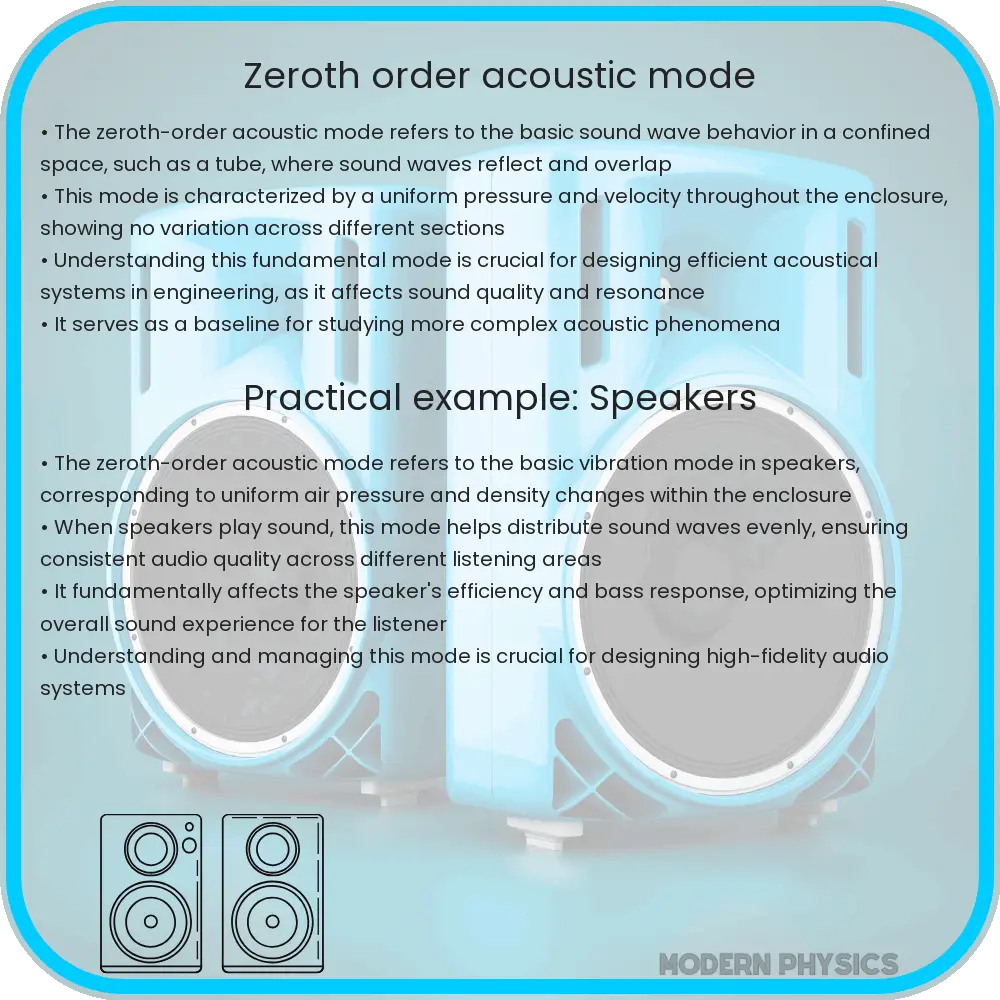
The concept of acoustic modes is essential in the field of acoustics and plays a pivotal role in understanding how sound behaves in different environments. Among these modes, the zeroth-order acoustic mode, often referred to as the fundamental mode, is particularly significant due to its foundational presence in various acoustic systems.
Basics of Zeroth-Order Acoustic Mode
Acoustic modes are specific patterns of pressure and displacement of air in a resonating system. These modes are quantified by numbers that represent their frequency and spatial pattern characteristics. The zeroth-order acoustic mode represents the lowest frequency at which a system can resonate, and unlike higher-order modes, it exhibits the simplest form of vibration and has a uniform distribution of acoustical energy within the resonator.
In mathematical terms, acoustic modes in a cavity can be represented by standing wave solutions of the wave equation. For a one-dimensional cavity with length L, the zeroth-order mode, also known as the fundamental mode, occurs at the frequency given by:
f0 = c / (2 * L) where c is the speed of sound in the medium.
This equation implies that the fundamental frequency is inversely proportional to twice the length of the cavity, highlighting how the physical dimensions of space impact the acoustic properties.
Analysis of the Zeroth-Order Acoustic Mode
To analyze this mode, consider a simple example such as a pipe closed at both ends. In such a setup, the zeroth-order mode is characterized by a pressure antinode at the center and pressure nodes at the closed ends. The air molecules at these nodes experience minimal displacement, whereas those at the antinode undergo maximum displacement. This setup provides a clear visual and physical manifestation of the acoustic mode in action.
Numerically, analyzing these modes involves solving the Helmholtz equation under appropriate boundary conditions. For a closed pipe, the boundary condition stipulates that the derivative of the pressure with respect to position equals zero at both ends of the pipe (reflecting the nodes). Solving this equation gives the spatial distribution of pressure and displacement, confirming the descriptions mentioned previously.
Applications of Zeroth-Order Acoustic Modes
The fundamental understanding of zeroth-order acoustic modes has extensive applications across several fields. In musical acoustics, for instance, these modes help in designing wind instruments such as flutes and organs, where the pitch of the note is directly related to the fundamental frequency of the air column inside the instrument.
In architectural acoustics, understanding and manipulating these modes can influence how sound is distributed in a room. For example, in concert halls, achieving a balance between different acoustic modes is crucial for optimal sound distribution and clarity.
Furthermore, in the field of noise control engineering, zeroth-order modes can be crucial for designing enclosures that minimize the transmission of sound. By adjusting dimensions or materials, engineers can shift the frequency of these modes, thereby influencing the acoustic isolation properties of an environment.
Understanding the zeroth-order acoustic mode not only provides a basis for more complex acoustic phenomena but also opens up avenues for practical applications that enhance our interaction with sound in various environments.
Experimental Studies and Further Research
Experimental studies often validate theoretical models of zeroth-order acoustic modes. Using sophisticated equipment such as microphones and oscilloscopes, researchers can observe and measure the sound patterns within different cavities. These experiments not only confirm the presence of these modes but also help in refining the theoretical models by accounting for real-world factors like material properties and air temperature fluctuations.
Further research in this area continues to explore new materials and geometries that could modify or exploit these acoustic modes for more advanced applications. For instance, metamaterials—engineered materials with properties not found in nature—are being studied to see how they can impact acoustic modes, potentially leading to new ways to control sound.
Educational Importance of Zeroth-Order Acoustic Modes
Educationally, the concept of zeroth-order acoustic modes is crucial in physics and engineering curricula. It demonstrates fundamental concepts such as wave theory, resonance, and harmonic oscillation. By integrating hands-on experiments that recreate these modes, educational institutes can enhance students’ understanding and interest in acoustics.
Moreover, simplified models and simulations of these acoustic modes can be powerful tools in the classroom, helping to visualize and explain complex phenomena in a digestible format. This approach not only aids in deeper comprehension but also sparks curiosity and innovation among students.
Conclusion
The zeroth-order acoustic mode serves as a cornerstone concept in acoustics, illuminating the basic principles of how sound interacts with its environment. From its theoretical basis to practical applications and importance in education, understanding this fundamental mode offers a window into the broader field of wave phenomena. Whether it’s designing the next generation of musical instruments or enhancing the acoustics of a public space, the principles governing the zeroth-order mode find relevance in numerous scientific and engineering endeavors. Thus, mastering this concept not only enriches our theoretical knowledge but also equips us with the practical skills to innovate and improve our acoustic world.