
Explore the role of Zeta Function Regularization in quantum physics, from quantum field theory applications to insights in advanced theoretical physics.
Zeta Function Regularization: Quantum Insights & Applications
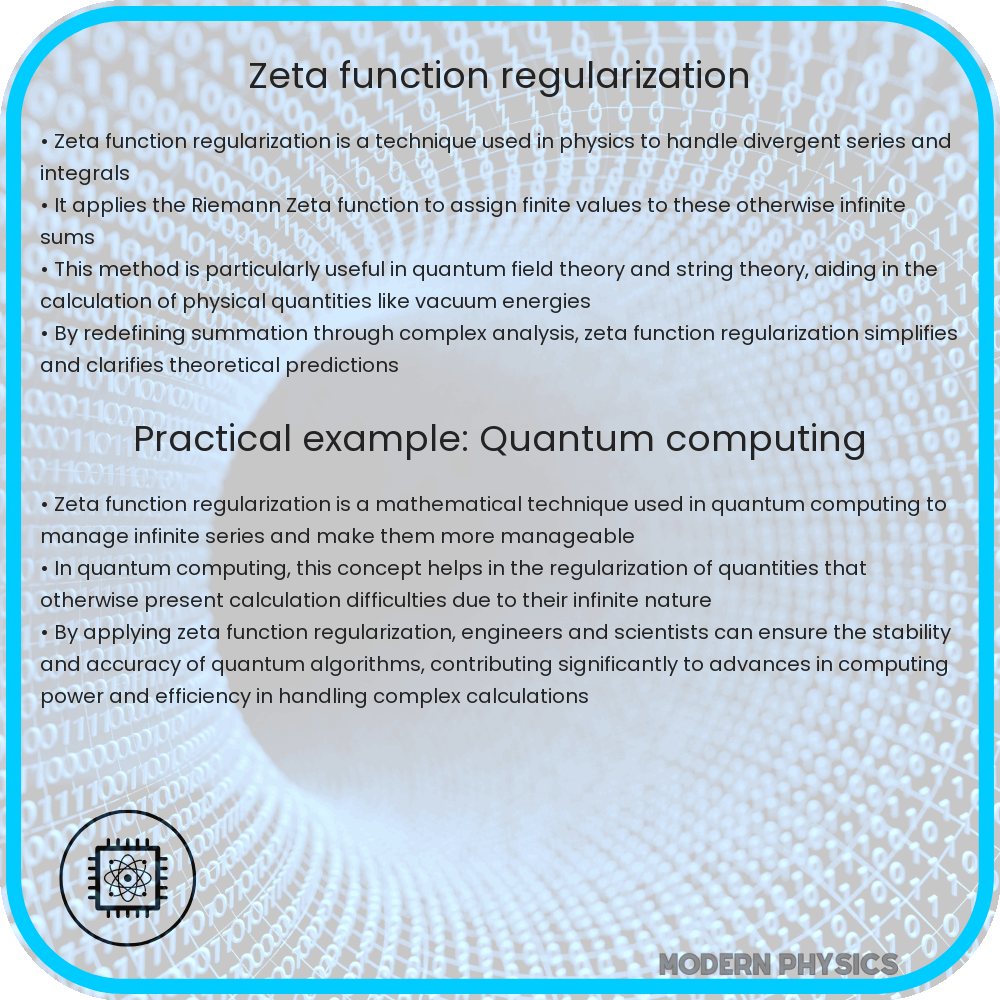
The concept of zeta function regularization plays a pivotal role in quantum field theory and various applications in physics, offering unique insights into the quantum world. This mathematical tool is essential for understanding phenomena like the Casimir effect and the vacuum energy in quantum fields. Zeta function regularization is a technique used to give meaning to divergent series and integrals, which frequently occur in quantum physics.
Understanding Zeta Function Regularization
Zeta function regularization is rooted in the Riemann Zeta function, denoted as ζ(s), where ‘s’ is a complex variable. The Riemann Zeta function is defined for s ≠ 1 as ζ(s) = ∑n=1∞ n-s, a series that converges for the real part of s greater than 1. In quantum field theory, divergences are often encountered in the form of infinite sums or integrals. Zeta function regularization provides a method to assign finite values to these divergences by analytically continuing the Riemann Zeta function to values where the series does not converge naturally.
Applications in Quantum Field Theory
In quantum field theory, zeta function regularization is used to address the issue of infinite vacuum energy. For instance, when calculating the zero-point energy of a quantum field, the result is typically an infinite sum. By applying zeta function regularization, this infinite sum can be converted into a finite value, allowing for meaningful physical interpretations. This technique is particularly useful in the study of quantum fluctuations and the Casimir effect, where it aids in predicting forces arising from vacuum fluctuations.
Implications in Quantum Physics
Zeta function regularization also has implications in understanding the quantum properties of black holes. For example, it is used in Hawking radiation calculations, where it helps in dealing with the divergences that arise in the quantization of fields in curved spacetime. This application demonstrates the broader impact of zeta function regularization beyond standard quantum field theory, venturing into the realms of cosmology and astrophysics.
Overall, zeta function regularization is a powerful mathematical tool that has significantly advanced our understanding of various quantum phenomena. It bridges the gap between abstract mathematical concepts and observable physical realities, allowing physicists to make sense of the otherwise incomprehensible infinities that arise in quantum calculations.
Enhancing Understanding of Quantum Mechanics
Zeta function regularization not only facilitates calculations in quantum field theory but also enhances our understanding of fundamental aspects of quantum mechanics. It provides a systematic approach to deal with infinities, a common challenge in quantum physics, thereby reinforcing the theoretical foundations of the discipline. This method is instrumental in exploring concepts like renormalization, a crucial process in making sense of quantum field theories.
Role in Advanced Theoretical Physics
Advanced areas of theoretical physics, such as string theory and loop quantum gravity, also benefit from zeta function regularization. In these domains, the technique helps in tackling the intricate mathematical structures and infinities that naturally arise. It aids in the computation of physical quantities that would otherwise be indefinable due to divergences.
Quantum Insights from Zeta Function Regularization
The insights provided by zeta function regularization extend to the quantum behavior of various systems under extreme conditions. For instance, in high-energy physics and cosmology, it plays a role in understanding the early universe’s quantum fluctuations and the nature of dark energy. These applications underscore the versatility and indispensability of zeta function regularization in modern physics.
Conclusion
Zeta function regularization stands as a cornerstone in the field of quantum physics, seamlessly integrating mathematical elegance with physical applicability. By transforming divergent series and integrals into meaningful quantities, it has opened new avenues in theoretical physics, allowing for deeper insights into the quantum realm. From elucidating the properties of black holes to shaping our understanding of the vacuum energy, zeta function regularization has proven indispensable. Its role in bridging mathematical concepts with physical phenomena not only underscores its importance in current research but also highlights its potential in unlocking future mysteries of the quantum universe.