
Explore the Casimir Effect’s role in quantum physics, its impact on vacuum fluctuations, entropy, and potential applications in nanotechnology.
Understanding the Casimir Effect: Quantum Forces and Vacuum Fluctuations
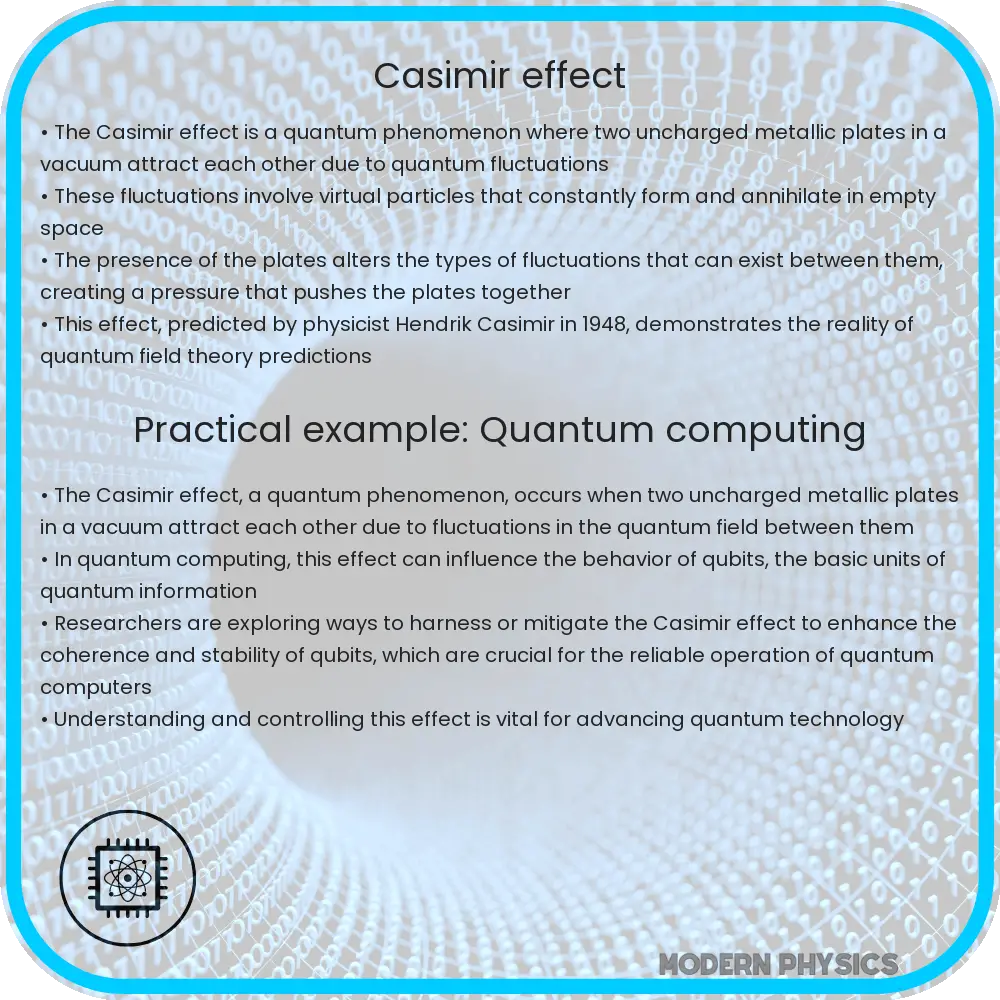
The Casimir Effect, a phenomenon in the realm of quantum physics, has garnered significant attention due to its intriguing manifestations and implications. At its core, this effect involves the creation of an attractive force between two uncharged, parallel plates in a vacuum. This force is a direct result of vacuum fluctuations associated with quantum field theory. Understanding the Casimir Effect requires delving into the concepts of quantum forces, vacuum fluctuations, and the role of entropy in this quantum phenomenon.
Quantum Forces and Vacuum Fluctuations
In quantum field theory, vacuum fluctuations refer to temporary changes in the amount of energy in a point in space, as a result of the Heisenberg Uncertainty Principle. This principle posits that it’s impossible to simultaneously measure the position and momentum of a particle with absolute precision. These fluctuations lead to the temporary appearance of particle-antiparticle pairs, even in what is considered a vacuum. The Casimir Effect arises when these fluctuations are altered by the presence of macroscopic boundaries, such as the uncharged metallic plates.
The force itself is a quantum force, emerging not from traditional electromagnetic interactions but from the alteration of the quantum vacuum state. This alteration results in a measurable force that, although weak, has been experimentally verified. This quantum force is a fundamental demonstration of the reality of quantum fluctuations and the impact they can have on macroscopic objects.
Entropy and the Casimir Effect
Entropy, a concept often associated with disorder in a system, plays a significant role in the Casimir Effect. When the two plates are brought close together, the number of quantum states available to the vacuum fluctuations between them is reduced, leading to a decrease in entropy. This reduction in entropy is thought to be directly related to the attractive force experienced by the plates, as systems naturally tend toward states of lower entropy. The interplay between entropy and the Casimir force provides a unique intersection of thermodynamics and quantum mechanics, offering insights into the deeper workings of the universe.
Understanding the Casimir Effect and its implications is not only a quest to comprehend the fundamental forces of nature but also a window into the potential applications in nanotechnology, where controlling such quantum forces could lead to groundbreaking advancements.
Applications and Implications of the Casimir Effect
The Casimir Effect, while predominantly a subject of theoretical interest, holds potential for practical applications, particularly in the field of nanotechnology. One of the most promising applications is in the development of microelectromechanical systems (MEMS). These systems, which function at the microscopic scale, could harness the Casimir force for operational purposes, such as actuation and sensing mechanisms. Furthermore, understanding this effect is crucial in designing nanoscale devices, where quantum forces like the Casimir force can dominate over classical forces.
Another intriguing application lies in the realm of quantum computing. The manipulation of quantum states, essential for quantum computing, could be influenced by the Casimir Effect. By controlling the distance between components at the nanoscale, it might be possible to manipulate quantum states more effectively, thus enhancing the efficiency and power of quantum computers.
Challenges and Future Research
Despite its potential, the Casimir Effect poses significant challenges. One of the primary challenges is the precise measurement and manipulation of the effect, which requires extremely fine control over the distance between objects at the nanoscale. Additionally, the theoretical models of the Casimir Effect need to be refined to better predict its manifestations in complex geometries and materials.
Future research is likely to focus on these challenges, with an emphasis on exploring the effect in various materials and geometries. Moreover, interdisciplinary research, combining insights from quantum physics, materials science, and engineering, is crucial for harnessing the Casimir Effect for practical applications.
Conclusion
The Casimir Effect stands as a fascinating phenomenon at the intersection of quantum physics and practical technology. It underscores the peculiarities and wonders of the quantum world, where forces emerge from the fluctuations of the vacuum itself. While currently a subject of theoretical and experimental intrigue, the potential applications in nanotechnology and quantum computing suggest that the Casimir Effect may soon transition from an abstract concept to a tangible tool in the advancement of technology. The journey to fully understand and utilize this quantum phenomenon continues, promising exciting developments in the realms of science and technology.