
Learn about Yttrium Aluminum Garnet (YAG), a synthetic material known for its stability and durability, widely used in high-tech applications.
Understanding Yttrium Aluminum Garnet (YAG)
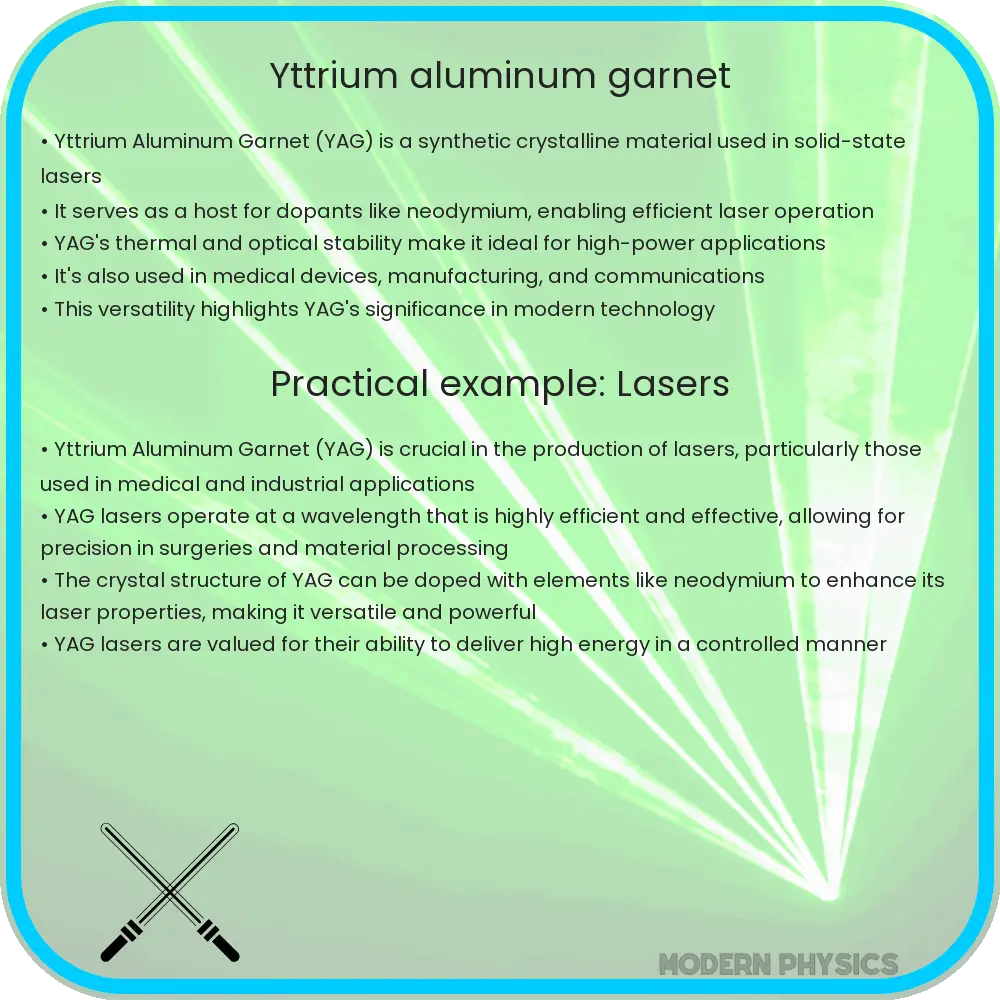
Yttrium Aluminum Garnet, or YAG, is a synthetic crystalline material of the garnet group. Predominantly composed of yttrium and aluminum oxides, YAG has the chemical formula Y3Al5O12. This material is noted for its unique properties such as high thermal stability, durability, and excellent mechanical properties, making it one of the most important garnets in scientific and industrial applications.
Properties of YAG
YAG possesses a set of properties that make it particularly valuable across various high-tech applications. To begin with, it has superb thermal stability which allows it to maintain its structure and performance even at high temperatures, typically up to 1970°C. This attribute is crucial for its use in environments exposed to extreme heat such as in laser systems or aerospace components.
Furthermore, YAG is highly durable and resistant to wear. It exhibits great mechanical strength and hardness, which means it can endure significant physical stress and abrasive conditions without degrading. Its chemical stability also makes it resistant to corrosion from various chemicals.
Another impressive feature of YAG is its electrical and optical properties. It is an excellent insulator and has good transmitivity in the infrared range, which is particularly useful in diverse applications ranging from laser technology to electrical insulators.
Applications of YAG
- Laser Technology: YAG is perhaps most famous for its application in laser technology. YAG crystals doped with neodymium (Nd:YAG) are used to produce high-power lasers. These lasers are employed in a vast array of fields such as medicine, manufacturing, and military.
- LEDs and Phosphors: Yttrium Aluminum Garnet doped with different rare-earth elements such as cerium can be used to make phosphors that are used in LED lighting and displays.
- Scintillators: YAG can also be used for manufacturing scintillators which are materials that luminesce when excited by ionizing radiation. These are crucial in medical imaging as well as in nuclear and high-energy physics research.
- Industrial Tomography: Due to its high density and effective atomic number, YAG is useful in industrial computed tomography to inspect the integrity and properties of manufactured components, especially in the aerospace sector.
The versatility and robustness of Yttrium Aluminum Garnet make it an indispensable component of various high-tech appliances and systems, translating science into practical solutions that propel numerous industries forward.
Future Potential of YAG
Given its remarkable properties, the future of YAG offers exciting possibilities. Researchers continue to explore new dopants that can enhance its luminescence or create more efficient laser systems. Advancements in synthetic techniques could also lead to higher quality crystals with even greater performance attributes, potentially opening up new applications in technology-driven fields.
Further potential lies in the development of YAG-based composites or coatings. These could add enhanced protective qualities to materials used in extreme environments, such as space exploration vehicles or high-performance engines, providing better resistance to temperature fluctuations and corrosive substances.
Environmental Considerations
While YAG is instrumental in technological advancements, it is also important to consider its environmental impact. The processes involved in synthesizing YAG typically require high energy inputs and can involve hazardous materials. However, the durable nature of YAG means products have a longer lifespan, potentially reducing waste and the need for frequent replacements.
Recycling and recovering valuable elements such as yttrium and rare earths from used YAG components are areas that need more attention and development. Promoting such practices can support sustainability efforts and reduce environmental footprints associated with high-tech applications.
Conclusion
Yttrium Aluminum Garnet (YAG) is more than just a versatile material in the realm of optics and electronics; it is a key player in advancing modern technologies and enhancing numerous industrial processes. Its extraordinary property profile including high thermal stability, resistance to physical stress, and impressive optical characteristics make it a strategic choice in fields ranging from medicine to aerospace.
The ongoing exploration of its potential, improvement of synthetic methods, and consideration of environmental impacts not only promise to broaden its applications but also contribute to sustainable practices within the industry. As science progresses, the utilization of YAG is likely to keep playing a pivotal role in overcoming technical challenges and meeting the demands of future innovations.
Whether in high-power lasers, advanced imaging techniques, or durable electronic components, YAG’s contributions to science and industry continue to make significant impacts, demonstrating the material’s indispensable value and potential for future technological breakthroughs.