
Explore the intricate relationship between group velocity, light speed, and Einstein’s theory in the context of wave packets and modern physics.
Understanding Group Velocity in the Context of Einstein’s Theory and Light Speed
The concept of group velocity is pivotal in understanding wave dynamics, especially in the realms of optics and quantum mechanics. This article delves into the intricate relationship between group velocity, Einstein’s theory of relativity, and the fundamental nature of light speed. It also explores the intriguing phenomenon of wave packets, which are essential to comprehending the behavior of waves in various mediums.
Group Velocity: A Core Concept in Wave Theory
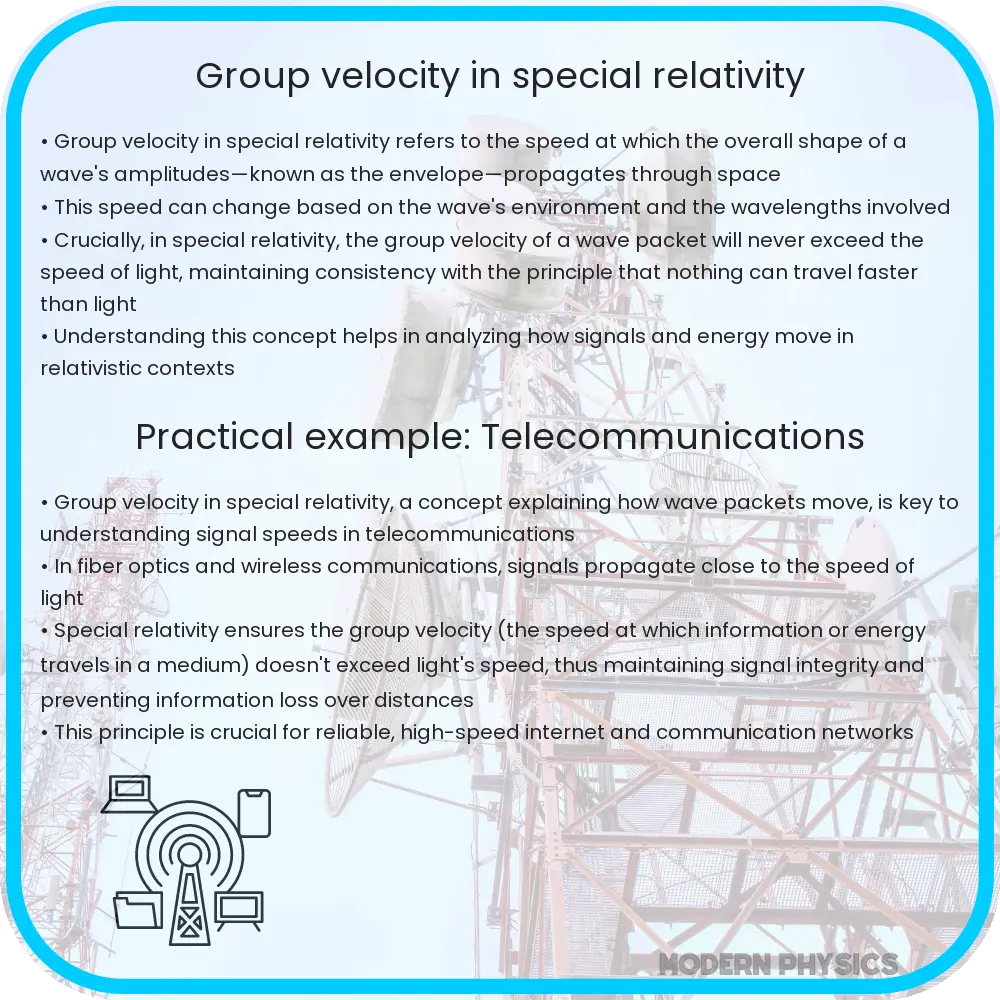
Group velocity, often denoted as Vg, is defined as the speed at which the overall shape of a wave’s amplitudes—known as the envelope or the wave packet—propagates through space. This is distinct from phase velocity, which refers to the speed at which any single phase of the wave travels. Group velocity is particularly significant in the study of wave packets, which are a collection of waves of different frequencies superimposed on each other, forming a localized pulse.
Einstein’s Theory and the Limit of Light Speed
Albert Einstein’s theory of relativity, which revolutionized our understanding of space, time, and gravity, also imposes a fundamental limit on the speed at which information or energy can be transmitted – the speed of light in vacuum, denoted as c. This limit is not only a cornerstone of modern physics but also a key factor in the study of wave propagation and group velocity.
Wave Packets and Light Speed
Wave packets provide a useful model for understanding light as both a particle and a wave, a duality central to quantum mechanics. The composition of these packets—multiple waves with different wavelengths—allows for a comprehensive analysis of group velocity. In the context of light, the group velocity can have significant implications for how light pulses move through different media and under various conditions.
In optical fibers, for instance, the group velocity determines how quickly data is transmitted. Interestingly, in certain exotic media, group velocity can exceed c, leading to apparent superluminal (faster-than-light) phenomena. However, this does not violate Einstein’s speed limit, as the actual information transfer still occurs at or below c.
Understanding group velocity in the context of light speed and Einstein’s theory opens a window into advanced concepts in physics. It underscores the nuanced nature of wave propagation and challenges our perceptions of speed and information transmission.
Is this conversation helpful so far?
The Implications of Group Velocity in Modern Physics
The exploration of group velocity extends into various applications in modern physics, particularly in the field of telecommunications and photonics. The ability to control and manipulate the group velocity of light in different materials is crucial for the development of high-speed optical communication systems. By adjusting factors like temperature, pressure, or the use of special materials like photonic crystals, scientists can alter the group velocity, affecting how fast data can be transmitted through an optical fiber.
Group Velocity in Quantum Mechanics
In quantum mechanics, group velocity takes on an even more fascinating role. The concept of group velocity is intertwined with Heisenberg’s uncertainty principle, which states that the more precisely the position of a particle is known, the less precisely its momentum can be known, and vice versa. This principle is directly related to the composition of wave packets, where the group velocity can provide insights into the momentum and position of particles.
Challenging the Bounds: Superluminal Group Velocities
One of the most intriguing aspects of group velocity is the possibility of superluminal speeds in certain exotic media. This phenomenon, where the group velocity of a wave packet exceeds the speed of light, has been demonstrated in various experiments. However, it’s important to note that this does not entail the transmission of information or energy faster than light, thus maintaining consistency with Einstein’s theory of relativity. The superluminal group velocities typically result from the peculiar dispersion properties of the medium through which the wave packet is traveling.
Conclusion
Group velocity is a fundamental concept in wave physics, providing deep insights into the nature of waves, from optical fibers to quantum particles. Its study bridges classical and modern physics, challenging and reaffirming Einstein’s theories. The phenomenon of wave packets and their behavior in different media reveal complexities in our understanding of light, speed, and information transmission. As we continue to explore the boundaries of physics, the study of group velocity not only enhances our understanding of the universe but also drives technological advancements, particularly in telecommunications and computing. In essence, group velocity serves as a critical tool in deciphering the intricate dance of particles and waves, a dance that underpins the very fabric of our reality.