
Learn the crucial differences between weather warnings and watches, their prediction methods, and their impact on public safety and preparedness.
Understanding Weather Warnings and Watches
Extreme weather conditions pose significant risks to public safety and infrastructure. Effective systems for weather warnings and watches are crucial to mitigating these risks through timely and accurate forecasts. Here, we explain the difference between weather warnings and watches, discuss how they are forecasted, and examine their impact on safety and preparedness.
Weather Warnings vs. Weather Watches
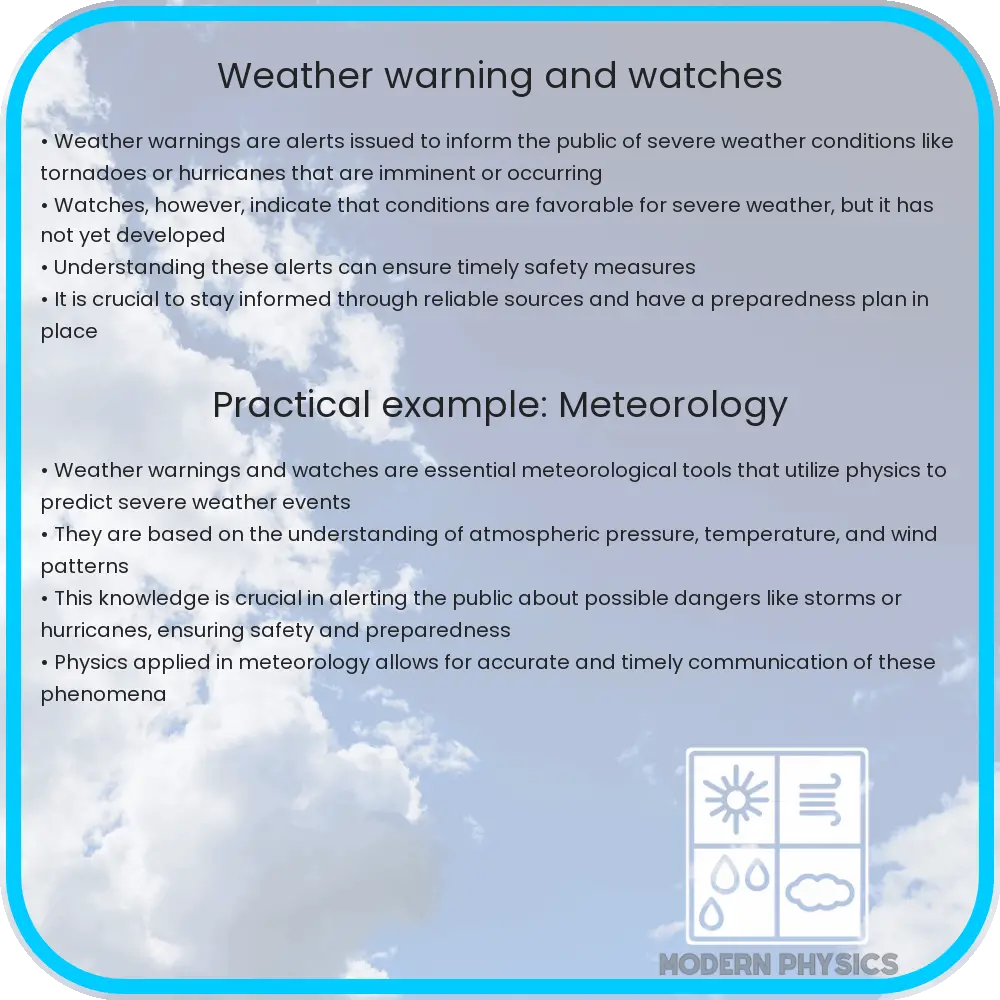
A weather warning indicates that a hazardous weather event, such as a tornado, hurricane, or severe thunderstorm, is imminent or already occurring. It is issued by meteorological agencies when the conditions for severe weather are certain. Warnings highlight an urgent need for people to prepare and act to protect life and property.
A weather watch, on the other hand, means that the potential for extreme weather exists, but its occurrence, location, or timing is still uncertain. It serves as a preliminary alert to inform the public of the possibility of a significant weather event and to encourage preparedness and vigilance.
How Are Weather Warnings and Watches Predicted?
The prediction of weather warnings and watches involves complex data analysis and modeling by meteorologists. Key components in this process include:
- Satellite Imagery: Helps in tracking cloud patterns and storm developments across wide geographic areas.
- Radar Technology: Utilized to observe precipitation and to assess storm structures and intensity. Doppler radar, in particular, can assess wind speeds and directions, which are crucial for detecting tornado and hurricane formation.
- Weather Stations: Distributed globally, these stations collect data on temperature, humidity, wind speed, and atmospheric pressure. This data is fed into weather models to improve the accuracy of forecasts.
- Computer Models: Advanced algorithms and supercomputers simulate weather patterns based on current and historical data. These models predict how weather systems will move and evolve.
Forecasters use this information to determine when to issue a watch or a warning, ensuring that the public gets timely and accurate information necessary to safeguard lives and property.
The Impact of Weather Warnings and Watches on Safety and Preparedness
Efficient and effective weather warnings and watches significantly influence public safety and emergency management. By providing advanced notice of potential hazardous weather, communities can implement disaster response strategies, residents can carry out safety measures, and governments can mobilize emergency services. Such preparedness efforts include:
- Evacuating areas likely to be affected by floods, hurricanes, or other severe conditions.
- Securing outdoor objects that might cause injury or damage being airborne due to high winds.
- Stocking up on emergency supplies such as water, food, batteries, and first-aid kits.
- Cancelling or postponing outdoor activities to prevent weather-related incidents.
Moreover, businesses and schools can plan closures or shifts in operation to maintain the safety of their employees and students. Forecast models and historical data also allow for improvement in architectural standards and urban planning to withstand extreme weather phenomena.
Technological Advancements in Weather Forecasting
Recent technological advancements have significantly improved the accuracy and efficiency of predicting severe weather conditions. Innovations such as AI and machine learning are now being integrated into meteorological processes, enhancing the ability to analyze vast amounts of data quickly. These technologies help in the early detection of weather anomalies and contribute to more accurate and timely weather warnings and watches.
- Artificial Intelligence: AI algorithms can identify patterns in weather data that may elude human forecasters, leading to earlier and more precise warnings.
- Machine Learning: These systems improve over time, learning from past forecasts and events to enhance future accuracy.
- Mobile Technology: Smartphones and apps provide real-time weather updates and alert systems directly to individuals, greatly improving personal preparedness.
Public Education and Awareness
Alongside technological advancements, public education plays a crucial role in enhancing safety during severe weather events. Governments and weather agencies conduct awareness campaigns to educate the public about the meaning and proper responses to weather warnings and watches. School programs, community workshops, and media broadcasts in multiple languages ensure widespread understanding and readiness.
- Community Drills: Organized simulations of severe weather scenarios help communities practice evacuation and other safety protocols.
- Online Resources: Websites and online courses offer accessible information and training on weather preparedness.
- Social Media: Platforms like Twitter and Facebook are used to spread urgent weather alerts and safety tips rapidly across communities.
Conclusion
Weather warnings and watches are vital tools in modern meteorology, designed to safeguard lives and reduce property damage during extreme weather events. The distinction between a warning and a watch is crucial for appropriate public response. With the aid of cutting-edge technology and effective communication strategies, meteorological agencies continue to enhance their predictive capabilities and public engagement. It is essential for individuals and communities to heed these warnings and watches, stay informed through reliable sources, and engage in preparedness activities to mitigate the impacts of severe weather. As technology evolves and educational efforts expand, society will be better equipped to handle the challenges posed by increasingly unpredictable weather patterns.