
Learn about Mesoscale Convective Systems (MCS), large complexes of thunderstorms impacting global weather.
Understanding Mesoscale Convective Systems
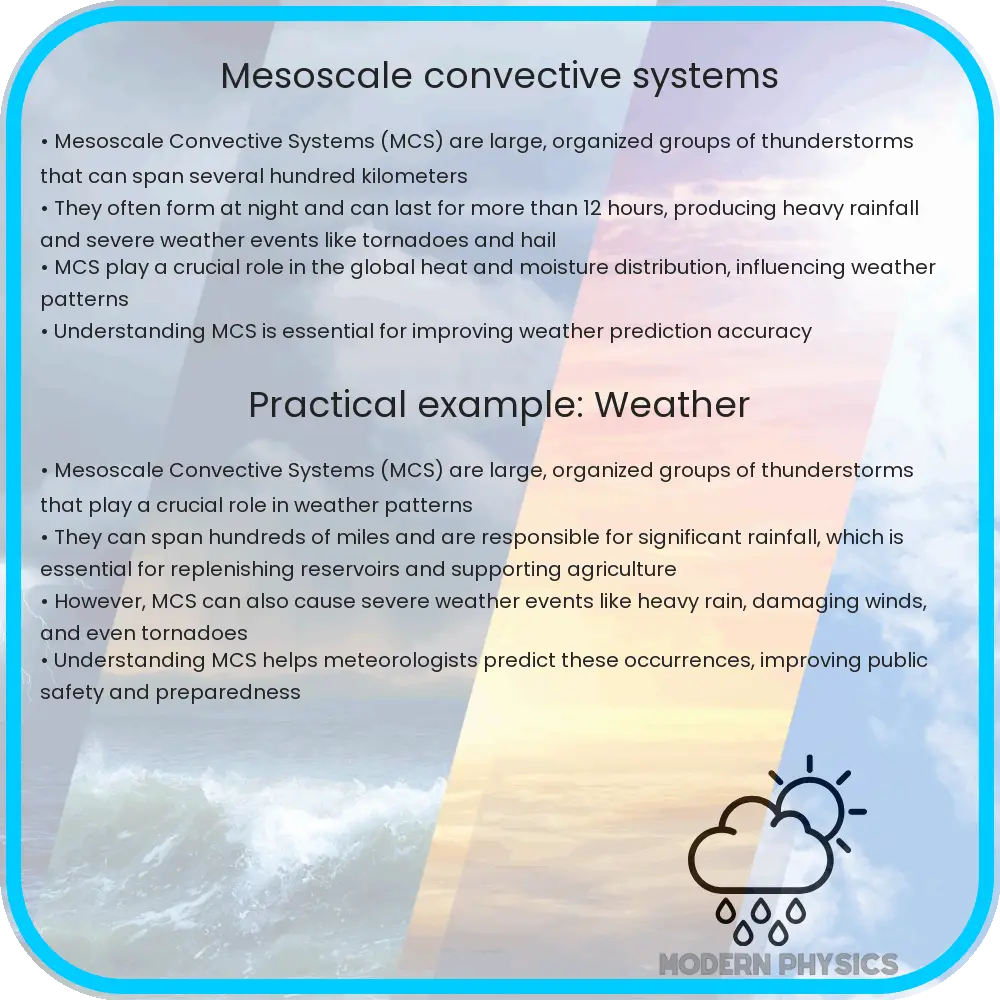
Mesoscale Convective Systems (MCS) are large, organized complexes of thunderstorms that can cover vast geographical areas and persist for several hours or even days. These systems are significant contributors to severe weather events across the globe, especially in the mid-latitudes. Understanding the dynamics, predictive techniques, and impacts of MCS is crucial for weather forecasting, preparation, and mitigation strategies.
Dynamics of Mesoscale Convective Systems
The dynamics of Mesoscale Convective Systems are influenced by a variety of atmospheric conditions including moisture, temperature instability, and wind shear. Typically, MCSs develop in environments where there is abundant atmospheric moisture and a significant degree of instability—conditions often found in frontal zones or where warm air converges. These systems can also form along the boundaries of contrasting air masses, known as ‘dry lines’, particularly evident in places like the Central United States.
- Lifecycle: The lifecycle of an MCS can be divided into three stages: development, maturity, and decay. During the development stage, individual thunderstorms merge due to the presence of strong winds aloft and abundant moist air at lower levels. In the maturity stage, the system reaches its peak intensity and size, often producing severe weather phenomena such as heavy rain, high winds, hail, and sometimes tornadoes. Finally, the decay stage occurs when the system loses its supply of moist, unstable air, or when atmospheric conditions become unfavorable.
- Wind Shear: Wind shear, the variation of wind speed and direction with height, plays a crucial role in the organization and longevity of MCSs. Moderate to strong vertical wind shear can help to organize the thunderstorm cells into a cohesive system which can sustain itself for many hours.
Prediction of Mesoscale Convective Systems
Predicting Mesoscale Convective Systems is a complex task due to their large scale and rapid development. Advanced numerical weather prediction models are often used, which incorporate data from various sources including satellites, radar, weather balloons, and surface weather stations. These models help forecasters to identify the potential development of MCSs by simulating the atmospheric conditions that lead to their formation.
- Numerical Models: Models such as the Global Forecast System (GFS) and the North American Mesoscale Model (NAM) provide insights into atmospheric conditions up to several days ahead. These models are crucial for predicting the likelihood of MCS formation and tracking their potential path.
- Real-time Data: Real-time observational data from radar and satellites play a vital role in monitoring existing MCSs. Radar is particularly useful for tracking the movement, intensity, and internal structure of the storms within an MCS, while satellite data provides a broader view of the system’s extent and its interactions with the larger-scale atmospheric environment.
Impact of Mesoscale Convective Systems
Mesoscale Convective Systems can have a profound impact on the areas they affect. The large amount of precipitation they often generate can lead to flooding, particularly if the MCS moves slowly over a region or repeatedly affects the same area. High winds and hail can cause substantial damage to structures, crops, and vegetation. Additionally, the severe weather conditions associated with MCSs, such as tornadoes, can pose significant threats to life and property.
- Flooding: One of the most common impacts of MCSs is flooding, which can disrupt transportation, damage property, and even lead to loss of life. Areas with poor drainage or those that are already saturated from previous rainfall are particularly susceptible.
- Wind Damage: The intense winds that often accompany MCSs can uproot trees, damage roofs, and, in some cases, result in power outages.
- Severe Weather: MCSs are capable of spawning severe weather including tornadoes and large hail, which pose additional risks to affected regions.
Understanding and predicting Mesoscale Convective Systems is vital for effective weather forecasting and preparedness. By studying the dynamics that lead to the development and maintenance of MCSs, meteorologists can better predict their formation and potential impacts, thereby mitigating their effects on affected communities.
Preparation and Mitigation Strategies for Mesoscale Convective Systems
Dealing with the risks associated with Mesoscale Convective Systems involves coordinated efforts between meteorologists, emergency services, and public awareness campaigns. Effective preparation and mitigation strategies are essential for minimizing the damage caused by these powerful weather events.
- Early Warning Systems: Timely and accurate forecasts provided by advanced meteorological tools allow for early warnings to be issued to the public. These systems are crucial in providing enough time for communities to prepare and respond appropriately.
- Community Preparedness Plans: Local governments and communities should develop and rehearse response plans for severe weather scenarios, including the possibility of MCS events. These plans often include evacuation routes, shelters, and protocols for emergency services to follow during the storm.
- Infrastructure Resilience: Strengthening infrastructure to withstand the effects of high winds and heavy rainfall can significantly reduce the impact of MCSs. This includes fortifying buildings, improving drainage systems, and ensuring that power grids and communication networks are robust enough to deal with severe weather conditions.
Conclusion
Mesoscale Convective Systems (MCS) are complex phenomena that pose substantial risks to the regions they affect. Understanding their dynamics and predictive patterns allows meteorologists to forecast their occurrences more accurately, thereby giving communities more time to prepare and mitigate potential damages. The lifecycle of MCSs, characterized by their development, maturity, and decay stages, highlights the dynamic nature of these systems and underscores the importance of continuous monitoring and advanced modeling in weather forecasting.
With the use of real-time data and numerical models, prediction accuracy has improved, but the inherently unpredictable nature of weather systems always leaves room for uncertainty. Therefore, the integration of efficient communication strategies, community preparedness, and robust infrastructure is imperative to effectively manage the risks associated with MCSs.
Continuous research and technological advancements will enhance our understanding and response capabilities toward Mesoscale Convective Systems, ultimately leading to better preparedness and lessened impact on human lives and property. Every step forward in the science of meteorology and community planning enhances our ability to weather the storms brought by these formidable natural events.