
Explore the mysteries of W boson production, its pivotal role in astrophysics, and how it shapes our understanding of the universe and fundamental forces.
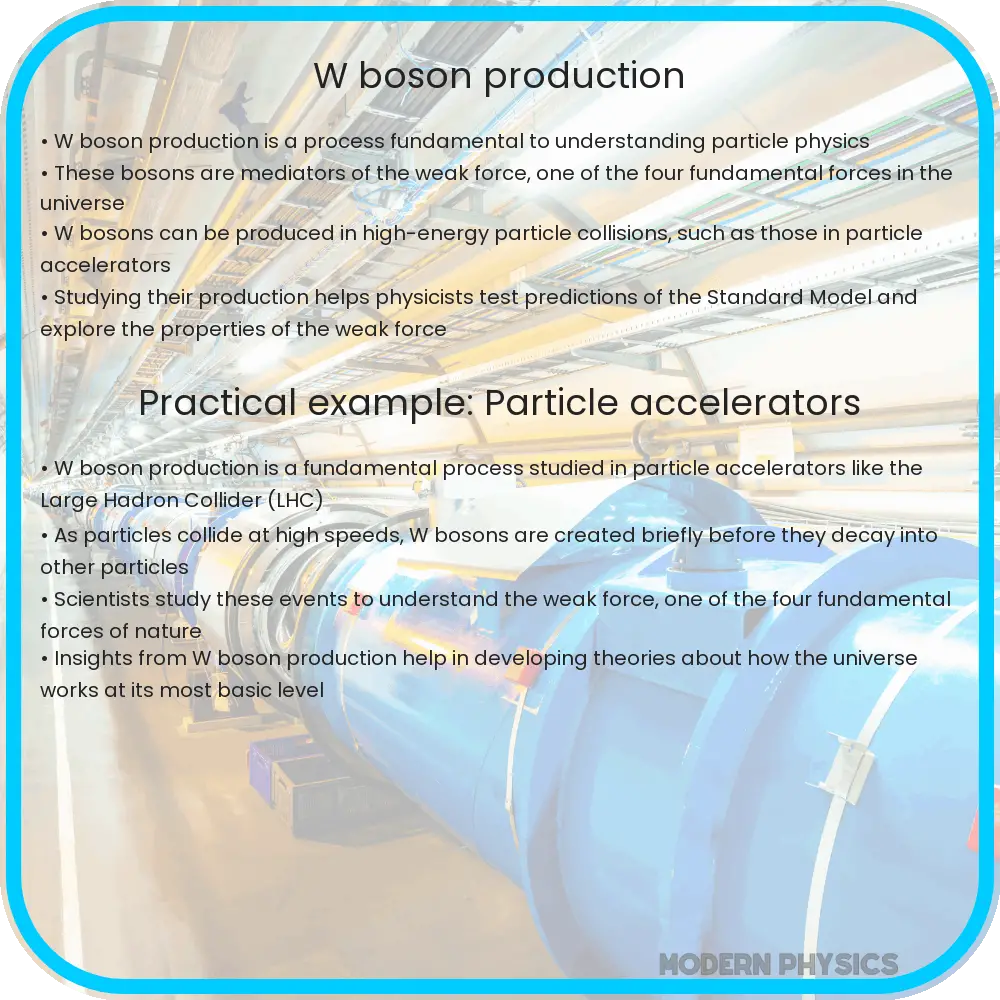
Understanding W Boson Production
The W boson is a fundamental particle in the Standard Model of particle physics, playing a crucial role in mediating the weak nuclear force, one of the four known fundamental forces. The production of W bosons is a significant area of research in astrophysics and particle physics, providing insights into the early universe’s conditions and the fundamental forces that shape our cosmos.
Techniques for W Boson Production
W bosons are primarily produced in high-energy particle collisions, such as those occurring in the Large Hadron Collider (LHC). These high-energy collisions allow particles to overcome the immense energy barrier necessary for W boson production. The process typically involves the collision of protons, which accelerates to near-light speeds before impacting each other. Various detection techniques, such as calorimetry and tracking detectors, are used to identify and analyze the byproducts of these collisions, confirming the presence of W bosons.
Another method for studying W boson production is through cosmic ray observations. High-energy cosmic rays impacting Earth’s atmosphere can also result in the production of W bosons. By studying the byproducts of these interactions, scientists can glean information about the conditions and processes that lead to W boson production in natural settings.
Impacts of W Boson Production in Astrophysics
The study of W boson production has profound implications for astrophysics. For instance, understanding how W bosons interact with other particles helps scientists comprehend the early universe’s conditions shortly after the Big Bang. Additionally, W boson interactions are essential for understanding stellar processes and the mechanisms driving supernovae explosions.
Moreover, W boson production is closely linked to the phenomenon of neutrino oscillations, which plays a critical role in solar and cosmic ray physics. By studying W bosons, researchers can gain insights into the properties of neutrinos, elusive particles that are crucial for our understanding of the universe’s structure and evolution.
Advanced Research and Future Prospects
Advanced research in W boson production continues to evolve, driven by innovations in particle accelerator technology and detection methods. The future of W boson research lies in the potential discovery of new physics beyond the Standard Model, such as supersymmetry or extra dimensions, which could be unveiled through anomalies in W boson production rates or interactions. Additionally, upcoming astrophysical observatories and neutrino detectors will provide new data sources to understand cosmic W boson production and its implications for cosmic evolution.
Furthermore, the study of W bosons is integral to the development of unified theories of particle physics, aiming to bridge the gap between the Standard Model and general relativity. This quest for a grand unified theory could revolutionize our understanding of the universe at both the largest and smallest scales.
Conclusion
W boson production remains a cornerstone of both particle physics and astrophysics, offering invaluable insights into the fundamental forces that govern the universe. Through the ongoing efforts in experimental and theoretical research, our understanding of W bosons continues to expand, shedding light on the early universe’s mysteries, the nature of fundamental forces, and the fundamental structure of matter. As technology and methodologies advance, the study of W bosons is poised to uncover new physics, challenging existing paradigms and potentially leading to a new understanding of the cosmos. The journey of discovering the intricate nature of W bosons and their role in the cosmic tapestry is far from over, promising exciting developments and discoveries in the years to come.