
Explore the depths of Vectorial Diffraction Theory, its applications in optical engineering, and how it surpasses scalar theories for advanced optics.
Introduction to Vectorial Diffraction Theory
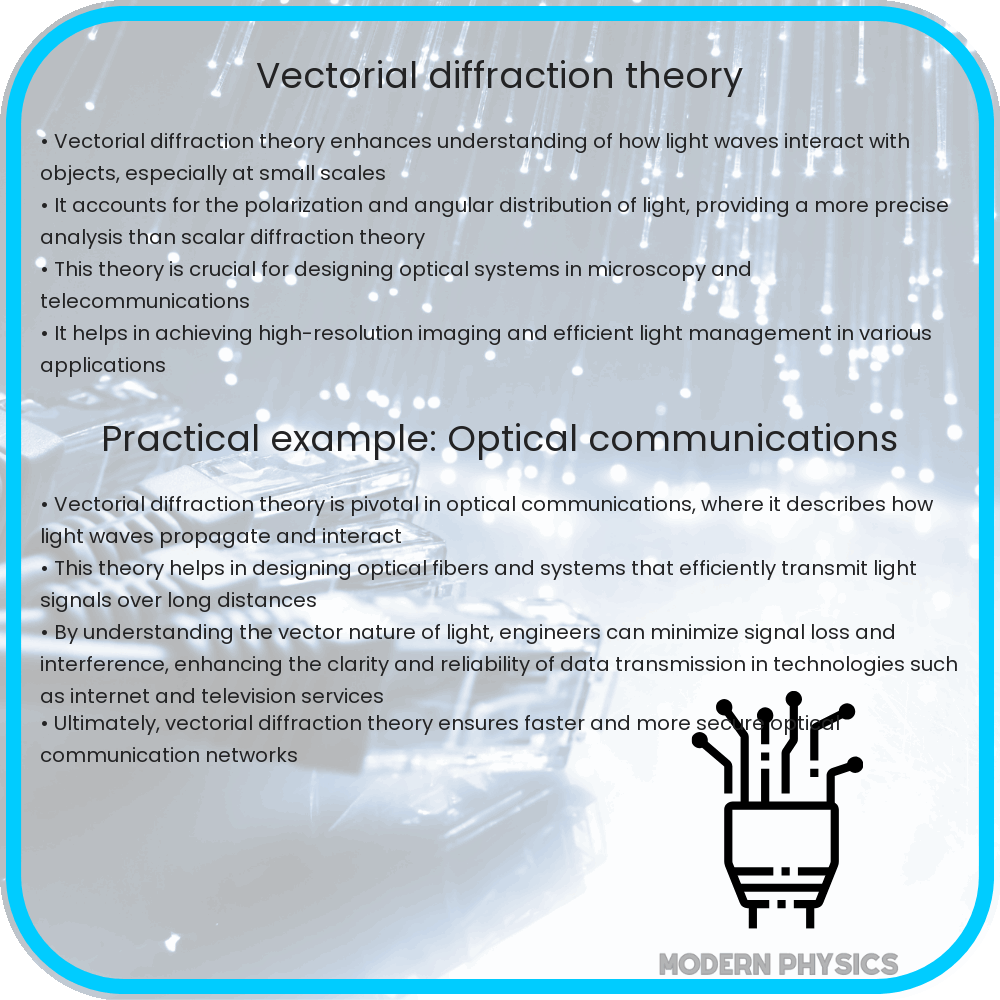
Vectorial Diffraction Theory (VDT) stands as a cornerstone in the understanding of light-matter interactions, especially in the realms of microscopy, optical engineering, and photonics. This advanced theoretical framework goes beyond the classical scalar diffraction theory by incorporating the electromagnetic nature of light, offering a more accurate and detailed description of diffraction phenomena. VDT is pivotal in applications requiring high resolution and precision, such as near-field microscopy and the design of optical systems with sub-wavelength features.
Foundations of Vectorial Diffraction Theory
At the heart of Vectorial Diffraction Theory is the consideration of light as an electromagnetic wave, characterized by both electric (E) and magnetic (M) vectors. This approach allows for the accurate modeling of light’s behavior when it interacts with objects that are comparable in size to its wavelength. The theory is based on Maxwell’s equations, which describe how electric and magnetic fields propagate and interact with matter. VDT takes into account the vector nature of light, including polarization effects, which are often neglected in scalar theories.
Applications and Implications of VDT
The application of Vectorial Diffraction Theory spans a wide range of optical technologies. In microscopy, for instance, VDT provides insights into the limits of resolution and contrast, guiding the development of high-performance imaging systems. For optical engineering, it aids in the design of lenses and other components that manipulate light at the nano-scale, enhancing the performance of photonic devices. Furthermore, VDT plays a crucial role in the accurate simulation and analysis of optical systems, ensuring the fidelity and efficiency of devices such as waveguides, optical storage media, and sensors.
Comparative Advantages of Vectorial Diffraction Theory
Compared to scalar diffraction theory, VDT offers several advantages. It provides a more comprehensive understanding of the phase and amplitude variations of light as it diffracts, especially in near-field regions. This results in a more precise prediction of optical phenomena, including the intricate patterns of light intensity distribution and polarization states. By accounting for the electromagnetic properties of light, VDT enables the design and analysis of advanced optical systems with enhanced functionality and resolution, pushing the boundaries of what is achievable in optical science and engineering.
Challenges and Future Directions in Vectorial Diffraction Theory
Despite its significant advantages, Vectorial Diffraction Theory also faces certain challenges. One of the primary hurdles is the computational complexity involved in solving Maxwell’s equations for complex structures and materials. This necessitates the development of more efficient numerical methods and computational tools to make VDT simulations more accessible and practical for a wider range of applications. Additionally, as optical systems continue to miniaturize and operate closer to the quantum limit, integrating quantum effects into VDT becomes essential for maintaining accuracy and relevance in future optical research and device design.
Integrating VDT with Other Optical Theories
To address these challenges and expand its application domain, VDT is increasingly being integrated with other optical theories and simulation techniques. For example, combining VDT with quantum optics can provide a more nuanced understanding of light-matter interactions at the nano-scale, essential for the development of quantum computing and communication technologies. Similarly, integrating VDT with nonlinear optics theory can enhance the analysis and design of optical materials and devices that rely on nonlinear phenomena, such as frequency conversion and optical switching.
Conclusion
Vectorial Diffraction Theory represents a sophisticated and powerful framework for understanding and manipulating light at a fundamental level. By accurately accounting for the electromagnetic nature of light, VDT offers unparalleled precision and detail in the analysis of optical phenomena, particularly in situations where traditional scalar theories fall short. Despite its computational challenges, ongoing advancements in numerical methods and the integration with other optical and quantum theories continue to expand its utility and impact across various fields of optics and photonics. As we push the boundaries of optical science and technology, the role of Vectorial Diffraction Theory will undoubtedly grow, driving innovation and enabling the development of next-generation optical devices and systems with capabilities far beyond our current imagination.