
Varifocal mirrors are adaptable optical devices that change focal length in real-time, offering precision and versatility in imaging systems, laser tech, and adaptive optics.
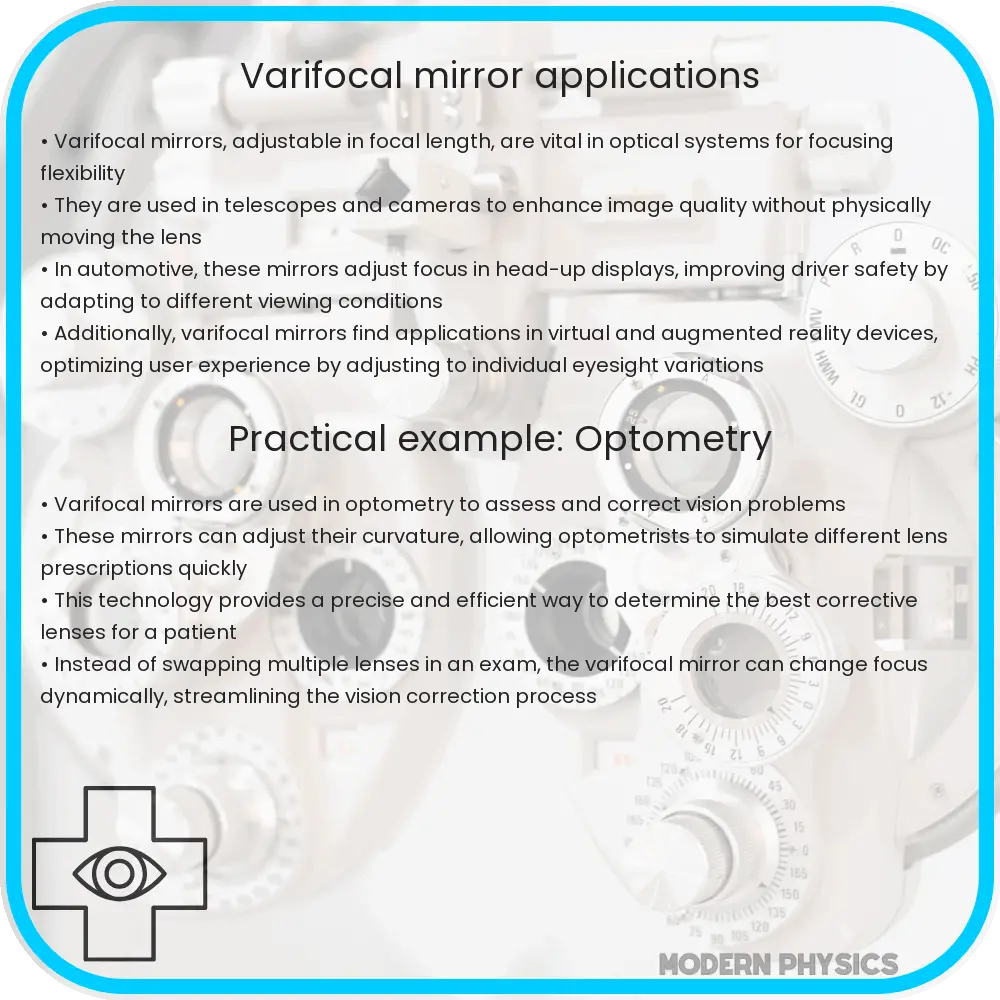
Varifocal Mirror Applications: Precision, Adaptability & Design
Varifocal mirrors, also known as adjustable or deformable mirrors, are optical devices designed to change their focal length in real-time. This adaptability makes them incredibly useful in numerous applications, ranging from advanced imaging systems to laser technology. In this article, we will explore the precision, adaptability, and design principles behind varifocal mirrors and their diverse range of applications.
Precision
The precision of varifocal mirrors is paramount in achieving high-quality optical performance. These mirrors are typically composed of a flexible, reflective membrane whose shape can be controlled using actuators. By adjusting the membrane’s curvature, these mirrors can focus or defocus light with great accuracy.
One common type of actuator used in varifocal mirrors is the piezoelectric actuator. When an electric voltage is applied, piezoelectric materials change shape, thus allowing for precise control over the mirror’s surface. The precision can be quantified using wavefront error measurements, ensuring that the mirror’s adjustments produce minimal distortion.
Mathematically, the change in focal length \( \Delta f \) can be described by the equation:
\[ \Delta f = \frac{R^{2}}{2 \Delta z} \]
where \( R \) is the radius of curvature of the mirror and \( \Delta z \) is the displacement caused by the actuators. This relationship helps in designing mirror systems for specific precision requirements.
Adaptability
The adaptability of varifocal mirrors is one of their standout features. Unlike traditional fixed-focus mirrors, varifocal mirrors can swiftly switch between different focal lengths without any mechanical repositioning. This capability is particularly useful in environments where fast adjustments are essential, such as in adaptive optics systems.
Adaptive optics systems often utilize varifocal mirrors to correct distortions in real-time. These systems are employed in astronomical telescopes to compensate for the Earth’s atmospheric turbulence, improving image clarity. By continuously adjusting the mirror’s shape, the system can counteract the distortive effects and provide sharper images of distant celestial objects.
Another promising application is in ophthalmology, where varifocal mirrors can be used in advanced retinal imaging devices. These devices benefit from the mirror’s adaptability to correct for individual variations in a patient’s eye, enhancing the accuracy of diagnoses.
Design Principles
Designing varifocal mirrors involves intricate knowledge of materials, mechanics, and optics. The reflective membrane, often made from materials like silicon or polymers, must be highly flexible and responsive to the actuators’ forces. The choice of material impacts the mirror’s range of movement and responsiveness to electric or mechanical control.
Actuator placement and type are crucial design considerations. Piezoelectric actuators are common due to their precision, but electromagnetic and electrostatic actuators can also be used. Each type has its advantages: piezoelectric actuators offer high precision and fast response times, while electromagnetic actuators can provide larger displacements.
The design process often involves computational simulations to predict how the mirror will behave under different conditions. Engineers use these simulations to optimize the actuator layout, ensuring uniform deformation and minimizing undesired bending or twisting of the mirror surface. This helps achieve a more consistent and predictable focal length adjustment.
Diverse Applications
Varifocal mirrors have a wide array of applications across various fields. In microscopy, they allow for rapid changes in focus, enabling researchers to quickly examine different layers of a sample without mechanical adjustments. This capability accelerates the research process and enhances the study of dynamic processes.
In augmented reality (AR) and virtual reality (VR) systems, varifocal mirrors can be used to create more realistic and comfortable user experiences. By adjusting focal lengths in real-time, these mirrors help to reduce eye strain and improve depth perception, making the virtual environment more immersive.
In laser systems, varifocal mirrors are employed to manage the focus of laser beams, which is crucial in applications such as material processing and medical surgeries. The ability to quickly adapt the focal point allows for greater precision and efficiency in these processes.
Security and surveillance systems also benefit from varifocal mirrors. They enhance the performance of cameras by allowing them to adjust their focus on different objects in real-time, providing clearer and more detailed images for monitoring purposes.
Conclusion
Varifocal mirrors stand out for their precision, adaptability, and versatile design, making them invaluable in numerous high-tech applications. From enhancing the capabilities of adaptive optics in astronomy to supporting advanced medical imaging techniques, these mirrors play a crucial role in various fields. Their ability to quickly and accurately adjust focal lengths without mechanical repositioning opens up possibilities for future innovations.
As the technology continues to evolve, we can expect even greater integration of varifocal mirrors in emerging applications, further expanding their impact on science and engineering. Understanding their principles and capabilities not only sheds light on existing uses but also inspires new ideas for leveraging this adaptable technology.