
Ultrasonic surgery uses high-frequency sound waves for precise, fast, and safe tissue removal in various medical procedures.
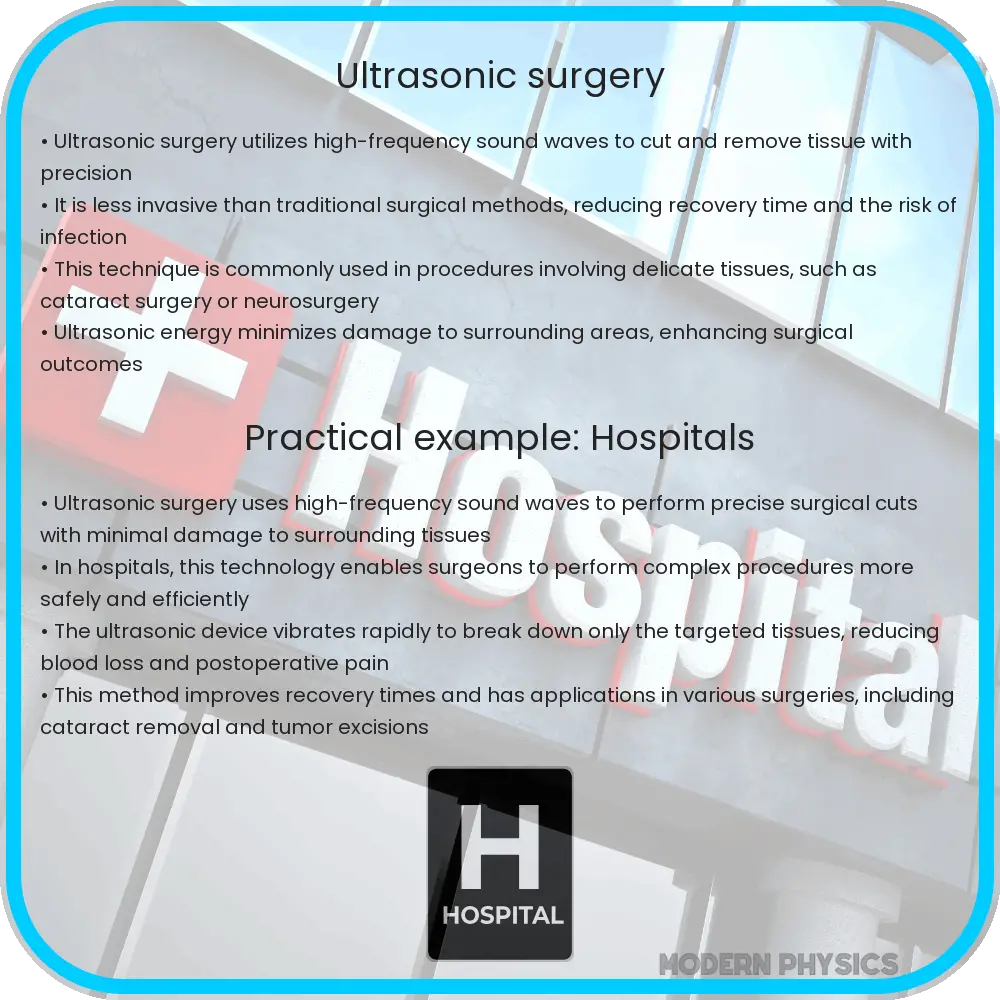
Ultrasonic Surgery: Harnessing High-Frequency Sound for Medical Miracles
Ultrasonic surgery represents a significant advance in medical technology, merging acoustics’ precision, speed, and safety to alter surgical methodologies profoundly. This technique uses ultrasonic vibrations to cut and remove tissue in a variety of clinical settings, offering numerous advantages over traditional surgical methods.
Understanding Ultrasonic Surgery
At its core, ultrasonic surgery relies on the generation of high-frequency sound waves, typically between 20 kHz and 60 kHz. These sound waves are created by a generator and transmitted through a hand-held device with a surgical tip. When this tip comes into contact with tissue, it vibrates rapidly. These vibrations cause the cells to break apart by cavitation and mechanical disruption, minimizing damage to surrounding tissues.
- Precision: The accuracy of ultrasonic surgery is one of its most essential attributes. The surgeon can precisely target diseased or damaged tissue without affecting the surrounding healthy tissue, thanks to the focused nature of the ultrasonic waves.
- Speed: Procedures done with ultrasonic equipment are considerably faster. This efficiency stems from the ability of the ultrasonic device to simultaneously cut and coagulate tissue, reducing the time needed for separate processes.
- Safety: Ultrasonic surgery is safer because it reduces the risk of blood loss and infection. The cavitation effect helps to seal blood vessels, promoting quicker clotting and reducing overall surgical risk.
The Science Behind Ultrasonic Surgery
The mechanics of ultrasonic surgery are an intriguing application of physics in a medical context. The process begins with the ultrasonic generator, which converts electrical energy into mechanical energy. This mechanical energy is then focused through the surgical tool’s tip made from a piezoelectric material that can change shape when an electric current is applied.
The vibration of the surgical tool at ultrasonic frequencies creates alternating high-pressure and low-pressure waves in the tissues. During high pressure, tissue particles are pushed apart, while during low pressure, cavitation bubbles form. These microbubbles swiftly collapse, releasing energy that disrupts cellular structures, effectively cutting through the tissue.
Mathematically, the power P used by an ultrasonic device can be described by the equation:
P = I * A
where I represents the intensity of the ultrasound wave, and A is the area over which the wave is applied. The intensity can further be broken down into:
I = (Pacoustic)/A
with Pacoustic representing the acoustic power. Thus, controlling the intensity and focusing the area A are crucial for maximizing the effectiveness of the surgical procedure while minimizing damage.
Another critical aspect is the frequency of the ultrasound. Lower frequencies generate larger, more aggressive cavitation bubbles, suitable for tougher tissues, while higher frequencies provide finer precision, ideal for delicate surgeries.
Applications of Ultrasonic Surgery
The versatility of ultrasonic surgery makes it suitable for a wide array of medical procedures. From cataract removal to liver surgery, its applications are vast and varied:
- Ophthalmology: Ultrasonic waves are used in phacoemulsification, a procedure to remove cataracts, where high-frequency ultrasound breaks up the cloudy lens, which is then extracted.
- Neurosurgery: Delicate brain surgeries benefit from ultrasonic aspirators that gently remove tumorous tissue without damaging critical areas.
- Liposuction: In cosmetic surgery, ultrasonics help liquefy fat before its removal, minimizing tissue damage and recovery time.
Benefits to Patient Recovery
One of the standout benefits of ultrasonic surgery is the enhanced recovery times experienced by patients. The precision and minimal invasiveness of this technique often result in less postoperative pain, smaller scars, and quicker healing periods compared to traditional surgery methods. Fewer complications like swelling and infection further speed recovery, allowing patients to return to their daily lives more quickly.
- Reduced Pain: As ultrasonics target only the necessary tissues, patients often require fewer painkillers during recovery.
- Quicker Healing: The minimized trauma to surrounding tissues facilitates a faster natural healing process.
- Lower Risk of Complications: The precise control offered by ultrasonic surgery minimizes the chance of accidental damage and subsequent complications, enhancing overall recovery.
Environmental and Economical Considerations
In addition to patient benefits, ultrasonic surgery presents fewer environmental impacts than many traditional surgical methods. The energy-efficient nature of the ultrasonic devices, which focus energy precisely where needed, leads to less waste of resources. Economically, the faster procedure times and reduced need for consumables (like sutures and gauze) translate into cost savings for healthcare facilities, potentially lowering the cost burden on patients as well.
Looking to the Future
The future of ultrasonic surgery holds significant potential for further innovation. Advances in materials science could produce even more efficient and durable piezoelectric elements, enhancing the effectiveness of surgical devices. Additionally, combinatorial techniques, integrating ultrasonic tools with other surgical technologies, could pave the way for new treatment protocols that offer unprecedented precision and safety.
There is also a promising angle in robotics and artificial intelligence. Future developments might integrate ultrasonic tools into robotic surgery systems, combining the benefits of ultrasonics with enhanced precision and flexibility provided by robotic arms controlled by AI algorithms. Such integration could lead to surgical procedures that are not only minimally invasive but also highly adapted to individual patient anatomy and conditions.
Conclusion
Ultrasonic surgery stands as a beacon of progress in the medical field, offering substantial benefits over traditional surgical practices. By harnessing the power of high-frequency sound waves, this technology takes advantage of physics to provide safer, faster, and less invasive surgeries. With applications ranging from ophthalmology to neurology, and with the potential for significant advances in materials and robotics, ultrasonic surgery is poised to continue its evolution, further transforming the landscape of surgical procedures and patient care. As researchers and engineers continue to explore its possibilities, the promise of ultrasonic surgery grows, marking a new era in medical technology that aims for the ultimate goal: better patient outcomes with minimal intervention.