
Explore the functionality and benefits of ultrasonic scalpels, innovative surgical tools that use high-frequency vibrations for precise and safer surgeries.
Introduction to Ultrasonic Scalpels
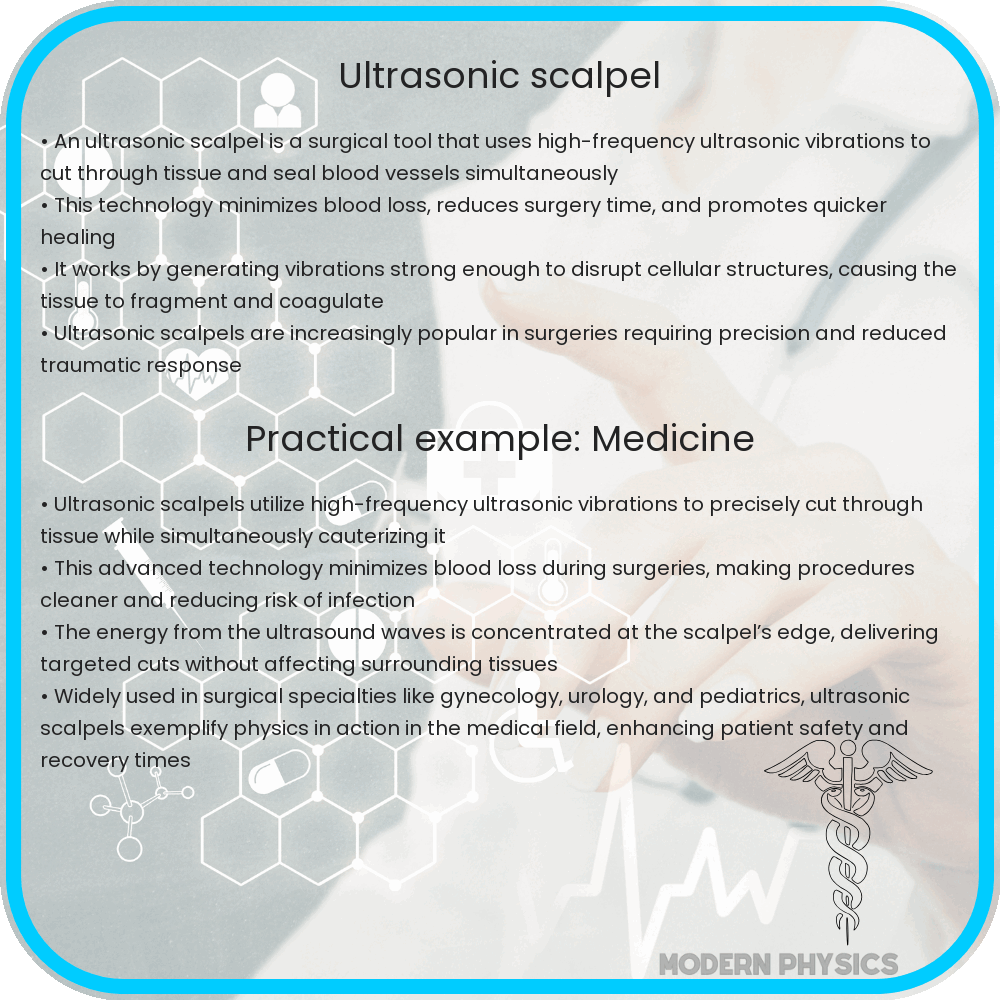
Ultrasonic scalpels, a marvel of modern medical technology, leverage the principles of physics and engineering to enhance surgical precision, speed up procedures, and improve safety. These tools use ultrasonic vibrations to cut through tissue and cauterize it simultaneously. This capability not only reduces surgical time but also minimizes blood loss and damage to surrounding tissues.
How Ultrasonic Scalpels Work
At the core of the ultrasonic scalpel’s functionality is a transducer, which converts electrical energy into mechanical vibrations. These vibrations occur at ultrasonic frequencies, typically above 20,000 Hz, beyond the range of human hearing. The high-frequency vibrations cause the scalpel’s blade to oscillate rapidly, providing the energy needed to cut through tissue and seal capillaries and blood vessels.
The process begins when an electrical signal, generated by a power supply, is fed into the transducer. The transducer often employs piezoelectric materials, which exhibit a property that allows them to change shape when an electric field is applied. This deformation generates ultrasonic vibrations, which are then amplified and directed to the scalpel’s tip.
Engineering Precision and Speed
The design and material science behind the ultrasonic scalpel are geared towards maximizing efficiency and control. The oscillating blade of the scalpel is finely tuned to operate at a specific frequency and amplitude, optimized to cut through different tissue types without requiring excessive force or causing unnecessary trauma.
The speed of an ultrasonic scalpel is one of its most significant advantages. Traditional surgical knives require physical force and precision to make incisions, which takes more time and can lead to variability in outcomes. In contrast, the ultrasonic scalpel’s rapid vibrations enable quicker incisions and are highly consistent, leading to shorter surgeries and better recovery times for patients.
Safety Features
Safety in surgical tools is paramount, and ultrasonic scalpels are designed with multiple safety features. The precision control reduces the risk of accidental cuts to surrounding tissues, which is especially critical in delicate surgeries. Additionally, since the tool cauterizes as it cuts, it significantly reduces the risk of postoperative infections and complications associated with bleeding.
Further enhancing safety, many ultrasonic scalpel systems are equipped with feedback mechanisms. These mechanisms monitor the quality of tissue contact and adjust power output accordingly, ensuring that the energy delivered is no more than necessary. This not only conserves energy but also minimizes thermal damage to tissues, promoting faster healing.
- Precision cutting reduces unnecessary tissue damage
- Simultaneous cutting and cauterization minimize bleeding
- Feedback mechanisms adjust power to optimal levels
Applications in Various Surgical Fields
Ultrasonic scalpels have broadened their applications across various surgical fields including general surgery, gynecology, and urology. They are particularly valued in procedures requiring intricate dissections or where access is restricted. For instance, in laparoscopic surgeries, their ability to perform precise cuts and minimize bleeding is highly beneficial, enhancing visibility and reducing the risk of complications.
In neurosurgery, ultrasonic scalpels help in delicately navigating around sensitive brain tissue, offering surgeons the ability to make precise incisions without affecting surrounding areas. This precision is crucial in reducing the risk of postoperative neurological deficits and improving patient outcomes.
Future of Ultrasonic Scalpels
The future development of ultrasonic scalpels looks promising with ongoing advancements in material science and digital technology. Researchers are exploring the integration of artificial intelligence (AI) to further enhance precision by providing real-time guidance during surgeries. Additionally, the next generation of ultrasonic scalpels might feature even more refined frequency and amplitude settings to handle an even wider range of tissue types, making them more versatile and effective.
Developments in materials used for the blades, such as utilizing stronger and lighter composites, could potentially lead to even smaller and more efficient handpieces. This would enhance maneuverability and reduce surgeon fatigue during prolonged operations.
Conclusion
Ultrasonic scalpels epitomize the remarkable synergy between physics and engineering in the medical field, translating fundamental scientific concepts into life-saving technologies. Their ability to perform precise cuts, minimize surgical times, and reduce complications highlights their pivotal role in modern surgical practices. As technology advances, these tools are set to become even more integral to surgery, pushing the boundaries of what is possible in medical treatment and improving patient care on a global scale.
- Expansive use in multiple surgical specialties due to precision and safety.
- Continuous improvement and integration with advanced technologies like AI.
- Potential to further enhance surgical outcomes and patient recovery.