
Explore the cutting-edge world of ultrafast optics, where precision and speed in light control revolutionize technology and scientific research.
Introduction to Ultrafast Optics
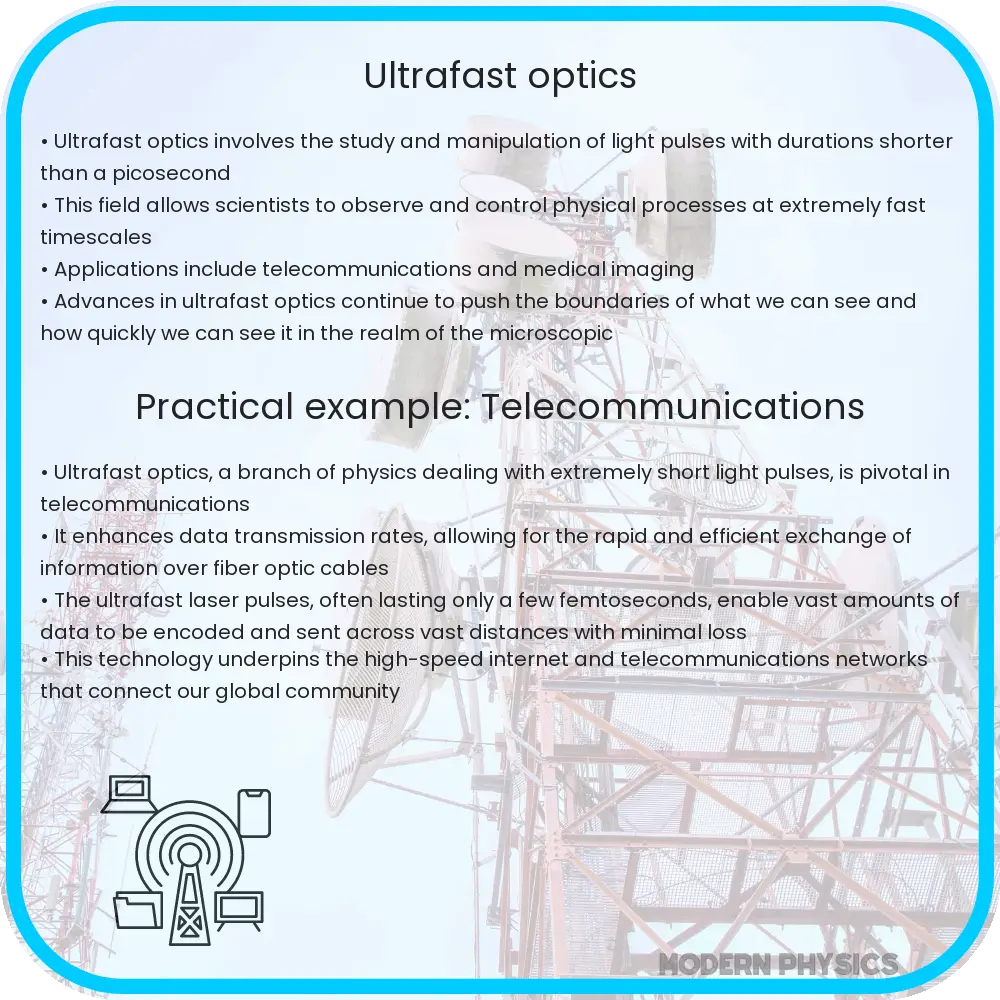
Ultrafast optics stands at the forefront of advancing how we understand, manipulate, and utilize light. This field involves the study and application of light pulses with durations in the femtosecond (10-15 seconds) to picosecond (10-12 seconds) range. These incredibly brief flashes of light open up a new realm of possibilities for precision and control in scientific research and technological applications.
The Essence of Ultrafast Phenomena
At the heart of ultrafast optics is the ability to observe and control processes that occur at speeds so fast, traditional imaging and measurement techniques cannot capture them. This includes chemical reactions, phase transitions in materials, and the dynamics of electrons in atoms and molecules. The precision offered by ultrafast laser pulses allows scientists to “freeze” these rapid phenomena in time, providing unprecedented insights into the fundamental processes of nature.
Technological Applications and Advancements
Ultrafast optics has paved the way for significant technological advancements. In the field of telecommunications, it has enhanced data transmission rates, enabling the rapid flow of information across the globe. In medicine, ultrafast laser technology has revolutionized surgical procedures, offering non-invasive options with remarkable precision and reduced recovery times. Moreover, in materials science, it facilitates the precise manipulation of materials at the atomic or molecular level, leading to the development of new materials with tailored properties.
Key Components of Ultrafast Optics Systems
- Ultrafast Lasers: The backbone of ultrafast optics, these lasers generate pulses of light that last for femtoseconds to picoseconds.
- Pulse Shaping: A technique used to control the phase, amplitude, and polarization of ultrafast pulses, tailoring them for specific applications.
- Nonlinear Optics: A fundamental aspect of ultrafast optics, where the high intensity of ultrafast pulses interacts with materials to produce new frequencies, enabling a wide range of applications from spectroscopy to imaging.
As ultrafast optics continues to evolve, its impact on science and technology grows exponentially. This field not only enhances our understanding of the microscopic world but also drives innovation across various industries, from healthcare to information technology, showcasing the incredible potential of light when controlled with precision and speed.
Challenges and Future Directions
Despite its numerous applications and potential, ultrafast optics faces several challenges. One of the primary obstacles is the complexity and cost of ultrafast laser systems, which can limit accessibility for research and industrial applications. Additionally, the generation and manipulation of ultrafast pulses require precise control and stabilization to prevent dispersion and nonlinear effects that can distort the pulse shape and duration.
Future developments in ultrafast optics are likely to focus on overcoming these challenges by making systems more compact, affordable, and robust. Advances in fiber lasers, for example, are promising for creating more accessible ultrafast sources. Moreover, ongoing research into new materials and nonlinear optical processes may yield more efficient ways to generate and shape ultrafast pulses, expanding their applicability.
Impact on Research and Industry
The implications of ultrafast optics extend beyond current applications, promising to revolutionize various fields of science and technology. In fundamental research, the ability to observe atomic and molecular dynamics in real time can lead to breakthroughs in physics, chemistry, and biology. For industry, the precision and control offered by ultrafast processes enable advancements in manufacturing, environmental monitoring, and the development of next-generation electronics and photonic devices.
Furthermore, the integration of ultrafast optics with emerging technologies such as quantum computing and nanotechnology signifies a leap towards future technologies that are more efficient, scalable, and capable of solving complex problems beyond the reach of current methods.
Conclusion
Ultrafast optics represents a critical area of photonics, offering unparalleled precision and speed in the control of light. Its ability to capture fleeting phenomena has not only expanded our understanding of the natural world but also catalyzed innovations across a broad spectrum of scientific and technological fields. Despite the challenges, the future of ultrafast optics is bright, with ongoing research and development promising to unlock new capabilities and applications. As we continue to push the boundaries of what is possible with light, ultrafast optics will undoubtedly play a pivotal role in shaping the future of science and technology.