
Explore the precision and speed of Ultrafast Laser Spectroscopy, its impact on research and industry, and future advancements in this comprehensive guide.
Introduction to Ultrafast Laser Spectroscopy
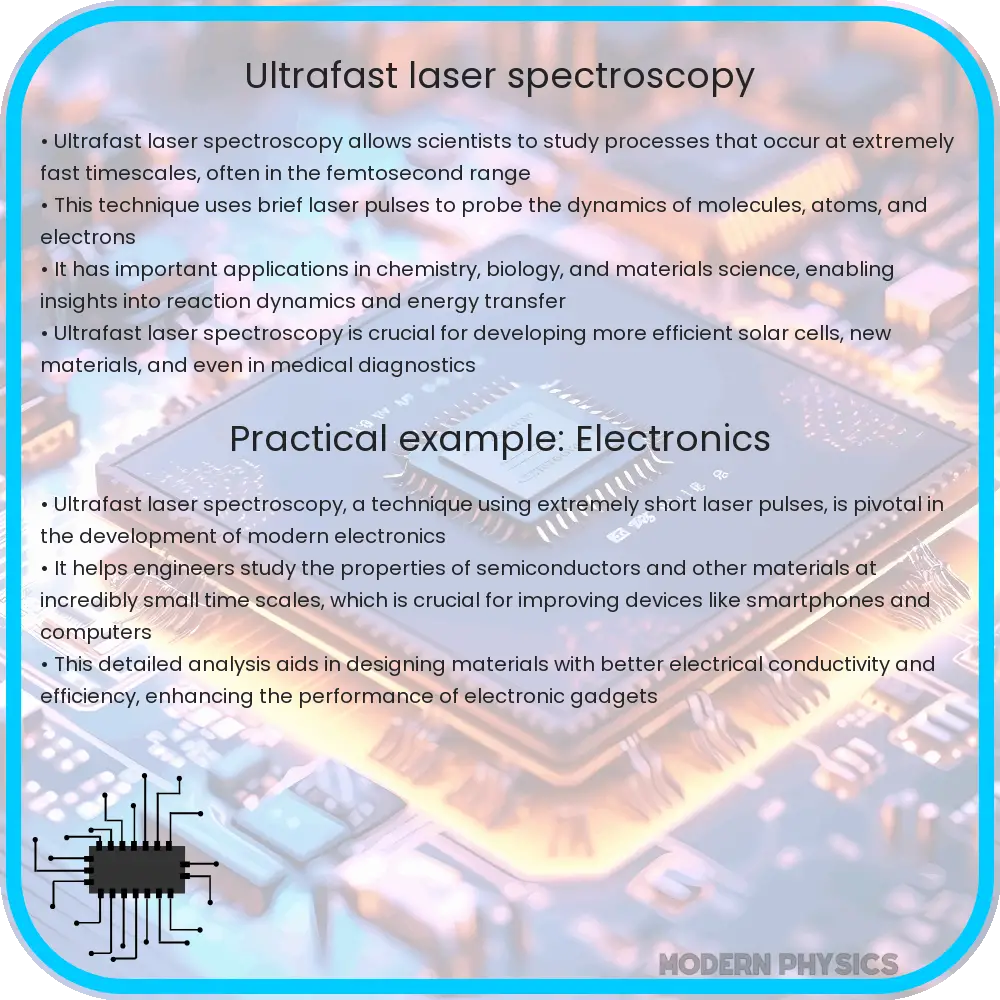
Ultrafast Laser Spectroscopy is a revolutionary technique in the realm of optical science and material analysis, offering unparalleled precision and speed. This method utilizes ultrafast laser pulses, typically in the femtosecond (10-15 seconds) to picosecond (10-12 seconds) range, to investigate the dynamic processes in atoms, molecules, and condensed matter systems. The core advantage of this technique lies in its ability to capture extremely rapid events that occur on a timescale often inaccessible by traditional spectroscopy methods.
Principles of Ultrafast Laser Spectroscopy
At its core, Ultrafast Laser Spectroscopy operates by exciting a sample with a short laser pulse and then probing it with another pulse after a controlled delay. This delay allows for the observation of dynamic changes in the sample’s properties. The technique encompasses various methods such as pump-probe spectroscopy, time-resolved fluorescence, and four-wave mixing, each offering unique insights into the sample’s behavior.
Applications in Research and Industry
The applications of Ultrafast Laser Spectroscopy are diverse and impactful. In chemical research, it provides insights into reaction dynamics, molecular vibration, and electron transfer processes. In materials science, it aids in understanding electron-phonon interactions and non-equilibrium dynamics in semiconductors and metals. Additionally, its application in biological systems offers valuable information about protein folding and photo-induced processes in biomolecules.
Technological Advancements in Ultrafast Optics
Advancements in ultrafast optics have been pivotal in enhancing the capabilities of ultrafast spectroscopy. The development of mode-locked lasers, capable of generating pulses in the femtosecond range, has been a game-changer. Additionally, the advent of non-linear optical materials and techniques like frequency doubling and parametric amplification has broadened the accessible spectral range, enabling deeper insights into material properties.
Moreover, the integration of advanced detectors and data analysis tools has improved the resolution and sensitivity of ultrafast spectroscopy. This integration allows for more accurate data collection and interpretation, making it an indispensable tool in modern research and development.
In summary, Ultrafast Laser Spectroscopy stands as a cornerstone technique in the fields of physics, chemistry, and biology. Its ability to unravel the complexities of rapid phenomena at the atomic and molecular level continues to drive innovations and discoveries across multiple scientific disciplines.
Challenges and Future Directions in Ultrafast Laser Spectroscopy
Despite its remarkable capabilities, Ultrafast Laser Spectroscopy faces several challenges. One of the primary issues is the high cost and complexity of ultrafast laser systems, which can limit accessibility for many research institutions. Additionally, the interpretation of spectroscopic data, especially in complex systems, requires sophisticated analytical models and computational methods, posing a significant challenge for researchers.
Looking forward, the field of Ultrafast Laser Spectroscopy is poised for significant advancements. Developments in laser technology, such as the creation of more compact and affordable ultrafast lasers, are expected to make this technique more accessible. Furthermore, advancements in computational power and algorithms will enhance data analysis, allowing for more precise and comprehensive understanding of ultrafast phenomena.
Impact on Industry and Society
The impact of Ultrafast Laser Spectroscopy extends beyond academic research, influencing various industries. In semiconductor manufacturing, it assists in the development of faster and more efficient electronic devices. In the pharmaceutical industry, its applications in studying drug interactions at the molecular level can lead to the development of more effective medicines. Moreover, its role in environmental monitoring, through the detection of pollutants and hazardous substances at molecular levels, is crucial for environmental protection and sustainability.
Additionally, Ultrafast Laser Spectroscopy plays a significant role in the advancement of renewable energy technologies. By understanding the dynamics of light-matter interaction in solar cells and other photovoltaic materials, it contributes to the development of more efficient and cost-effective solar energy solutions.
Conclusion
In conclusion, Ultrafast Laser Spectroscopy represents a transformative approach in the study of rapid phenomena in various scientific fields. Its unmatched speed and precision have enabled groundbreaking discoveries in physics, chemistry, biology, and material science. While challenges exist in terms of accessibility and data interpretation, ongoing technological and computational advancements are set to overcome these hurdles. As the technique becomes more refined and accessible, its influence is expected to grow, leading to further innovations in both scientific research and industry. Ultimately, Ultrafast Laser Spectroscopy stands as a testament to the power of human ingenuity in unlocking the mysteries of the natural world.