
Explore the essentials of triplet lens design, its role in improving optical clarity, precision, and compactness, and its impact across various technologies.
Understanding Triplet Lens Design
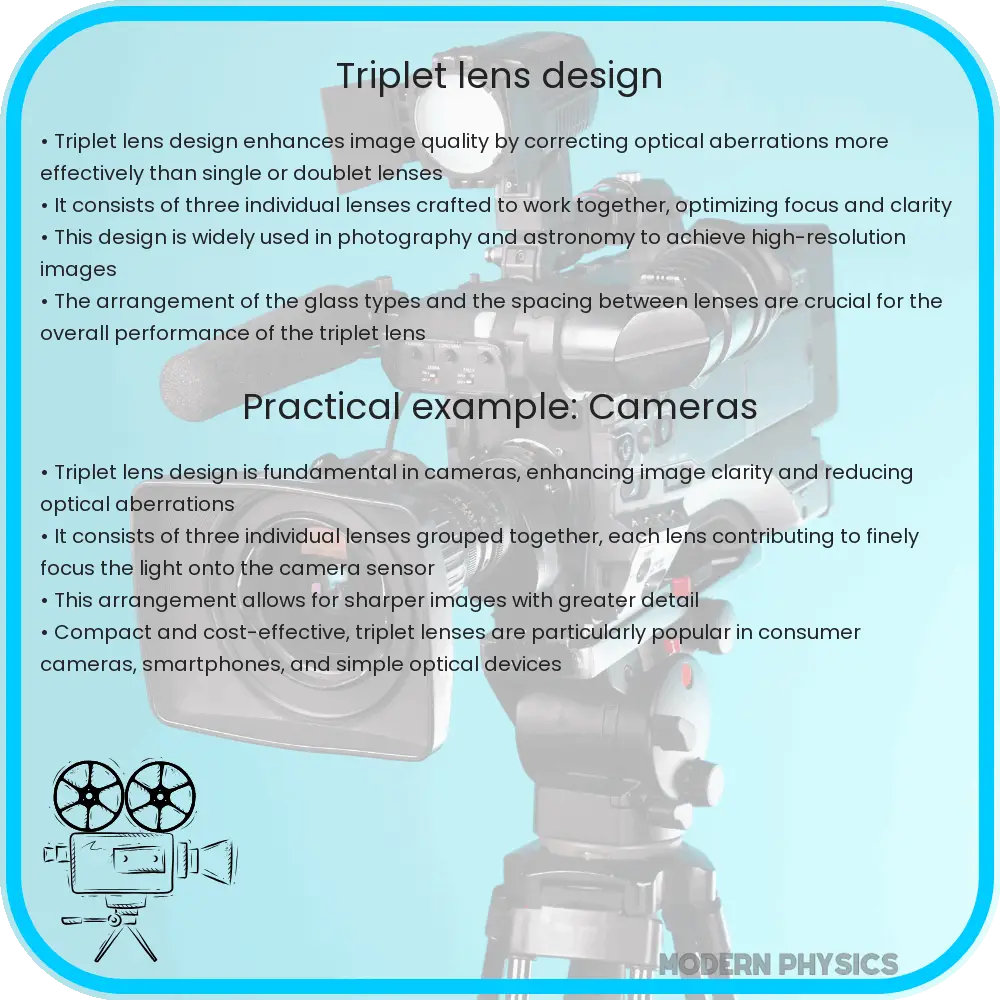
Triplet lens design stands as a cornerstone in the realm of optical engineering, offering a blend of clarity, precision, and compactness that is crucial for various applications. This design typically comprises three individual lens elements, meticulously arranged to correct aberrations and enhance image quality. Its utility spans across photography, microscopy, and even in the advanced optics of telescopes and binoculars.
The Science Behind Triplet Lenses
At its core, the triplet lens design aims to address chromatic and spherical aberrations—two prevalent issues in lens optics. Chromatic aberration occurs when different wavelengths of light do not converge at the same point after passing through a lens, resulting in a spectrum of colors around the edges of images. Spherical aberration, on the other hand, results from the spherical shape of lens surfaces, causing light rays to focus at different points along the optical axis, thus blurring the image.
The genius of the triplet design lies in its configuration of lens elements, which can be made from different types of glass, each with unique refractive properties. This diversity allows the lens designer to correct for aberrations by bending light rays more effectively. The first element typically has a positive focal length, gathering light into a converging beam. The middle element, often negative, serves to spread the light back out, correcting for spherical aberration and, to some extent, chromatic aberration. The final element, again positive, refines the focus, further reducing chromatic aberration and enhancing image sharpness.
Advantages of Triplet Lens Design
- Enhanced Image Quality: By effectively correcting for major optical aberrations, triplet lenses deliver superior clarity and sharpness in the images they produce.
- Compactness: Despite their multi-element composition, triplet lenses can be designed to be remarkably compact, making them ideal for portable optical devices.
- Versatility: The adaptability in the choice of glass types for the lens elements allows for extensive customization, enabling the design to meet specific requirements across different applications.
Applications and Technological Impact
The versatility and superior performance of triplet lens design have paved the way for its widespread adoption in various fields. In photography, especially in high-end telephoto lenses and compact camera systems, triplets provide an unbeatable combination of sharpness and portability. Astronomers and stargazers benefit from the design’s precision in telescopes, where clarity over long distances is paramount. Moreover, in the realm of scientific research, microscopes equipped with triplet lenses offer unparalleled detail, facilitating breakthroughs in fields ranging from biology to materials science.
Another significant application is in the development of virtual reality (VR) and augmented reality (AR) devices. The compactness and clarity provided by triplet lenses are essential for creating immersive experiences in these technologies, where the quality of the visual experience is crucial for user engagement and comfort.
Future Directions in Triplet Lens Design
The future of triplet lens design is bound by the relentless pursuit of perfection in optical technology. Innovations in materials science, such as the development of new glass types and synthetic materials with extraordinary refractive properties, offer exciting possibilities for further aberration correction and even lighter lens elements. Computational optics, where software complements hardware, also stands to revolutionize triplet lens design, enabling dynamic adjustment of images for optimal clarity in real-time.
Conclusion
The triplet lens design embodies a perfect harmony of clarity, precision, and compactness, making it a staple in optical engineering. Its ability to correct aberrations while maintaining a compact form factor has rendered it indispensable in a myriad of applications, from everyday photography to cutting-edge scientific research. As technology progresses, the triplet lens design will continue to evolve, undoubtedly playing a pivotal role in the advancement of optical devices. The ongoing innovations in this field not only promise enhanced performance but also open the door to new applications, further solidifying the triplet lens design’s position at the forefront of optical technology.