
Learn about transistors, the essential components that amplify or switch electronic signals in modern devices, shaping the future of electronics.
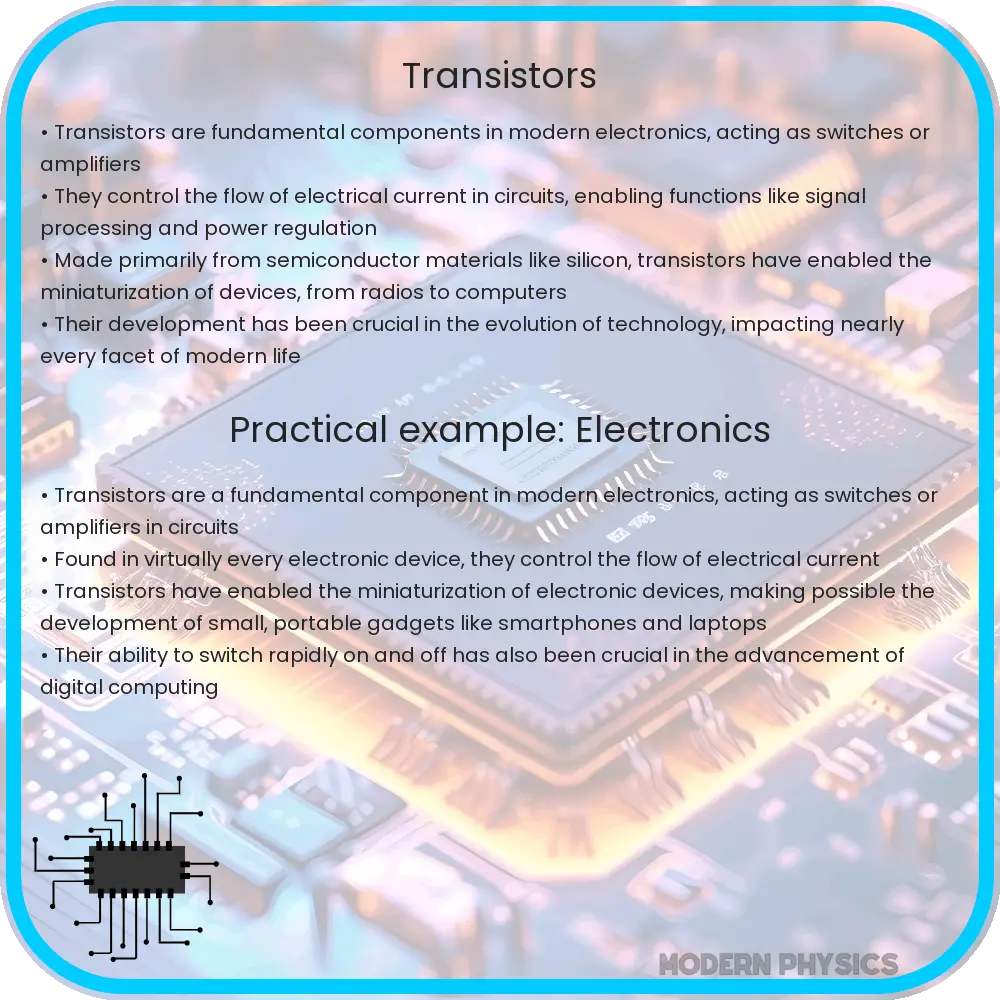
Understanding Transistors: The Heart of Modern Electronics
Transistors are the fundamental building blocks of modern electronic devices. From the tiny microprocessors in our smartphones to large-scale data centers powering the cloud, these small but mighty components play a crucial role in the operation of virtually all electronic systems. This article explores how transistors function, their types, and the cutting-edge materials that are setting the stage for the next generation of electronic devices.
How Do Transistors Work?
At its core, a transistor is a semiconductor device used to amplify or switch electronic signals and electrical power. It operates by using a small input voltage to control a larger output voltage, thus acting as an amplifier. Alternatively, it can function as a switch—a component that can turn on and off the flow of current in an electronic circuit.
Transistors consist of three layers of semiconductor material, each capable of carrying a current. By convention, these layers are called the emitter, base, and collector. The ability to control the flow between these layers is what makes a transistor so useful. The basic operation involves applying a voltage to the base layer, which controls the current flow through the other two layers from the emitter to the collector.
Types of Transistors
There are mainly two types of transistors:
- Bipolar Junction Transistors (BJT): BJTs contain three terminals named emitter, base, and collector. They require a small current to turn on (like flipping a switch), which then allows a larger current to flow.
- Field-Effect Transistors (FET): FETs also have three terminals called source, gate, and drain. Unlike BJTs, FETs operate with a small input voltage at the gate which controls the electrical conductivity between the drain and source.
Each type has its own unique advantages, making them suitable for different applications. BJTs are known for their faster response and effectiveness in high-frequency applications. On the other hand, FETs are typically more energy-efficient and have higher electrical impedance, which makes them ideal for digital circuits.
Advancements in Materials for Transistors
While silicon has been the backbone of transistors since their inception, engineers and scientists are constantly in search of materials that can surpass the capabilities of silicon, especially as devices are scaled down to nanometric dimensions. Two such materials are:
- Gallium Nitride (GaN): GaN transistors are renowned for their high efficiency and capacity to handle high temperatures and voltages. This makes them highly suitable for power electronics, where managing high power and efficiency is crucial.
- Graphene: Known as a “wonder material”, graphene is a single layer of carbon atoms arranged in a hexagonal lattice. Its exceptional electrical, thermal, and mechanical properties make it an exciting candidate for future electronics, potentially offering faster speeds and greater efficiency than silicon-based transistors.
As research continues in enhancing transistor materials, the focus remains not only on improving performance but also on sustainability and energy efficiency. These advancements promise a new era in electronics, driving forward innovations that could transform technology in ways we have yet to imagine.
Applications of Transistors
Transistors are pivotal in a plethora of applications ranging from everyday gadgets to sophisticated industrial machinery. Here are a few prominent applications:
- Computing Devices: Transistors serve as the fundamental switch in processors of computers, smartphones, and tablets, allowing them to perform billions of operations per second.
- Audio Equipment: In audio amplifiers, transistors increase the amplitude of sound signals, ensuring high-quality sound production in devices such as speakers and headphones.
- Radio Frequency (RF) Applications: Transistors are integral in RF circuits, which are crucial for wireless communication devices, including radios, mobile phones, and satellite communications.
- Medical Devices: They are used in medical equipment such as ultrasound machines, MRI systems, and other diagnostic tools where precision and reliability are critical.
The versatility of transistors makes them essential components not only in creating smarter, faster technology but also in advancing the reliability and functionality of many electronic devices.
Future of Transistors
The field of transistors is continuously evolving, driven by the demands for faster computing, smaller device sizes, and lower energy consumption. As we look towards the future, transistors made from new materials like graphene and GaN are expected to lead the charge. Innovations such as three-dimensional (3D) transistors are already being developed to combat the limitations faced by traditional planar transistor designs, potentially leading to even more efficient computing technologies.
Researchers are also exploring the possibilities of molecular electronics wherein single molecules act as electronic components, offering a new frontier in the miniaturization of circuits. Understanding and harnessing these advancements will be crucial as we move towards more sustainable and efficient electronic solutions.
Conclusion
Transistors, often termed as the “nerve cells” of the technological world, continue to be the backbone of all electronic devices. The journey from the simple point-contact transistor to today’s sophisticated silicon, graphene, and GaN transistors underscores the rapid progression and innovation within the field. As scientists push the boundaries of materials science and nanotechnology, the potential applications and improvements in electronic performance and efficiency appear limitless.
Staying abreast of these advancements not only fuels our curiosity but is essential for inspiring the next generation of engineers and scientists to further harness and evolve the capabilities of transistors in various technological domains. The future of electronics, empowered by revolutionary transistor technologies, is poised to continue transforming our lives in unimaginable ways.