
Explore the fascinating concept of time-reversal symmetry, its implications in physics, unusual phenomena, and its role in advancing technology.
Understanding Time-Reversal Symmetry
Time-reversal symmetry is a fundamental concept in physics, particularly within the realms of quantum mechanics and statistical physics. This principle asserts that the basic equations governing the dynamics of physical systems remain invariant when time is reversed. In simpler terms, time-reversal symmetry suggests that physical processes can proceed identically backwards as they do forwards, at least at the microscopic level.
Unusual Phenomena Associated with Time-Reversal Symmetry
One of the most intriguing aspects of time-reversal symmetry is its role in various unusual physical phenomena. For example, in the realm of quantum mechanics, particles such as electrons exhibit behavior that respects time-reversal symmetry, leading to phenomena like quantum entanglement and superposition. Additionally, time-reversal symmetry is a crucial element in understanding anti-particles and the concept of CPT (Charge, Parity, and Time Reversal) symmetry in particle physics.
Impacts of Time-Reversal Symmetry
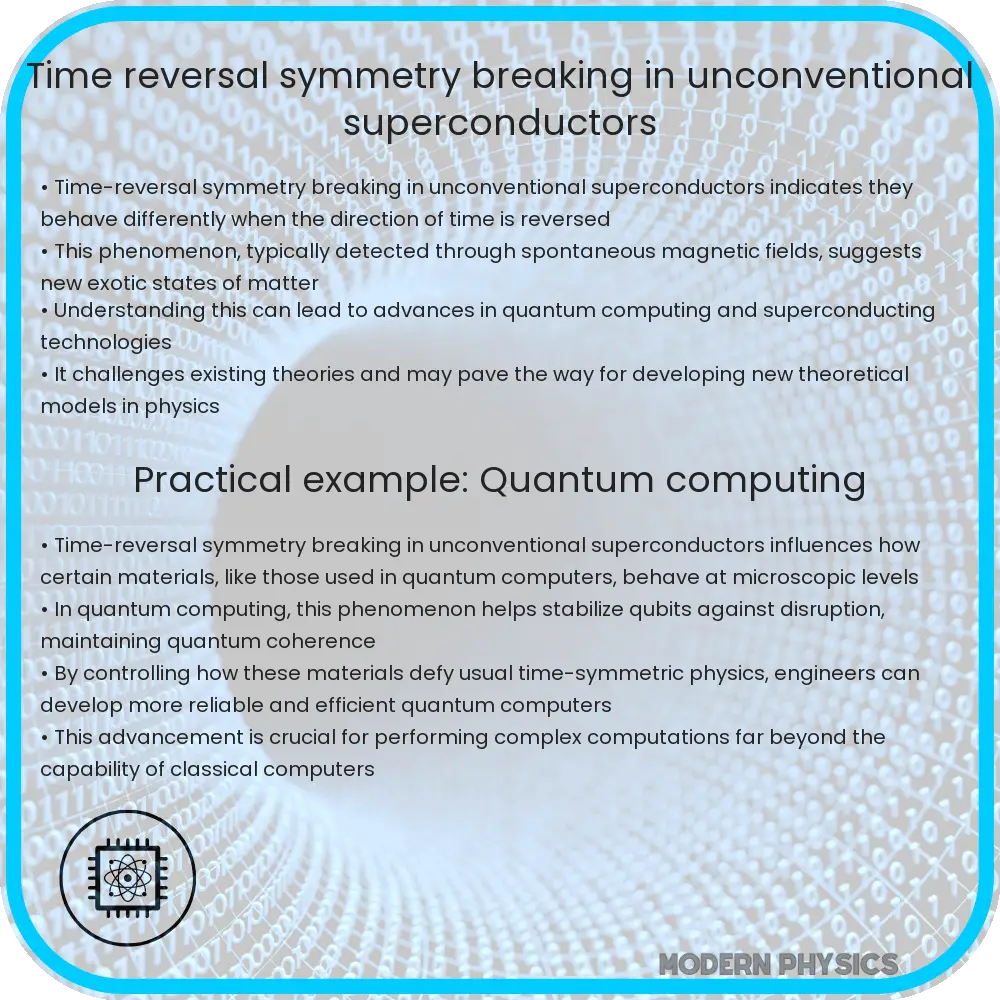
The implications of time-reversal symmetry are vast and varied. In condensed matter physics, this symmetry principle underlies the theoretical description of topological insulators, materials that conduct electricity on their surface but not in their bulk. These materials have potential applications in quantum computing and electronics due to their unique electrical properties. Furthermore, time-reversal symmetry breaking, when a system no longer behaves the same way if time is reversed, is a critical concept in the study of magnetic materials and superconductivity.
Analysis of Time-Reversal Symmetry
Analyzing time-reversal symmetry involves a deep dive into the mathematical structures of physical theories. In quantum mechanics, for instance, time-reversal symmetry is connected to the anti-unitary nature of the time-reversal operator. This contrasts with classical physics, where time-reversal simply involves changing the sign of the time variable in equations. The study of how time-reversal symmetry is broken in certain conditions, such as in the presence of magnetic fields or during the process of time evolution in non-equilibrium systems, provides crucial insights into the fundamental laws of nature.
Breaking of Time-Reversal Symmetry
While time-reversal symmetry is a foundational principle in physics, its breaking is equally significant in understanding the universe’s complexity. Notably, in systems like ferromagnets, where the alignment of spins breaks time-reversal symmetry, we observe phenomena such as permanent magnetization. Similarly, in the field of particle physics, the violation of time-reversal symmetry contributes to explaining the matter-antimatter imbalance in the universe. This asymmetry is essential for understanding CP violation in the context of the Standard Model of particle physics.
Experimental Observations and Technological Implications
Experimentally, time-reversal symmetry and its breaking have been observed in various contexts, from atomic clocks to large hadron colliders. These experiments not only validate theoretical predictions but also open doors to new technologies. For instance, the understanding and manipulation of time-reversal symmetry breaking in materials science lead to innovations in electronics and quantum computing, promising faster and more efficient devices.
Conclusion
Time-reversal symmetry is a cornerstone of modern physics, providing deep insights into the laws governing the universe. Its implications stretch from the microscopic world of quantum particles to the macroscopic realms of cosmology and materials science. The unusual phenomena associated with time-reversal symmetry and the significant impact of its breaking reveal the universe’s complex and intriguing nature. As research continues, the exploration of time-reversal symmetry will undoubtedly lead to further discoveries and technological advancements, continuing to challenge and expand our understanding of the physical world.