
Explore the fascinating world of time-reversal symmetry breaking in superconductors, revealing novel quantum phases, technological implications, and future research directions.
Time-Reversal Symmetry Breaking in Superconductors
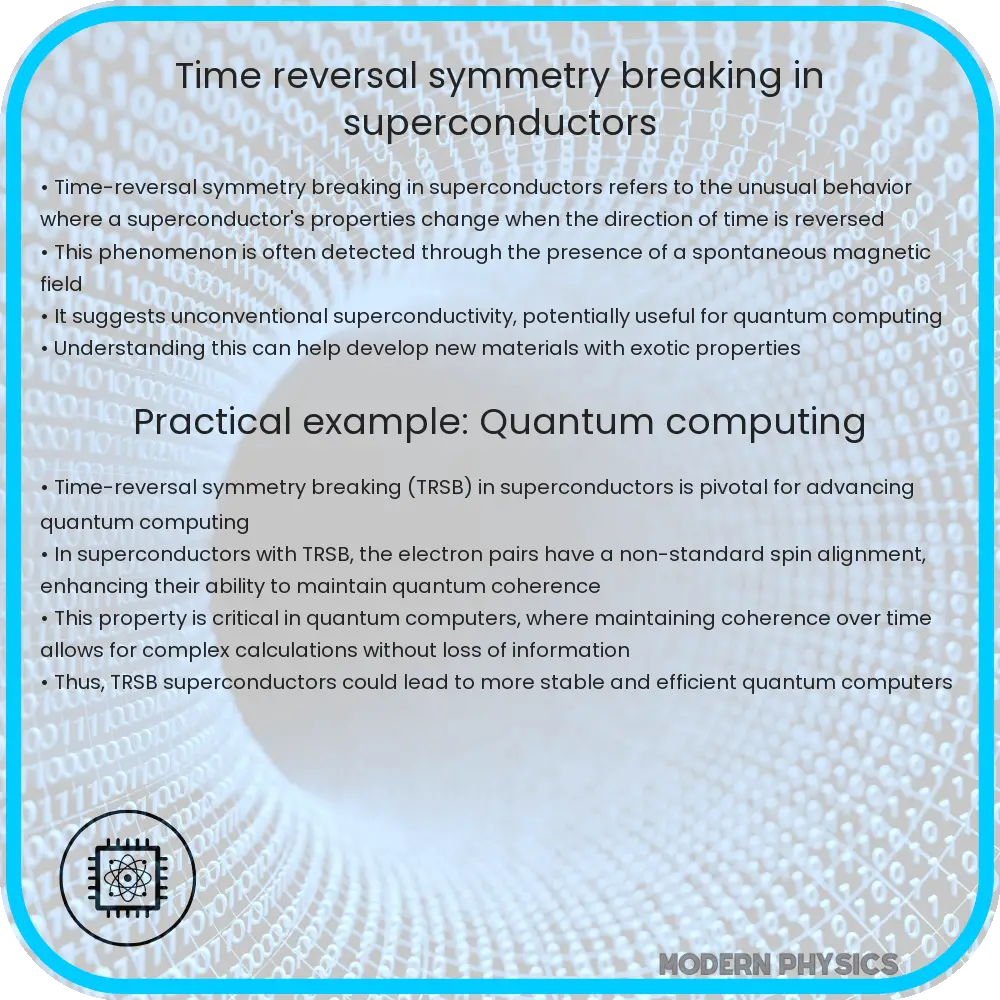
Time-reversal symmetry (TRS) is a fundamental concept in physics that asserts if the direction of time were to reverse, the basic laws of physics would remain unchanged. However, in certain exotic phases of matter, such as in some types of superconductors, this symmetry can be broken. This breaking of time-reversal symmetry in superconductors heralds the emergence of novel quantum states and has significant implications for our understanding of quantum mechanics and materials science.
Understanding Superconductors
Superconductors are materials that exhibit zero electrical resistance below a certain critical temperature. This remarkable property enables the free flow of electrical current without energy loss, which has practical applications in magnetic resonance imaging (MRI), maglev trains, and energy transmission. Superconductors are also characterized by the Meissner effect, where they expel magnetic fields from their interior, maintaining a perfect diamagnetic state.
Breaking of Time-Reversal Symmetry
In conventional superconductors, Cooper pairs of electrons move in a way that preserves time-reversal symmetry. However, in unconventional superconductors, the pairing mechanism can lead to a phase of matter where this symmetry is broken. This phenomenon is often detected through advanced techniques such as muon spin rotation (μSR) or polar Kerr effect measurements, which show an intrinsic magnetization or rotation of polarization, respectively, indicating a lack of time-reversal invariance.
Novel Quantum Phases and Effects
The breaking of time-reversal symmetry in superconductors is not just a theoretical curiosity but has profound implications for the development of new quantum phases and materials. It suggests the presence of complex order parameters and exotic excitations such as Majorana fermions, particles that are their own antiparticles, which are of great interest for quantum computing. Additionally, TRS-breaking superconductors can host topological states, which are robust against perturbations and could be pivotal in creating fault-tolerant quantum computers.
Understanding and harnessing these novel phases require a deep dive into the quantum mechanical underpinnings of superconductivity and the conditions under which time-reversal symmetry is broken. This exploration opens the door to not only new fundamental physics but also potential technological innovations in energy, computing, and sensing.
Exploring the Mechanisms Behind TRS Breaking
The mechanisms driving time-reversal symmetry breaking in superconductors are multifaceted and often rooted in the complex interplay of electronic, magnetic, and lattice degrees of freedom. For instance, in some heavy-fermion superconductors, the interaction between conduction electrons and localized magnetic moments leads to unconventional pairing that defies time-reversal symmetry. Similarly, in high-Tc cuprates, the d-wave symmetry of Cooper pairs is thought to contribute to TRS breaking. Understanding these mechanisms requires sophisticated experimental techniques and theoretical models that bridge the gap between macroscopic quantum phenomena and microscopic physical interactions.
Implications and Applications
The discovery of TRS-breaking superconductors has far-reaching implications, extending beyond the realm of fundamental physics. In technology, materials exhibiting these properties could revolutionize the field of quantum computing by providing a platform for more stable and efficient qubits. Moreover, the unique electromagnetic properties of TRS-breaking superconductors could lead to advancements in sensor technology, offering unprecedented sensitivity and new functionalities. From a theoretical standpoint, these systems provide a rich playground for exploring quantum topological states and transitions, pushing the boundaries of our understanding of matter and quantum mechanics.
Challenges and Future Directions
Despite the significant progress in understanding TRS-breaking superconductors, numerous challenges remain. Pinpointing the exact conditions and materials that exhibit this phenomenon requires precise control over material purity, composition, and structure. Additionally, developing theoretical frameworks that can accurately describe these complex systems is an ongoing effort. Future research will likely focus on synthesizing new materials, refining experimental techniques, and enhancing theoretical models to unlock the full potential of TRS-breaking superconductors.
Conclusion
The breaking of time-reversal symmetry in superconductors represents a groundbreaking development in condensed matter physics, offering a window into the intricate interplay between quantum mechanics and material properties. As researchers continue to unravel the mysteries of TRS-breaking superconductors, the potential for new technological applications and fundamental insights into the quantum realm grows. The journey from theoretical prediction to practical application is long and fraught with challenges, but the prospects it holds for advancing our understanding and capability in quantum technology and materials science are profound and far-reaching.