
Explore the efficiency, control, and modeling of thermally driven flows in diverse applications, from industry to environmental sustainability.
Understanding Thermally Driven Flows: Efficiency, Control, and Modeling
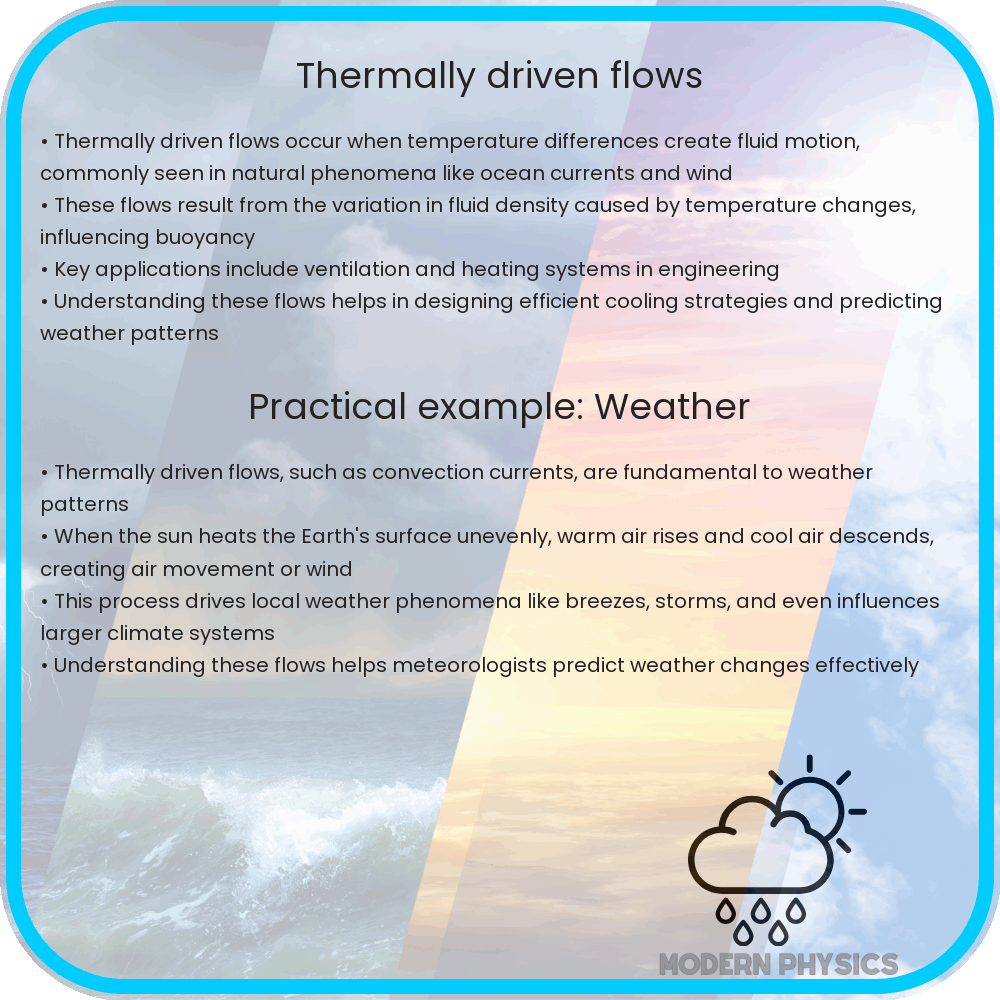
Thermally driven flows are a pivotal aspect of fluid dynamics, where heat plays a crucial role in influencing the movement and behavior of fluids. This phenomenon is observed in various applications, from industrial processes to natural environments. Understanding and optimizing these flows is essential for enhancing efficiency, precision in control, and developing accurate models.
Efficiency in Thermally Driven Flows
Efficiency in thermally driven flows refers to the effective conversion of thermal energy into kinetic energy of the fluid. This is a key factor in industries where heating or cooling processes are integral. For instance, in power generation, the efficient transfer of heat to the working fluid in a boiler can significantly improve the overall energy output. Similarly, in heating, ventilation, and air conditioning (HVAC) systems, efficient thermal flows ensure better temperature regulation and energy conservation.
Control of Thermal Flows
Control mechanisms in thermal flows are critical for maintaining desired conditions and preventing undesirable events like overheating. Advanced control systems employ sensors and actuators to monitor and regulate temperature and flow rates. In manufacturing processes, such precise control ensures product quality and safety. For example, in the chemical industry, maintaining a specific temperature range is essential for reaction kinetics and preventing hazardous situations.
Modeling of Thermally Driven Flows
Modeling thermally driven flows involves simulating the behavior of fluids under thermal influences. This is crucial for predicting system behavior, designing efficient systems, and conducting feasibility studies. Computational Fluid Dynamics (CFD) is a commonly used tool in this domain. It allows engineers to visualize flow patterns, temperature distribution, and potential problem areas. For instance, in aerospace engineering, CFD models help in understanding the thermal stresses and aerodynamic performance of aircraft components.
Real-world applications of thermally driven flows are diverse and include natural phenomena like ocean currents and weather patterns. In these contexts, thermal gradients caused by solar heating or geothermal activities drive the movement of air and water masses, influencing climate and weather systems. Accurate modeling of these flows is essential for climate research and predicting environmental changes.
The efficiency, control, and modeling of thermally driven flows thus play a vital role in various sectors, contributing to technological advancements, environmental understanding, and industrial optimization.
Advanced Techniques in Thermal Flow Modeling
Recent advancements in thermal flow modeling have revolutionized this field. Techniques like Machine Learning (ML) and Artificial Intelligence (AI) are now being integrated into traditional CFD approaches. This integration enhances predictive accuracy and reduces computational time, making it feasible to tackle complex scenarios that were previously unmanageable. For example, in the field of renewable energy, such as solar and wind power, these advanced models enable more accurate predictions of environmental impact and system efficiency under varying conditions.
Challenges in Thermally Driven Flows
Despite the advancements, challenges remain in the study and application of thermally driven flows. One of the primary challenges is dealing with turbulent flows, which are chaotic and unpredictable. Turbulence significantly affects heat transfer rates and flow efficiency, making it a critical factor to consider in industrial applications. Another challenge lies in accurately simulating the vast scale of natural thermally driven systems, such as ocean currents, where the sheer size and complexity pose significant computational and modeling hurdles.
Environmental Impact and Sustainable Practices
The study of thermally driven flows is not just confined to industrial applications but also extends to environmental sustainability. Understanding these flows is crucial in assessing the impact of human activities on natural systems, like the thermal pollution of water bodies from industrial discharges. Sustainable practices in managing thermally driven flows are essential to mitigate adverse environmental impacts and promote ecological balance.
Future Prospects
The future of thermally driven flow studies is poised for more groundbreaking developments. With the ongoing advancement in computational power and modeling techniques, it is expected that future models will offer even greater accuracy and efficiency. This will have a profound impact on various sectors, from enhancing renewable energy systems to mitigating climate change effects.
Conclusion
Thermally driven flows represent a complex yet fascinating area of study, intertwining disciplines like fluid dynamics, thermodynamics, and computational modeling. The efficiency, control, and accurate modeling of these flows are crucial in a wide range of applications, impacting industries, environmental systems, and technological innovations. As we move forward, the integration of advanced computational techniques and a deeper understanding of these flows will continue to drive progress in energy efficiency, environmental sustainability, and industrial processes. The ongoing research and development in this field hold the promise of unlocking further potential in harnessing and optimizing the power of thermally driven flows.