
Explore the dynamic world of heat waves in non-equilibrium systems, uncovering their patterns, impacts, and relevance across various scientific fields.
Understanding Heat Waves in Non-Equilibrium Systems
Heat waves in non-equilibrium systems present a fascinating area of study, combining aspects of thermodynamics, fluid dynamics, and pattern formation. These phenomena, which occur far from thermodynamic equilibrium, are characterized by the spontaneous emergence of complex, often unpredictable patterns and dynamics. This article delves into the intricacies of these systems, exploring their underlying mechanisms, observable patterns, and the broader implications they have on our understanding of dynamic systems.
Dynamics of Non-Equilibrium Systems
Non-equilibrium systems are defined by their deviation from equilibrium, where standard laws of thermodynamics do not fully apply. In such systems, external factors continuously supply or remove energy, leading to a constant state of flux. Heat waves in these contexts can be viewed as transient, localized spikes in temperature that propagate through the medium. The dynamic nature of these systems is governed by a set of non-linear equations, often resulting in complex, chaotic behavior.
Pattern Formation in Heat Waves
The study of pattern formation in heat waves within non-equilibrium systems has revealed a variety of intricate structures. These include Rayleigh-Bénard convection, where fluid heated from below exhibits a pattern of convective cells, and the Belousov-Zhabotinsky reaction, a chemical oscillation manifesting in visually striking patterns. These patterns arise from the interplay of factors like temperature gradients, reaction kinetics, and diffusion processes.
Impact and Applications
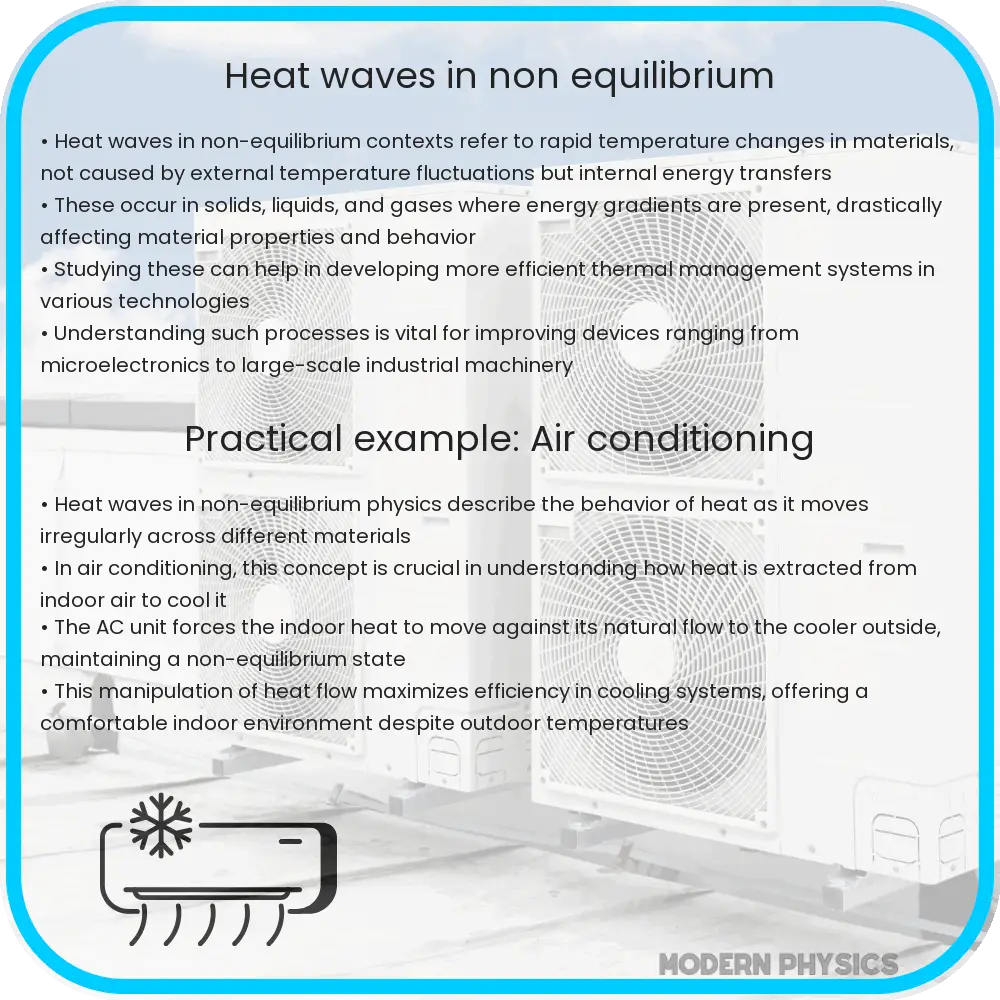
The study of heat waves in non-equilibrium systems has profound implications across multiple disciplines. In meteorology, understanding these dynamics can aid in predicting and mitigating the effects of extreme weather events. In materials science, insights into pattern formation can guide the development of new materials with tailored properties. Furthermore, the principles underlying these phenomena have applications in fields as diverse as biology, where they can explain pattern formation in living organisms, and engineering, where they inform the design of efficient heat management systems.
The exploration of these systems also challenges and enriches our understanding of thermodynamics and fluid dynamics. By studying how systems behave under non-equilibrium conditions, scientists gain valuable insights into the fundamental laws governing energy and matter. This not only advances the field of physics but also has potential applications in developing sustainable energy solutions and understanding environmental processes.
Advanced Techniques in Studying Heat Waves
To further understand heat waves in non-equilibrium systems, researchers employ a variety of advanced techniques. Computational modeling plays a crucial role, allowing scientists to simulate and predict complex behaviors in these systems. These models incorporate algorithms that solve non-linear differential equations, providing insights into the evolution and stability of patterns over time. Additionally, experimental methods, such as laser diagnostics and thermal imaging, enable precise measurement and visualization of temperature patterns and gradients within a system.
Challenges and Future Directions
Despite significant progress, studying non-equilibrium heat waves presents unique challenges. One major hurdle is the inherent unpredictability and instability of these systems, which makes experimental replication and theoretical modeling complex. Additionally, bridging the gap between microscopic (molecular or atomic level) and macroscopic (observable phenomena) understanding of these systems remains a formidable task. Future research aims to develop more accurate models and experimental techniques to overcome these challenges.
Environmental and Climate Considerations
Understanding non-equilibrium heat waves also has direct implications for environmental and climate studies. These systems can serve as models for understanding large-scale environmental processes, including climate dynamics and oceanic circulation patterns. The insights gained can contribute to more accurate climate modeling, better prediction of weather extremes, and more effective strategies for environmental conservation.
Conclusion
In conclusion, the study of heat waves in non-equilibrium systems is a vibrant and continually evolving field, intersecting various scientific disciplines. It challenges our conventional understanding of thermodynamics and fluid dynamics, offering new perspectives on pattern formation, energy transfer, and system dynamics. The knowledge gained from these studies not only enhances our theoretical understanding but also has practical applications in technology, environmental science, and beyond. As we continue to explore these complex systems, we pave the way for innovative solutions to some of the most pressing challenges in science and technology, ultimately contributing to a deeper understanding of the natural world.