
Explore the precision, speed, and reliability of thermal effusivity sensors in various industries, from textiles to electronics and sustainability.
Understanding Thermal Effusivity Sensors: Precision, Speed, and Reliability
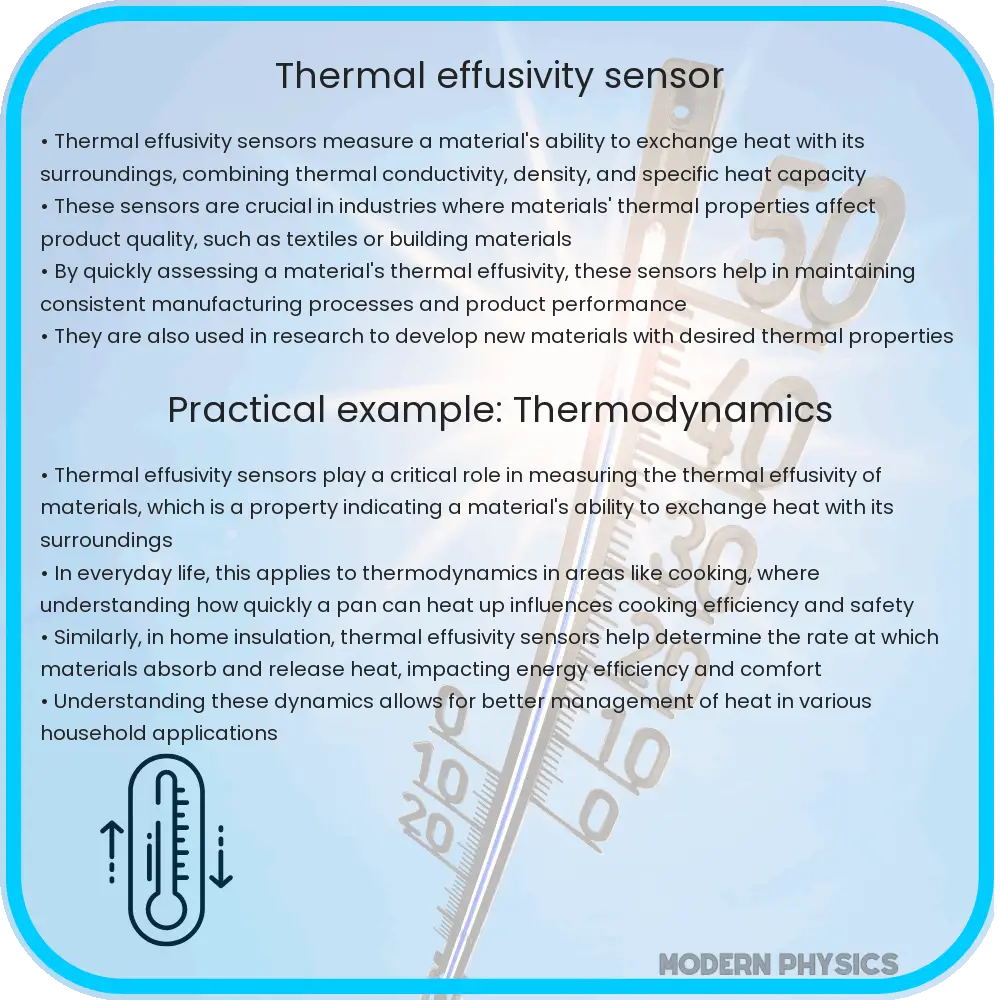
Thermal effusivity sensors are pivotal in various industrial and scientific applications, offering precise, rapid, and reliable measurements of a material’s ability to exchange heat with its surroundings. This property, known as thermal effusivity, is crucial in fields ranging from material science to thermal management in electronics.
Key Principles and Functionality
At the core of these sensors is the principle of thermal effusivity, defined as \( e = \sqrt{k \cdot \rho \cdot c} \), where \( k \) is thermal conductivity, \( \rho \) is density, and \( c \) is specific heat capacity. The sensor works by introducing a known amount of heat to a material and measuring the rate of temperature change. This data, combined with the material’s density and specific heat capacity, allows for the calculation of its thermal effusivity.
Applications and Importance
Thermal effusivity sensors find extensive use in various industries. In the textile industry, they help in assessing the thermal comfort of fabrics, crucial for clothing and upholstery materials. In electronics, these sensors aid in evaluating thermal management solutions, essential for preventing overheating in devices. Additionally, in the construction sector, they are used to analyze building materials for thermal efficiency, contributing to energy-saving measures.
Advancements in Technology
Recent advancements have greatly enhanced the precision and speed of these sensors. Modern sensors now incorporate microelectromechanical systems (MEMS) technology, improving sensitivity and response time. Additionally, the integration of advanced algorithms and digital signal processing techniques has increased the accuracy of measurements, even in complex materials with heterogeneous compositions.
Choosing the Right Sensor
Selecting the appropriate thermal effusivity sensor involves considering factors such as measurement range, accuracy, response time, and environmental conditions. It’s also important to consider the compatibility of the sensor with the material being tested, as different sensors are optimized for different types of materials.
For instance, sensors designed for high-effusivity materials like metals might not be suitable for low-effusivity materials such as foams or textiles. The sensor’s calibration and maintenance requirements are also vital considerations, impacting long-term reliability and measurement consistency.
In conclusion, thermal effusivity sensors are indispensable tools in modern industry and research. Their ability to provide precise, fast, and reliable measurements makes them critical in a wide range of applications. As technology continues to advance, we can expect even greater capabilities and applications of these sensors in the future.
Advantages of Thermal Effusivity Sensors
One of the key benefits of using thermal effusivity sensors is their non-destructive testing (NDT) nature. Unlike other methods that may require altering or damaging a sample, these sensors can assess materials in their natural state. This feature is particularly beneficial in quality control processes where preserving the integrity of the sample is crucial. Additionally, the ability of these sensors to provide real-time data enhances their utility in dynamic environments and processes.
Innovations and Future Trends
The future of thermal effusivity sensors looks promising with ongoing research and development. Emerging trends include the miniaturization of sensors, enabling integration into a wider range of applications and devices. There’s also a growing focus on enhancing connectivity and data analysis capabilities, with sensors increasingly becoming part of the Internet of Things (IoT) ecosystem. This integration allows for remote monitoring and data collection, opening new possibilities in predictive maintenance and process optimization.
Environmental Impact and Sustainability
Thermal effusivity sensors also play a significant role in promoting environmental sustainability. By optimizing thermal management in various industries, these sensors contribute to energy efficiency and reduced carbon footprints. In the building sector, for instance, they help in designing energy-efficient structures, while in manufacturing, they aid in optimizing processes to minimize energy waste.
Challenges and Considerations
Despite their numerous advantages, there are challenges in the application of thermal effusivity sensors. One of the primary challenges is the need for precise calibration to ensure accuracy. Environmental factors like humidity and temperature can also affect sensor performance, necessitating careful consideration of operating conditions. Moreover, the interpretation of data requires expertise, as different materials can exhibit complex thermal behaviors.
Conclusion
In summary, thermal effusivity sensors are essential tools in today’s technology-driven world. Their precision, speed, and reliability offer significant advantages in various applications, from material science to environmental sustainability. The continual advancements in this field promise even greater efficiency and versatility, making these sensors integral components in a wide array of industries. As we move towards a more connected and sustainable future, the role of thermal effusivity sensors in enhancing efficiency and reducing environmental impact cannot be overstated. Their contribution to technology and sustainability marks them as key instruments in the ongoing evolution of scientific and industrial processes.