
Explore the world of Terahertz Spectroscopy: its principles, applications, and future in precision analysis and material science.
Understanding Terahertz Spectroscopy: Precision, Speed, and Analysis
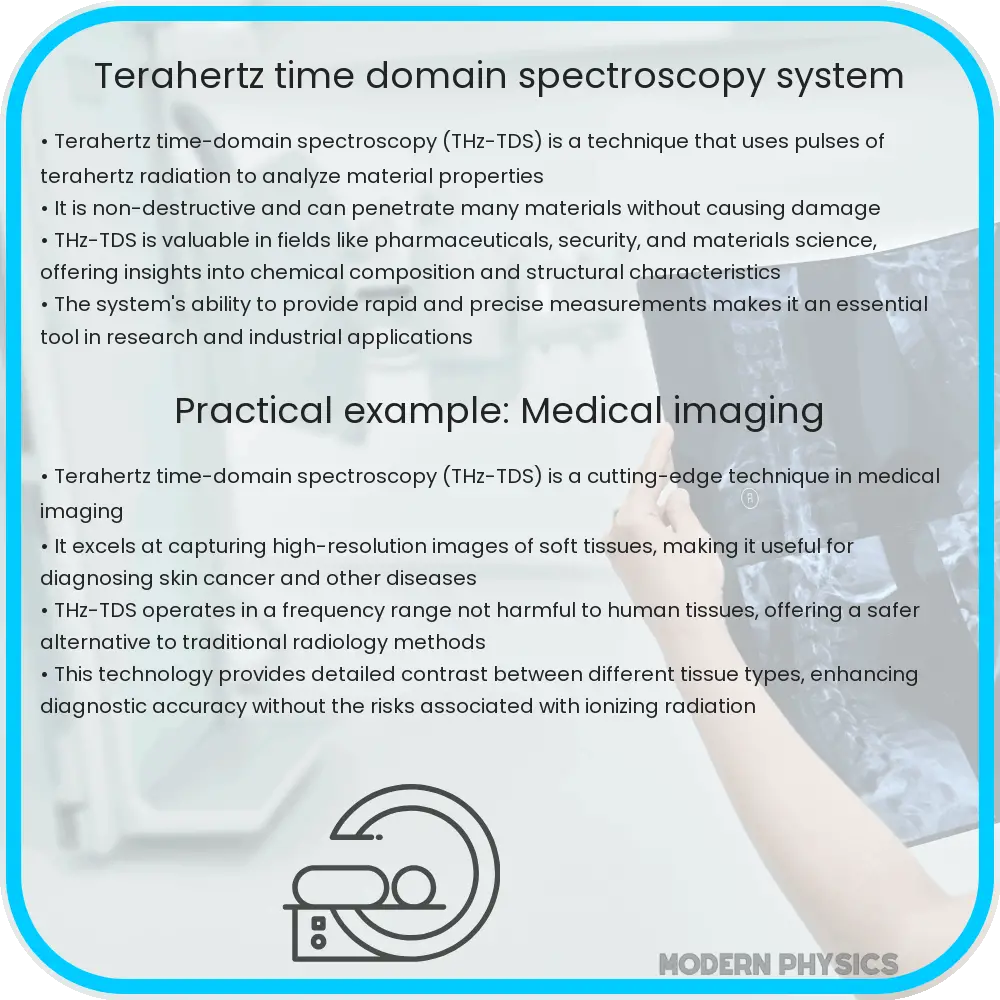
Terahertz spectroscopy, a groundbreaking technology in the field of spectroscopic analysis, operates in the terahertz frequency range (0.1 – 10 THz), bridging the gap between microwave and infrared regions of the electromagnetic spectrum. This technique is garnering attention for its remarkable capabilities in various scientific and industrial applications, owing to its unique interaction with different materials.
Principles of Terahertz Spectroscopy
At its core, terahertz spectroscopy involves the emission, detection, and analysis of terahertz radiation. When terahertz waves interact with a sample, they can be absorbed, reflected, or transmitted, each providing valuable information about the sample’s properties. The technique is particularly effective in probing rotational and vibrational transitions in molecules, as well as in examining collective excitations in solids, like phonons and plasmons.
Applications in Material Analysis and Beyond
One of the most significant applications of terahertz spectroscopy lies in material analysis. It’s capable of identifying and characterizing a wide range of substances, from organic compounds to pharmaceuticals, thanks to its ability to penetrate various non-conducting materials without causing damage. For instance, in the pharmaceutical industry, it’s used for coating analysis, tablet inspection, and quality control processes.
Advantages: Precision and Speed
The precision of terahertz spectroscopy is unmatched. It can detect subtle changes in a material’s chemical composition, crystalline structure, and physical properties. Moreover, the speed of this technique is a key advantage. Unlike traditional spectroscopic methods that can be time-consuming, terahertz spectroscopy offers rapid analysis, making it ideal for real-time monitoring in manufacturing processes or security screenings.
Safety and Non-Destructive Analysis
Another vital aspect of terahertz spectroscopy is its safety and non-invasive nature. The low-energy photons in terahertz waves are non-ionizing, posing no health risks to operators or damage to samples. This feature makes it particularly useful in the inspection of biological tissues, art conservation, and cultural heritage preservation.
Overall, terahertz spectroscopy stands out for its exceptional combination of precision, speed, and non-destructive analysis capabilities, revolutionizing how we examine and understand materials in a myriad of fields.
Technological Advancements in Terahertz Spectroscopy
Recent technological advancements have significantly enhanced the capabilities of terahertz spectroscopy. Modern terahertz systems incorporate advanced features like time-domain spectroscopy (TDS) and frequency-domain spectroscopy (FDS), enabling higher resolution and more detailed spectral information. Additionally, the development of compact, portable terahertz devices has expanded the scope of its applications, making it accessible for on-site analysis in various environments.
Challenges and Future Directions
Despite its many advantages, terahertz spectroscopy faces certain challenges. The most notable is the relatively weak penetration power through metallic and water-containing materials, limiting its use in some scenarios. Also, the development of more efficient and powerful terahertz sources and detectors remains an area of active research. Overcoming these challenges will pave the way for broader applications of this technology in fields such as biomedical imaging, environmental monitoring, and wireless communication.
Integration with Other Spectroscopic Techniques
An exciting development in the field is the integration of terahertz spectroscopy with other spectroscopic methods like Raman and infrared spectroscopy. This synergy enhances the overall analytical capabilities, providing a more comprehensive understanding of the samples under study. Such multi-modal spectroscopic approaches are proving invaluable in complex analytical tasks in pharmaceuticals, nanotechnology, and materials science.
Educational and Research Implications
The educational impact of terahertz spectroscopy cannot be overstated. It provides a practical platform for students and researchers to explore fundamental concepts in physics, chemistry, and materials science. Moreover, its growing use in research is leading to new discoveries and insights in various scientific domains, further pushing the boundaries of our knowledge.
Conclusion
Terahertz spectroscopy, with its blend of precision, speed, and non-destructive analysis, is a transformative technology with far-reaching implications. As it continues to evolve, it promises to unlock new possibilities in scientific research, industrial applications, and beyond. The ongoing advancements in this field not only enhance our analytical capabilities but also open new horizons for innovation and discovery. Embracing this technology is key to advancing our understanding of the material world, ultimately contributing to progress across multiple disciplines and industries.