
Learn the essentials of telescopes, focusing on magnification, clarity, and range to enhance your viewing of distant objects, from stars to landscapes.
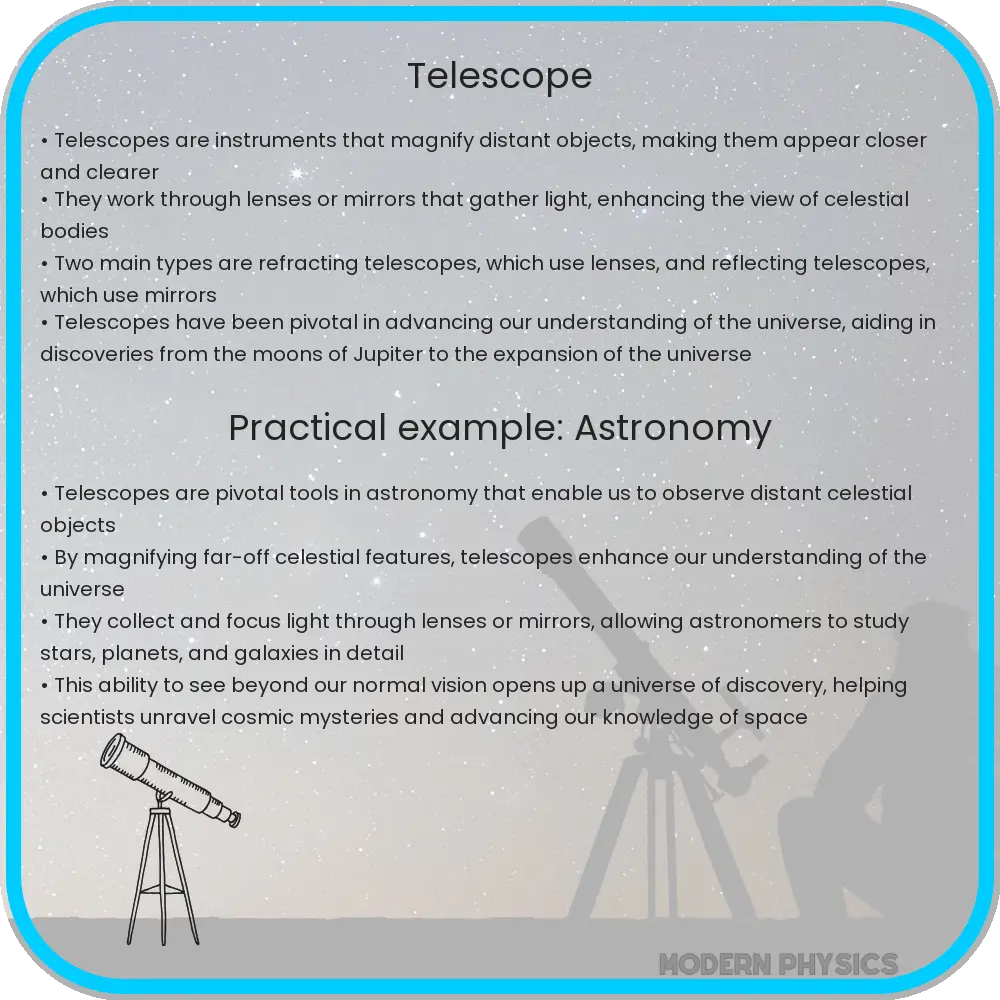
Telescope Essentials | Magnification, Clarity & Range
Telescopes are fascinating instruments that allow us to observe distant objects with clarity. Whether you’re peering into the night sky or examining distant landscapes, understanding the essentials of telescope operation can greatly enhance your viewing experience. Let’s explore the key aspects: magnification, clarity, and range.
Magnification
Magnification is one of the most frequently mentioned attributes of a telescope. It refers to how much larger an object appears through the telescope compared to the naked eye. The magnification (M) can be calculated using the formula:
M = \frac{f_{o}}{f_{e}}
Where:
f_{o}: Focal length of the objective lens or primary mirror.f_{e}: Focal length of the eyepiece.
For instance, if the focal length of the objective is 1000 mm and the focal length of the eyepiece is 20 mm, the magnification would be:
M = \frac{1000}{20} = 50
This means the telescope makes the object appear 50 times larger than seen by the naked eye. However, higher magnification doesn’t always mean a better view. Too much magnification can lead to a blurry and less detailed image.
Clarity
Clarity refers to how sharp and clear an image appears through the telescope. Several factors influence clarity:
- Optical Quality: The materials and craftsmanship of the lenses and mirrors play a significant role in image clarity.
- Atmospheric Conditions: Air turbulence, weather, and light pollution can affect the clarity of the image.
- Collimation: Ensuring the telescope’s optical components are properly aligned is critical to achieving clear views.
A common way to measure clarity is through the angular resolution, defined as the smallest angle between two point sources that can be distinguished. Angular resolution (\(\theta\)) can be approximated by:
\theta = \frac{1.22 \lambda}{D}
Where:
\lambda: Wavelength of light.D: Diameter of the objective lens or mirror.
A telescope with a larger diameter (D) can resolve finer details, providing a sharper image.
Range
Range, in the context of telescopes, refers to how far into space or across a landscape one can see. The range is influenced by the telescope’s light-gathering ability, often determined by the diameter of its objective lens or mirror. Larger diameters mean more light is collected, allowing the telescope to observe fainter objects which are farther away.
The light-gathering power (LGP) of a telescope can be compared to the human eye using the formula:
LGP = (\frac{D_{t}}{D_{e}})^2
Where:
D_{t}: Diameter of the telescope’s objective lens or mirror.D_{e}: Diameter of the human eye’s pupil, typically around 7 mm in darkness.
For example, if a telescope has a 140 mm diameter objective, the light-gathering power compared to the human eye is:
LGP = (\frac{140}{7})^2 = 400
This means the telescope can gather 400 times more light than the naked eye, allowing it to see much fainter objects.
Choosing the Right Telescope
When selecting a telescope, consider the following tips to match it to your needs:
- Purpose: Determine if you’ll be using it for astronomical or terrestrial viewing. Different types of telescopes are better suited for each purpose.
- Portability: Smaller, more portable telescopes are easier to transport and set up but might offer less magnification and range.
- Budget: Higher quality telescopes with larger diameters and better optics can be expensive.
- Ease of Use: Beginners might prefer a simpler setup, like a refractor telescope, which requires less maintenance compared to reflectors.
Maintaining Your Telescope
To ensure your telescope performs well, regular maintenance is crucial. Here are some basic tips:
- Clean Lenses and Mirrors: Use a soft brush or air blower to remove dust. Clean with a mild solution and a lint-free cloth if necessary.
- Check for Alignment: Regularly check the collimation of your telescope to maintain clarity.
- Cover When Not in Use: Use protective caps and covers to keep dust and moisture off the optics.
- Store Properly: Store in a cool, dry place and avoid sudden temperature changes to prevent condensation on the lenses.
Conclusion
Understanding the essentials of a telescope, including magnification, clarity, and range, is crucial for making the most of your viewing experience. By considering factors like the quality of optics, atmospheric conditions, and proper maintenance, you can achieve clear and detailed observations. Whether you are exploring the craters on the Moon or the rings of Saturn, a well-chosen and well-maintained telescope opens up a universe of discovery.