
Discover the essentials of reflector telescopes: how they enhance clarity, magnification, and user experience for both amateur and seasoned astronomers.
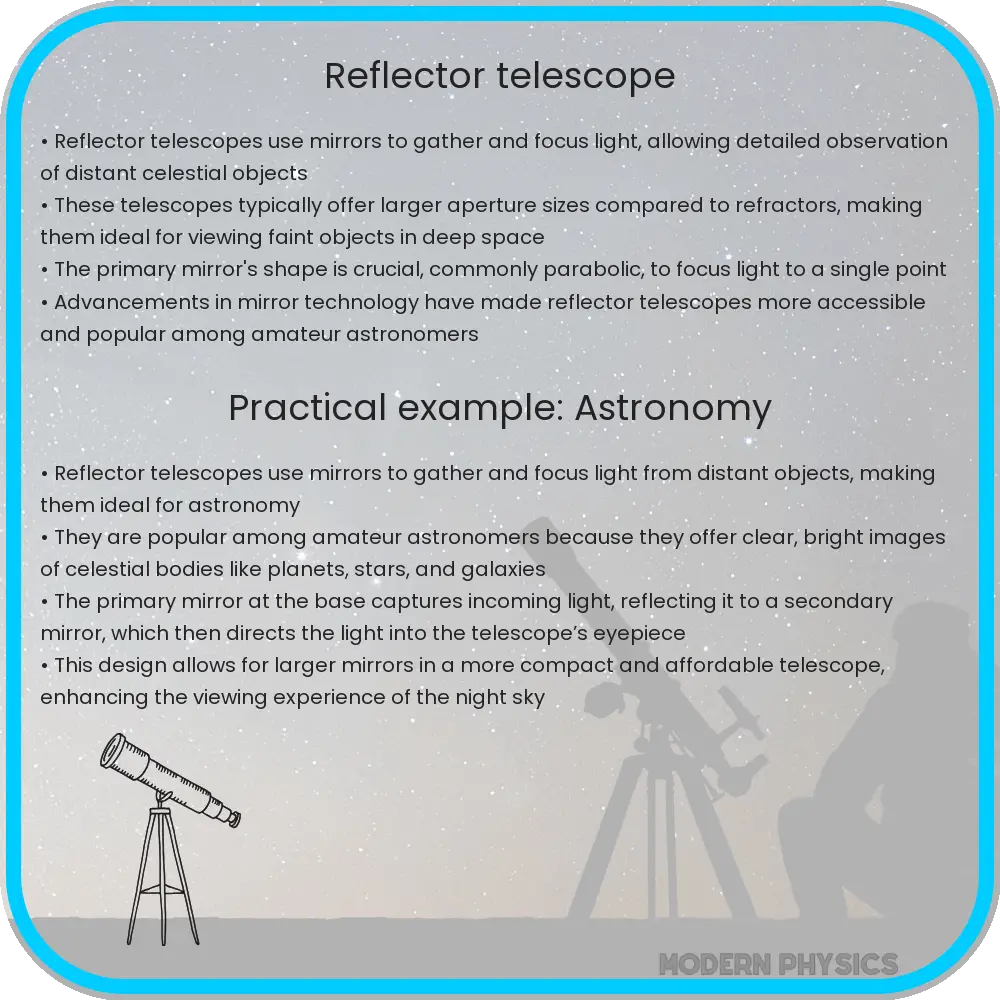
Understanding Reflector Telescopes: Clarity, Magnification, and Ease of Use
Reflector telescopes, celebrated for their powerful magnification and clarity, have revolutionized the way we observe the cosmos. Unlike their refractor counterparts, reflectors use a large concave mirror to gather and focus light, offering several distinct advantages for both amateur astronomers and seasoned stargazers.
Clarity and Light Gathering
The key to a reflector telescope’s superior clarity lies in its primary mirror. This mirror’s ability to collect light is directly proportional to its size; larger mirrors can capture more light from distant celestial objects, making them brighter and clearer in the eyepiece. This aspect is particularly beneficial for viewing deep-sky objects like nebulae, galaxies, and star clusters, which emit faint light over great distances.
Magnification Capabilities
Magnification in reflector telescopes is a function of the focal length of the telescope and the eyepiece used. These telescopes can achieve high levels of magnification without losing image quality, thanks to their large mirrors. By swapping out eyepieces, users can easily adjust the magnification to suit different observational targets, from the craters of the Moon to the rings of Saturn.
Ease of Use and Maintenance
Reflectors are known for their ease of use, making them a popular choice among beginners. The design of the mount and the telescope’s overall structure are straightforward, facilitating easy setup and adjustments during observation sessions. However, reflector telescopes require regular maintenance, including occasional collimation (alignment of the mirrors) to ensure optimal performance. The open tube design of most reflector telescopes means that the mirrors can accumulate dust over time, necessitating careful cleaning.
Conclusion
The advantages of reflector telescopes in terms of clarity, magnification, and user-friendliness make them an excellent choice for anyone interested in exploring the night sky. Whether you’re a novice aiming to catch your first glimpse of the Andromeda Galaxy or an experienced observer chasing the intricate details of Jupiter’s cloud bands, a reflector telescope can open up a universe of awe-inspiring views.
Understanding the Mechanics of Reflector Telescopes
Reflector telescopes, also known as Newtonian telescopes, are a popular choice among amateur astronomers and professionals alike due to their superior clarity, impressive magnification capabilities, and relative ease of use. These telescopes utilize a mirror-based system to gather and focus light, which distinguishes them from their refractor counterparts that use lenses. This design not only reduces optical aberrations but also allows for larger apertures at a more affordable cost.
Clarity and Magnification Explained
The clarity of an image in a reflector telescope is primarily determined by its aperture size—the diameter of the telescope’s main mirror. A larger aperture allows more light to be collected, which enhances the telescope’s ability to resolve fine details in distant celestial objects. Magnification, on the other hand, is a function of the telescope’s focal length and the eyepiece being used. Reflector telescopes offer the flexibility to change eyepieces, thus adjusting the magnification to suit the observation target, whether it’s a planet, nebula, or galaxy.
The Ease of Use and Maintenance
Reflectors are favored for their ease of use, especially for beginners. They generally require less maintenance than refractors since their mirrors are less susceptible to dust and other environmental factors. However, they do occasionally require collimation—adjusting the alignment of the mirrors—to ensure optimal performance. This process might seem daunting at first, but it becomes straightforward with practice and contributes to the educational value of using such a telescope.
Conclusion
In conclusion, reflector telescopes stand out for their clarity, magnification, and user-friendly design, making them an excellent choice for anyone looking to explore the night sky. Whether you’re a novice stargazer or a seasoned astronomer, the reflector telescope offers a window to the universe with unparalleled detail and accuracy. By understanding the principles behind their operation, enthusiasts can fully appreciate the capabilities of these powerful instruments and make informed choices about their astronomical adventures.