
Explore the benefits and considerations of using teleconverter lenses for enhanced magnification and image quality, ideal for wildlife and sports photography.
Understanding Teleconverter Lenses: A Deep Dive into Optics, Magnification, and Image Quality
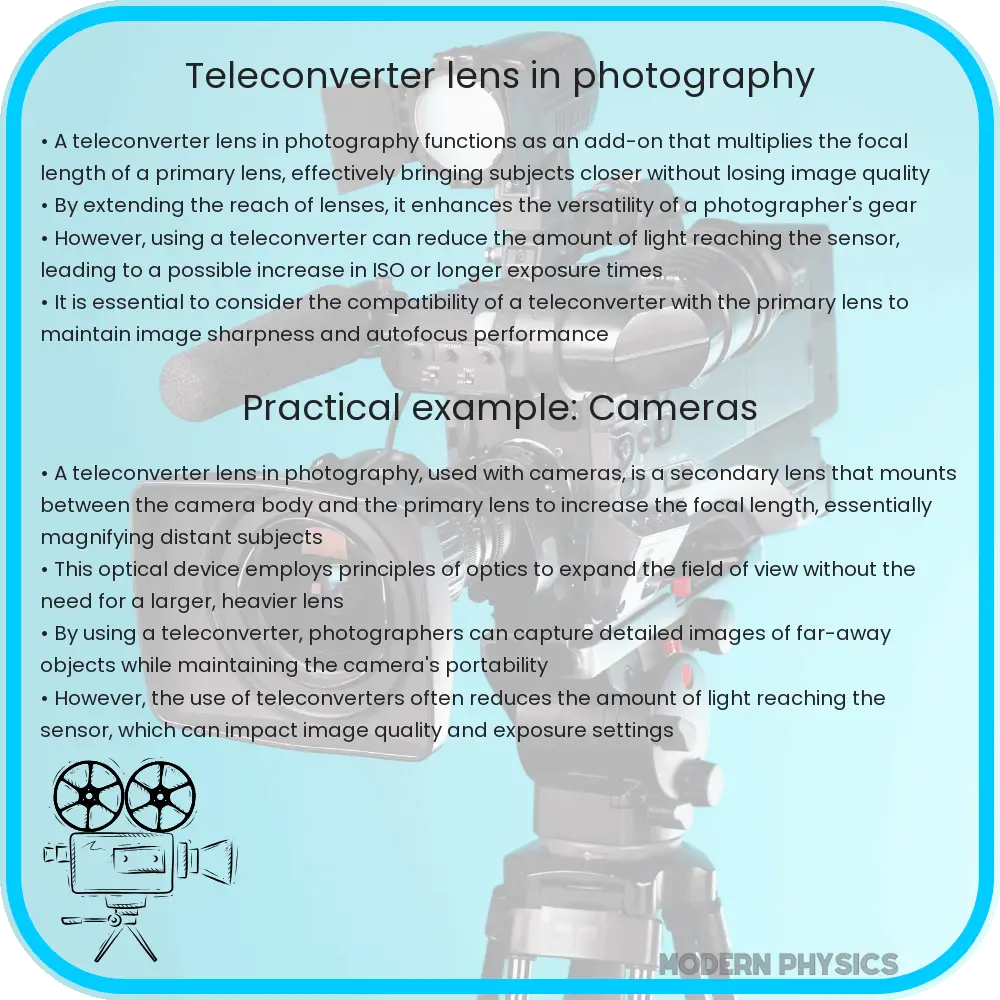
Teleconverter lenses, often referred to simply as teleconverters (TCs), are unique optical accessories that can significantly enhance the magnification capabilities of your primary lens. By fitting a teleconverter between your camera body and your primary lens, you can extend the focal length of the lens, bringing distant subjects closer and enhancing your photography’s versatility without the need to invest in additional, expensive lenses.
The Optical Mechanics of Teleconverters
At its core, a teleconverter contains a set of optical elements that function by increasing the effective focal length of the lens it’s paired with. This is achieved without altering the closest focusing distance, thus magnifying the subject more than the lens alone. Teleconverters are commonly available in magnifications of 1.4x, 1.7x, and 2x. This means, for example, a 1.4x teleconverter will increase the focal length of a 200mm lens to 280mm.
Impacts on Image Quality
While teleconverters offer significant advantages in terms of magnification, they also come with potential drawbacks regarding image quality. Introducing additional optical elements can lead to a reduction in the amount of light reaching the sensor, typically by one to two stops, depending on the teleconverter’s magnification power. This necessitates the use of slower shutter speeds or higher ISO settings, which could impact the image’s overall quality.
Moreover, the additional glass elements can affect the lens’s resolving power, potentially reducing sharpness and contrast. It’s crucial to use high-quality teleconverters and lenses together to minimize these effects. Premium teleconverters are designed with superior optics to mitigate degradation in image quality.
Magnification and Its Creative Uses
The primary benefit of using a teleconverter is the ability to achieve greater magnification, making them invaluable for specific photography genres. Wildlife and sports photographers, in particular, can benefit from the extended reach that allows them to capture detailed shots of distant subjects without disturbing them. However, it’s essential to understand that while teleconverters increase focal length, they do not change the perspective. The background compression and depth of field associated with longer focal lengths remain consistent with the lens’s original specifications.
Considerations for Using Teleconverters
Choosing to use a teleconverter is not just about achieving longer focal lengths; it’s also essential to consider compatibility and autofocus performance. Not all lenses work effectively with teleconverters, particularly those with slower maximum apertures. The reduction in light reaching the camera’s sensor can impact the autofocus system’s efficiency, potentially making it slower or less responsive, especially in low-light conditions. Therefore, teleconverters are most compatible with lenses that have larger maximum apertures (e.g., f/2.8 or f/4).
Additionally, the physical connection between the lens, teleconverter, and camera body must be seamless to ensure the integrity of the image data transmitted between the lens and the camera. This is why using teleconverters and lenses from the same manufacturer or those specifically designed to be compatible is advisable.
Maximizing Image Quality with Teleconverters
To make the most out of teleconverters and mitigate any potential drawbacks in image quality, photographers should consider several best practices. Firstly, using a tripod or another form of stabilization can help counteract the effects of slower shutter speeds. Secondly, shooting in optimal lighting conditions, or using additional light sources, can alleviate the need for higher ISO settings. Lastly, stopping down the lens (using a smaller aperture) by one or two stops from its maximum can enhance sharpness and reduce the visual impact of any optical imperfections introduced by the teleconverter.
Conclusion
Teleconverters offer a unique solution for photographers looking to extend the reach of their lenses without the significant investment required for high-end telephoto lenses. By understanding the optical principles behind teleconverters, their impact on image quality, and the creative possibilities they unlock, photographers can make informed decisions on how to integrate these tools into their workflow. While teleconverters do come with certain considerations, such as reduced light transmission and potential impacts on autofocus performance, the benefits of increased magnification and the ability to capture distant subjects clearly can outweigh these drawbacks for many. With careful use and attention to compatibility and shooting techniques, teleconverters can be a valuable addition to any photographer’s kit, expanding the potential for creative expression and the capture of stunning, detailed images from afar.