
Exploring the intricacies of sound quality in synthesizers, covering design elements, acoustic dynamics, and engineering principles.
Understanding Sound Quality in Synthesizers
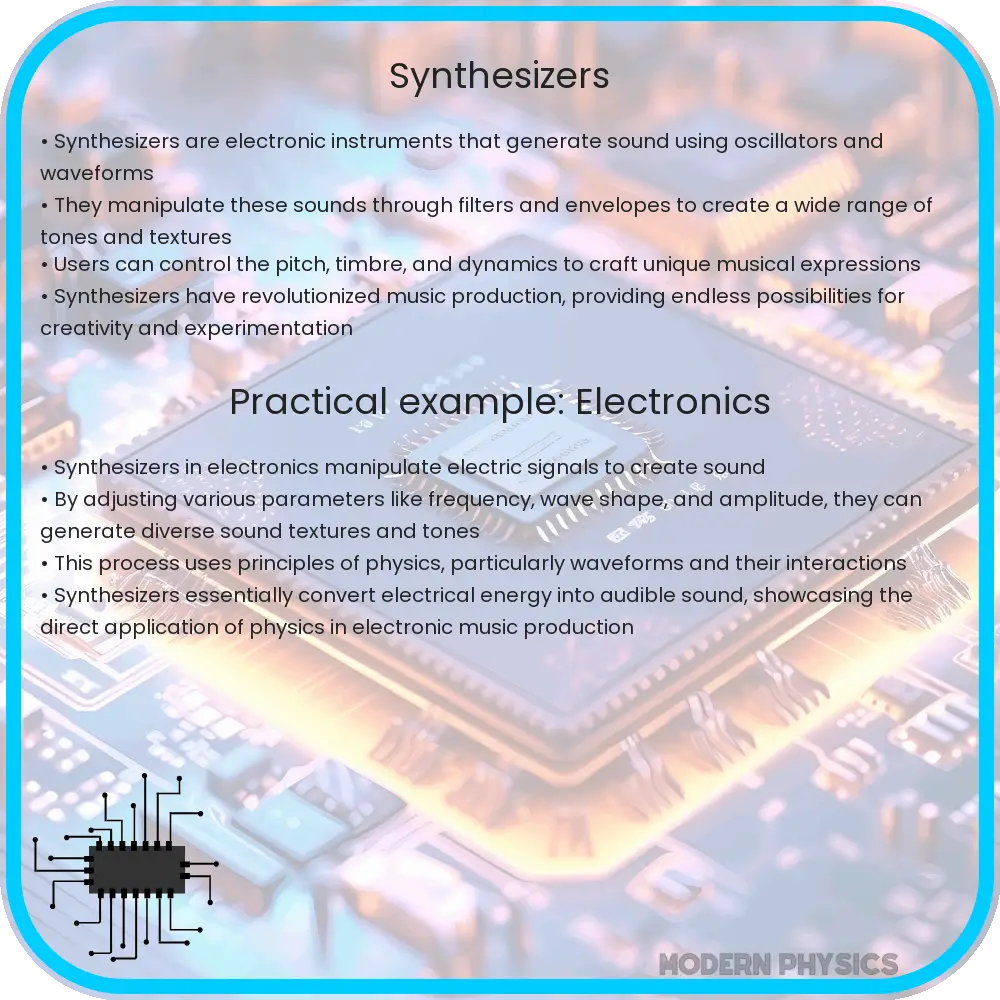
At the heart of modern music production, synthesizers are indispensable tools that sculpt both the harmonic foundation and tonal color of audio works. Synthesizers are electronic instruments that generate audio signals which can be shaped into sound by various components. The sound quality of a synthesizer is influenced by its design and the acoustics dynamics it employs.
Design Elements of Synthesizers
Synthesizers vary greatly in design, from traditional analog machines to complex digital systems. Each type employs different methods for generating and manipulating sound waves. Analog synthesizers often use oscillators for generating electronic signals, while digital models may employ mathematical algorithms to produce sound.
An oscillator in an analog synthesizer typically produces basic waveforms like sine waves, square waves, and sawtooth waves. These waveforms form the primary colors of the synth’s sound palette, which can be further modified by filters, modulators, and amplifiers.
Digital synthesizers, on the other hand, might use techniques such as wavetable synthesis, where waveform data is stored in tables, or frequency modulation (FM) synthesis, in which the frequency of a basic waveform is altered by other frequency waveforms to produce new sounds. In both cases, the synthesis technique profoundly impacts the timbre and texture of the output sound.
Acoustics Dynamics in Synthesizers
The acoustical dynamics of a synthesizer are largely dictated by how the sound waves are manipulated within the instrument. Some key components involved include:
- Filters: These adjust the brightness and richness of the sound by altering the amplitude (volume) of certain frequencies. Low-pass filters, for example, allow frequencies below a set threshold to pass through, which can soften and warm up the sound.
- Amplifiers: These increase the power of the signal, allowing the waveform to be loud enough to hear. The use of amplifiers also includes dynamics processing like compression, which can change the percussiveness and punch of the sound.
- Envelopes: Envelope generators provide control over the attack, decay, sustain, and release (ADSR) parameters of a sound, influencing how a note evolves from the moment it is played till it fades out. This aspect is crucial for imparting expressiveness and dynamics to the synthesized sound.
Combining these design elements and acoustic dynamics allows synthesizers to produce a wide array of sounds, from replicating existing musical instruments to creating entirely new sonic textures. The interplay between these factors not only defines the character of the synthesizer but also plays a pivotal role in the music creation process.
Exploring the Engineering Behind Synthesizer Sound Quality
Engineering principles are fundamental in optimizing the sound quality of synthesizers. The precision of electronic components like oscillators and filters, and the algorithms used in digital synthesis, must adhere to high standards to avoid unwanted noises and distortions. The design of a synthesizer also integrates principles from physics, particularly acoustics, to understand how sound propagates through different media and how it perceives by the human ear.
One common challenge in synthesizer design is maintaining a balance between usability and sound quality. Engineers must ensure that the synthesizer interfaces are intuitive for musicians while also delivering rich, high-fidelity audio. This often requires innovative solutions, blending electrical engineering, sound design, and user experience principles.
As we delve further, we’ll examine how newer technologies like software synthesis and digital signal processing are pushing the boundaries of what synthesizers can achieve, both in terms of functionality and sound quality.
Impact of Digital Technology on Synthesizer Development
The advancement of digital technology has significantly expanded the capabilities of synthesizers. Software synthesizers, for instance, leverage the processing power of computers to simulate the sound generation and modulation processes of hardware synthesizers, often offering greater versatility and accessibility. Digital signal processing (DSP) is at the core of these innovations, enabling intricate sound manipulation that was not feasible with strictly analog technology.
DSP algorithms can mimic the warmth of analog sounds or create entirely novel timbres. Additionally, these digital platforms facilitate extensive user customization and presets, enhancing the creative workflow by allowing composers to save and recall complex settings instantly.
Environmental and Economic Advantages
Beyond the improvements in sound and functionality, digital synthesizers offer environmental and economic benefits. They typically require less physical material to produce than large hardware units, leading to reduced manufacturing costs and material waste. As the synthesizer market continues to evolve, sustainability becomes an increasingly important factor, influencing both the design philosophy and consumer choice.
Conclusion
Synthesizers, from their humble beginnings to their present digital forms, have continually pushed the frontiers of music production. The intricate dance of engineering, physics, and sound design underlying every synthesizer allows musicians to express themselves in endlessly creative ways. By understanding the essential design elements, acoustical dynamics, and the latest technological advances, we gain deeper appreciation and insight into this sophisticated instrument. As synthesizer technology advances, it promises not only new musical possibilities but also more sustainable and cost-effective solutions for sound production in an ever-changing musical landscape.