
Acoustic harmonic generation involves the creation of harmonic frequencies when a sound wave passes through a nonlinear medium, resulting in complex sounds.
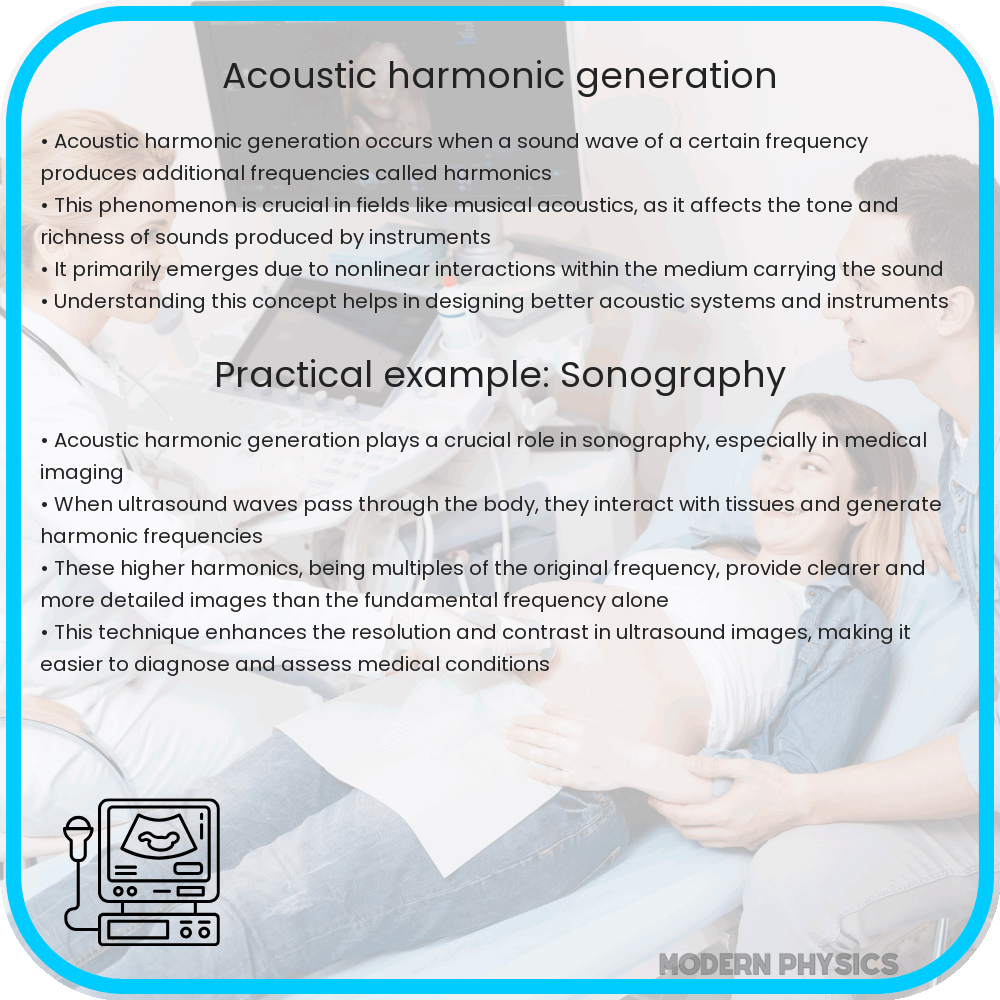
Understanding Acoustic Harmonic Generation
Acoustic harmonic generation is a fascinating phenomenon observed within the field of wave theory, particularly in acoustics. It involves the production of harmonic frequencies when a sound wave interacts with a nonlinear medium. These harmonics are integer multiples of the original frequency, leading to a richer and more complex sound. Understanding this phenomenon not only enhances our knowledge of sound propagation but also finds practical applications across different fields.
Basics of Wave Theory and Sound Propagation
Before delving into acoustic harmonic generation, it is crucial to grasp some fundamental concepts of wave theory and sound propagation. Sound waves are longitudinal waves consisting of compressions and rarefactions in the medium through which they travel. These waves are characterized by their frequency, wavelength, speed, and amplitude.
The relationship between these characteristics can be described by the basic wave equation:
v = f * λ
where v is the speed of the wave, f is the frequency, and λ (lambda) is the wavelength. In a simple scenario, when a sound wave travels through a linear medium, its speed and waveform remain constant, assuming no external influences alter its properties.
Introduction to Nonlinear Acoustics
However, when sound waves travel through a nonlinear medium, the story changes significantly. Nonlinearity in a medium can arise due to various reasons such as the medium’s molecular structure, temperature gradients, or acoustic saturation at high sound intensity levels. In such media, the response of the medium to sound waves is not directly proportional to the wave’s amplitude, leading to phenomena like acoustic harmonic generation.
This nonlinear interaction results in the original wave distorting as it travels, creating additional waves at multiple harmonic frequencies of the original frequency. Technically, if a wave of frequency f passes through a nonlinear medium, it can generate frequencies like 2f, 3f, and so on, known as the second harmonic, third harmonic, etc.
Mathematical Description and Analysis
In a more mathematical form, if a wave with an initial pressure profile P0(x, t) = P0sin(2πft), where P0 is the pressure amplitude and t is time, travels through a nonlinear medium, the resulting pressure profile can be expanded to include harmonic terms:
P(x, t) = P0sin(2πft) + αP02sin(2*2πft) + βP03sin(3*2πft) + …
In this expression, α, β, etc., are coefficients representing the strength of each harmonic, which are determined by the properties of the medium.
- The first term is the original wave (fundamental frequency).
- The second term represents the second harmonic (double the frequency).
- The third term symbolizes the third harmonic (triple the frequency), and so forth.
The subsequent discussion will explore the numerous applications and ongoing research in the area of acoustic harmonic generation, shedding light on how this principle is utilized in various technological innovations and scientific explorations.
Applications of Acoustic Harmonic Generation
Acoustic harmonic generation has myriad applications in both scientific research and practical technology. In medical imaging, for example, the generation of harmonic frequencies is utilized to enhance the clarity and resolution of ultrasound images. This is crucial for the accurate diagnosis and treatment of medical conditions.
Another significant application is found in underwater acoustics. Here, harmonics are used to improve communication over long distances and aid in underwater navigation and research by providing more detailed, less ambiguous sound signals.
Furthermore, materials science benefits from the study of harmonic frequencies to assess the structural integrity of materials. Nonlinear acoustic techniques, through the analysis of generated harmonics, can detect flaws and stress within materials without causing any damage.
Ongoing Research and Future Prospects
Research in the field of acoustic harmonic generation continues to grow as scientists and engineers uncover new applications and strive to optimize existing technologies. Recent studies focus on enhancing the efficiency of harmonic generation processes and extending its capabilities to newer areas such as non-destructive testing, energy harvesting, and environmental monitoring.
Moreover, there is ongoing investigation into customizing materials and devices that are more sensitive to specific harmonic frequencies, which could lead to breakthroughs in various sectors including acoustic metamaterials and nano-engineering.
As our understanding deepens and technology advances, the potential for innovative applications of acoustic harmonic generation seems almost limitless. With further research, we can expect even more sophisticated uses in various fields that could redefine our approach to problems and solutions in acoustic technology.
Conclusion
Acoustic harmonic generation represents a fascinating interplay of physics and engineering. Starting from the basic wave theory and sound propagation through to complex nonlinear interactions within various media, this phenomenon showcases the intricacies of acoustics. Through its various applications—from medical imaging and underwater communication to materials testing—the practical utility of harmonic generation is vast and impactful.
With continued research and technological advancements, our understanding and ability to utilize this phenomenon will only increase, promising exciting new discoveries and innovations in the future. For anyone interested in the dynamics of sound and its applications, the study of acoustic harmonic generation offers a rich and rewarding field of inquiry.