
Explore the fundamentals of surface photometry in astrophysics, including key techniques, data analysis, and its application in studying celestial bodies and galaxies.
Introduction to Surface Photometry
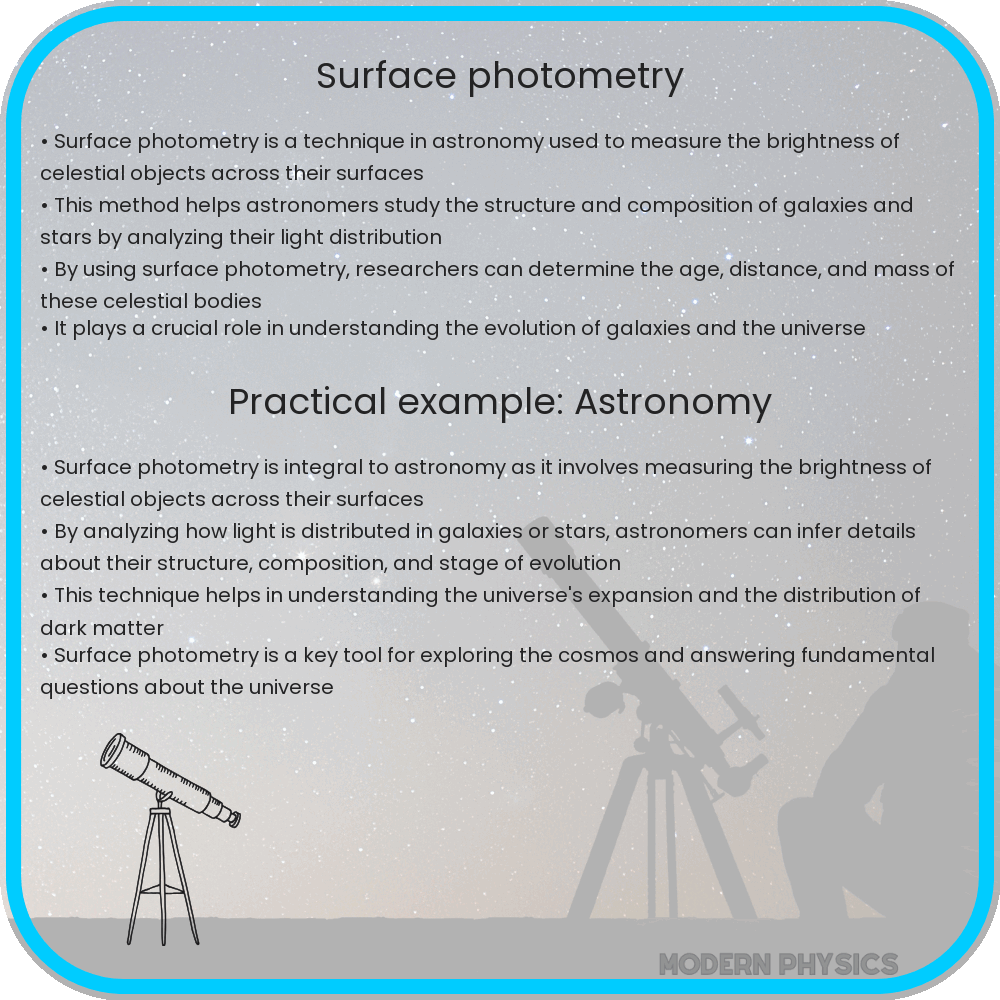
Surface photometry is a crucial technique in the field of astrophysics, enabling astronomers to study the brightness and structure of celestial bodies such as galaxies, stars, and nebulae. By measuring the flux or light emitted per unit area, scientists can deduce valuable information about the composition, distance, and evolution of these cosmic objects. This methodology involves various sophisticated techniques and data analysis procedures, which are essential for interpreting the complex information gathered from observations.
Key Techniques in Surface Photometry
The foundation of surface photometry lies in the accurate measurement of light distribution across the surface of an astronomical object. This involves several key techniques:
- Photometric Calibration: This step ensures that the measured brightness is consistent and comparable across different observations by calibrating the data against standard light sources.
- Background Subtraction: To isolate the light coming from the object of interest, astronomers must carefully remove the contribution of background light, including sky glow and instrumental effects.
- Isophotal Analysis: This technique involves mapping out contours of equal brightness, or isophotes, which helps in understanding the structure and morphology of the object.
- Profile Fitting: By fitting mathematical models to the light profile of an object, astronomers can extract parameters such as scale lengths, ellipticity, and light concentration.
Data Analysis in Surface Photometry
Data analysis in surface photometry is multifaceted, involving the processing and interpretation of the gathered photometric data. Key steps include:
- Image Processing: Raw images are processed to correct for instrumental effects and to enhance the quality of the data for analysis.
- Error Analysis: Understanding the sources of error and quantifying their impact is crucial for assessing the reliability of the photometric measurements.
- Light Profile Extraction: This involves determining the brightness distribution across the object, which is essential for studying its structure and properties.
Uses of Surface Photometry in Astrophysics
Surface photometry has a wide range of applications in the field of astrophysics, helping to unravel the mysteries of the universe:
- Galaxy Morphology: By studying the light distribution of galaxies, astronomers can classify them into different types (e.g., spiral, elliptical, irregular) and understand their evolutionary processes.
- Stellar Populations: Analysis of light profiles helps in identifying different populations of stars within galaxies, shedding light on their formation and aging processes.
- Dark Matter Distribution: The gravitational effects of dark matter on the luminous components of galaxies can be inferred from surface photometry, contributing to our understanding of this mysterious substance.
- Distance Measurement: Surface brightness profiles can be used to estimate distances to celestial objects, a fundamental parameter in cosmology.
Conclusion
Surface photometry is a fundamental tool in astrophysics, providing essential data for understanding the structure and evolution of celestial bodies. Through meticulous data analysis and the application of various techniques, astronomers can decipher the luminous messages sent across vast cosmic distances. This field continues to evolve with technological advancements, promising even deeper insights into the fabric of the universe. As we refine our methods and instruments, surface photometry will remain a cornerstone in the quest to unravel the complexities of the cosmos.