
Explore the fascinating world of supernova cosmology, uncovering the secrets of the universe’s expansion, dark energy, and the critical role of Type Ia supernovae.
Supernova Cosmology: Unraveling the Universe’s Expansion and Dark Energy
The study of supernovae has dramatically transformed our understanding of the Universe’s history, structure, and ultimate fate. Supernova cosmology involves the examination of exploding stars, known as supernovae, to probe the vast cosmos and uncover the nature of its accelerating expansion. This field intertwines the cataclysmic end of stars with the cosmic scale phenomena, including the mysterious dark energy that pervades the universe.
Origins of Supernova Cosmology
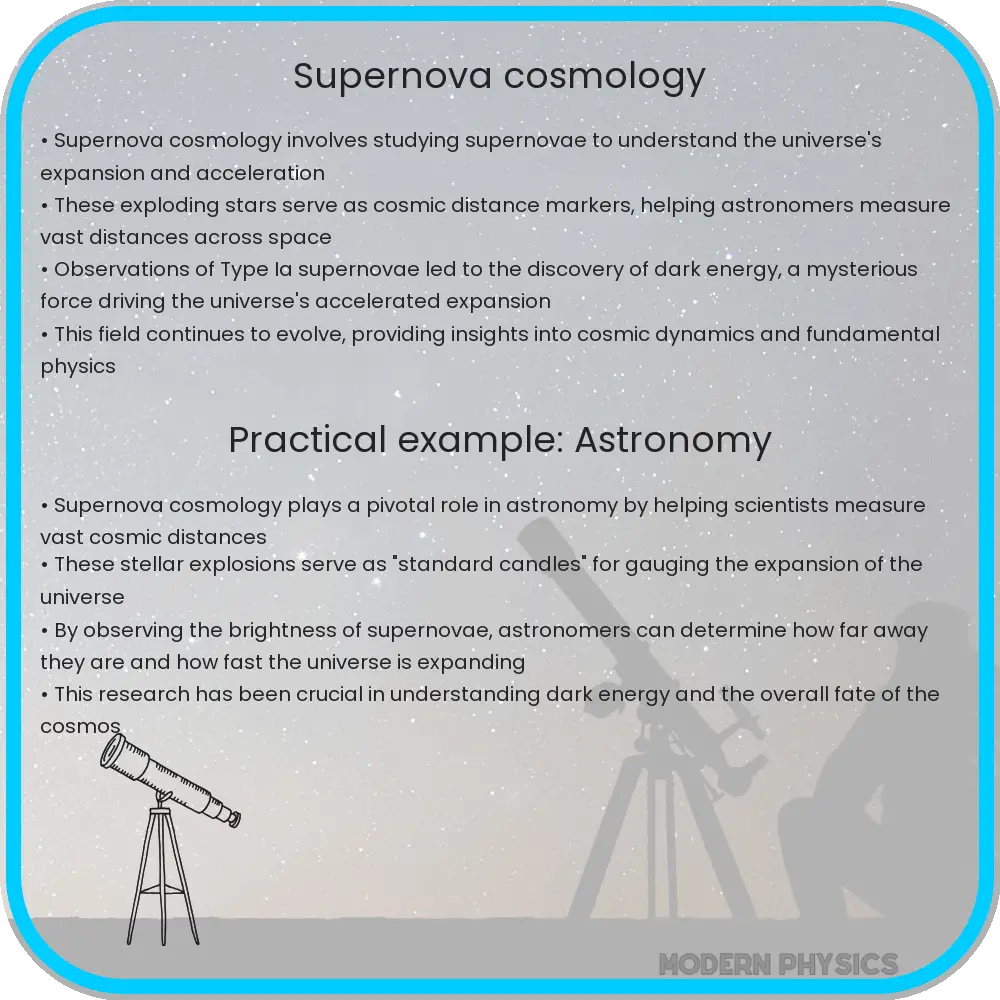
Supernova cosmology originated from observations of Type Ia supernovae. These stellar explosions serve as ‘standard candles’ due to their consistent intrinsic brightness. By measuring their apparent brightness from Earth, astronomers can calculate their distances using the inverse-square law of light. The consistent nature of Type Ia supernovae arises from a uniform scenario: a white dwarf star accreting matter from a companion until it reaches a critical mass and undergoes a thermonuclear explosion. This process releases a tremendous amount of energy, briefly outshining entire galaxies and providing a beacon for cosmological studies.
Supernovae and the Expansion of the Universe
The real breakthrough came in the late 1990s when two independent research teams used distant Type Ia supernovae to discover that the universe is expanding at an accelerating rate. This unexpected observation suggested that some unknown force, later termed “dark energy,” is driving the acceleration. The finding was contrary to the then-prevailing theory that the universe’s expansion, caused by the Big Bang, should be slowing down due to gravitational attraction. This discovery has profound implications for cosmology, leading to the development of the standard model of cosmology, which incorporates dark energy as a fundamental component.
Understanding Dark Energy
While supernovae have illuminated the existence of dark energy, the nature of this force remains one of the greatest mysteries in physics. Dark energy is thought to constitute about 68% of the universe’s total energy content, yet its properties are still largely unknown. Its discovery has prompted a wealth of theoretical and observational studies aimed at understanding its characteristics and impact on the universe’s fate.
Measuring Cosmic Distances and Expansion
The use of supernovae for measuring cosmic distances involves a relationship known as the “redshift-distance relationship. As the universe expands, light from distant galaxies is stretched, or “redshifted,” towards longer, redder wavelengths. By measuring the redshift of a supernova’s light, astronomers can determine how fast the galaxy hosting the supernova is moving away from us. Combined with the distance measured using the supernova’s brightness, this provides a direct measurement of the universe’s expansion rate, known as the Hubble Constant. Ongoing observations continue to refine these measurements, offering deeper insights into the rate of expansion and the influence of dark energy.
Future Prospects in Supernova Cosmology
The future of supernova cosmology is vibrant, with new technologies and telescopes enabling more precise observations. Projects like the Vera C. Rubin Observatory and the James Webb Space Telescope are set to revolutionize our understanding by observing thousands of supernovae across the universe. These future missions will improve our understanding of dark energy and the cosmic expansion rate, potentially leading to new physics beyond the current standard model of cosmology.
Conclusion
Supernova cosmology has fundamentally altered our understanding of the universe. By studying the explosive deaths of stars, astronomers have uncovered the accelerating expansion of the cosmos and the enigmatic dark energy driving it. Despite the monumental discoveries made, dark energy remains one of the most profound mysteries in physics. As observational techniques improve and new telescopes come online, the field of supernova cosmology promises to further our understanding of the universe’s history, structure, and fate. The journey to unravel the mysteries of dark energy and the universe’s expansion is far from over, but the path forward is illuminated by the light of supernovae, guiding us towards deeper cosmic truths.