
Explore the mysteries of dark energy, its impact on the universe’s expansion, and the latest advances in astrophysics shaping our understanding of cosmic phenomena.
Unveiling the Mystery: Dark Energy in Astrophysics
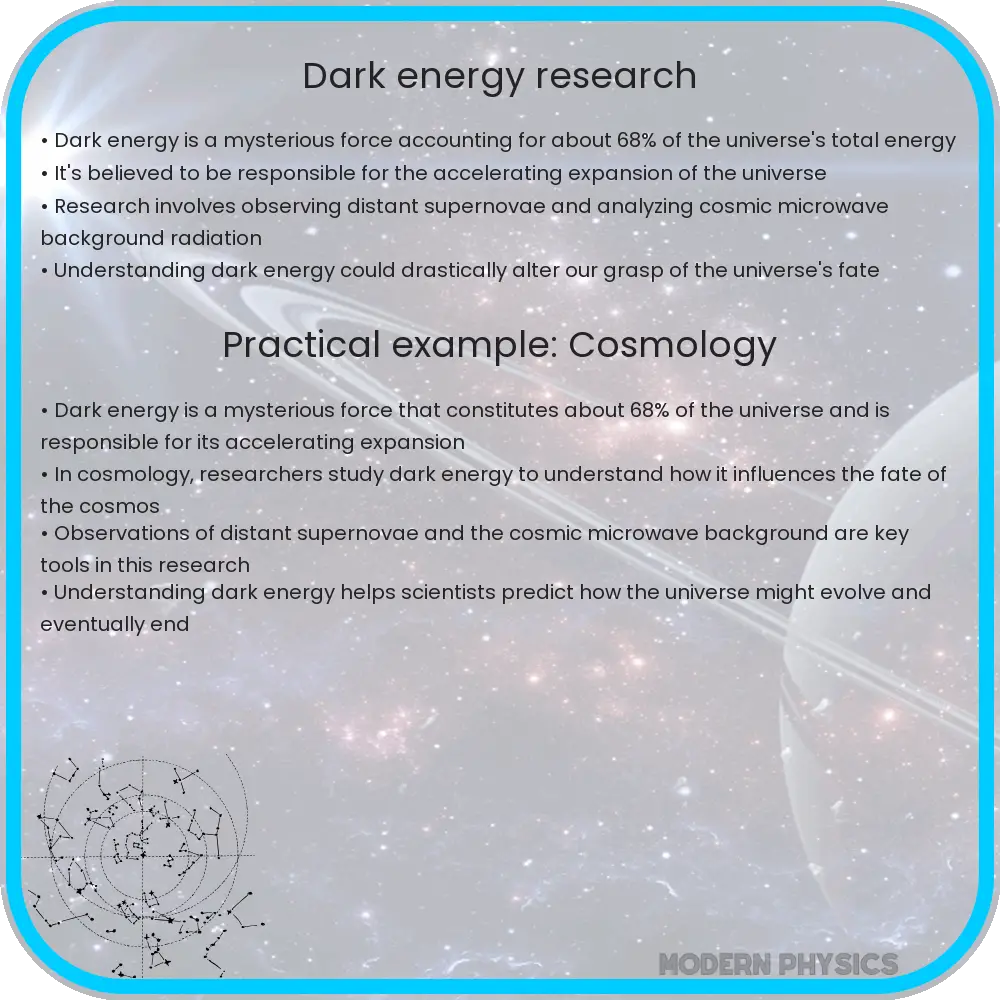
The enigmatic force known as dark energy has captivated scientists and astronomers for decades. Constituting approximately 68% of the universe, dark energy remains one of the most profound mysteries in the field of astrophysics. Unlike dark matter, which exerts gravitational pull, dark energy appears to have the opposite effect—accelerating the expansion of the universe. This discovery has revolutionized our understanding of the cosmos and its evolving nature.
Historical Background and Discovery
Dark energy’s existence was first hinted at through observations of distant supernovae in the late 1990s. These observations revealed that the universe was not just expanding, but doing so at an accelerating rate. This acceleration was unexpected; according to the then-prevailing cosmological models, the universe’s expansion should have been slowing down due to gravity. The concept of dark energy was introduced to account for this accelerating expansion, leading to a major shift in the cosmological paradigm.
Theoretical Frameworks and Models
Several theories have been proposed to explain the nature of dark energy. The most prevalent is the Cosmological Constant (Λ), introduced by Albert Einstein as part of his General Theory of Relativity. Einstein originally introduced Λ to achieve a static universe, but it has been repurposed to explain the accelerating expansion. Other theories include quintessence, a dynamic, evolving form of energy with varying density across space and time, and modifications to General Relativity itself.
Advances in Observational Astrophysics
Advancements in technology and observational methods have allowed scientists to study dark energy more closely. Projects like the Dark Energy Survey (DES) and the upcoming Euclid mission by the European Space Agency (ESA) aim to map the cosmos in unprecedented detail, providing insights into the distribution and influence of dark energy across the universe. These surveys use techniques such as baryon acoustic oscillations and weak gravitational lensing to study the large-scale structure of the universe and its expansion history.
Exploring the Enigma of Dark Energy
The concept of dark energy remains one of the most profound mysteries in astrophysics and cosmology, challenging our understanding of the universe’s very fabric. Despite its invisible nature, dark energy is believed to account for approximately 68% of the universe’s total energy content, propelling the accelerated expansion of the cosmos. This expansion was first observed in the late 1990s through measurements of distant supernovae, leading to the groundbreaking discovery that the universe’s growth is not slowing down, as previously thought, but is instead speeding up.
Since its discovery, dark energy has been a focal point of astronomical research, with scientists employing various methods to probe its characteristics and origins. Theories abound, yet the true nature of dark energy remains elusive. One leading hypothesis posits that dark energy is a property of space itself, described by Albert Einstein’s cosmological constant, Λ, in his field equations of General Relativity. This “constant energy density filling space” suggests that empty space can possess its own energy.
Another theory suggests that dark energy is dynamic, changing over time, and could be associated with a new kind of field, similar to electromagnetic fields, known as quintessence. Quintessence differs from the cosmological constant in that its energy density can vary in time and space. Despite these theoretical advances, no direct evidence has yet confirmed the exact nature of dark energy.
Advancements in technology and methodology have opened new avenues for dark energy research. Projects like the Dark Energy Survey (DES) and upcoming missions such as the Euclid space telescope and the Vera C. Rubin Observatory are designed to map the cosmos in unprecedented detail. These initiatives aim to measure the effects of dark energy on the structure of the universe, providing insights into its influence on galaxy formation, the distribution of cosmic structures, and the universe’s ultimate fate.
Conclusion and Future Perspectives
The enigma of dark energy represents one of the most significant challenges in modern astrophysics, holding the key to understanding the ultimate fate of the universe. As observational techniques become more sophisticated and theoretical models more refined, the next few decades promise exciting advancements in our comprehension of the cosmos. By piecing together the puzzle of dark energy, scientists move closer to unraveling the fundamental nature of the universe, bridging the gap between known physics and the uncharted territories of cosmic phenomena. The journey to demystify dark energy not only deepens our understanding of the cosmos but also challenges our place within it, underscoring the beauty and complexity of the universe we inhabit.