
Supercritical mass is the minimum amount of fissile material needed to maintain an increasing nuclear chain reaction, crucial in nuclear reactors and weapons.
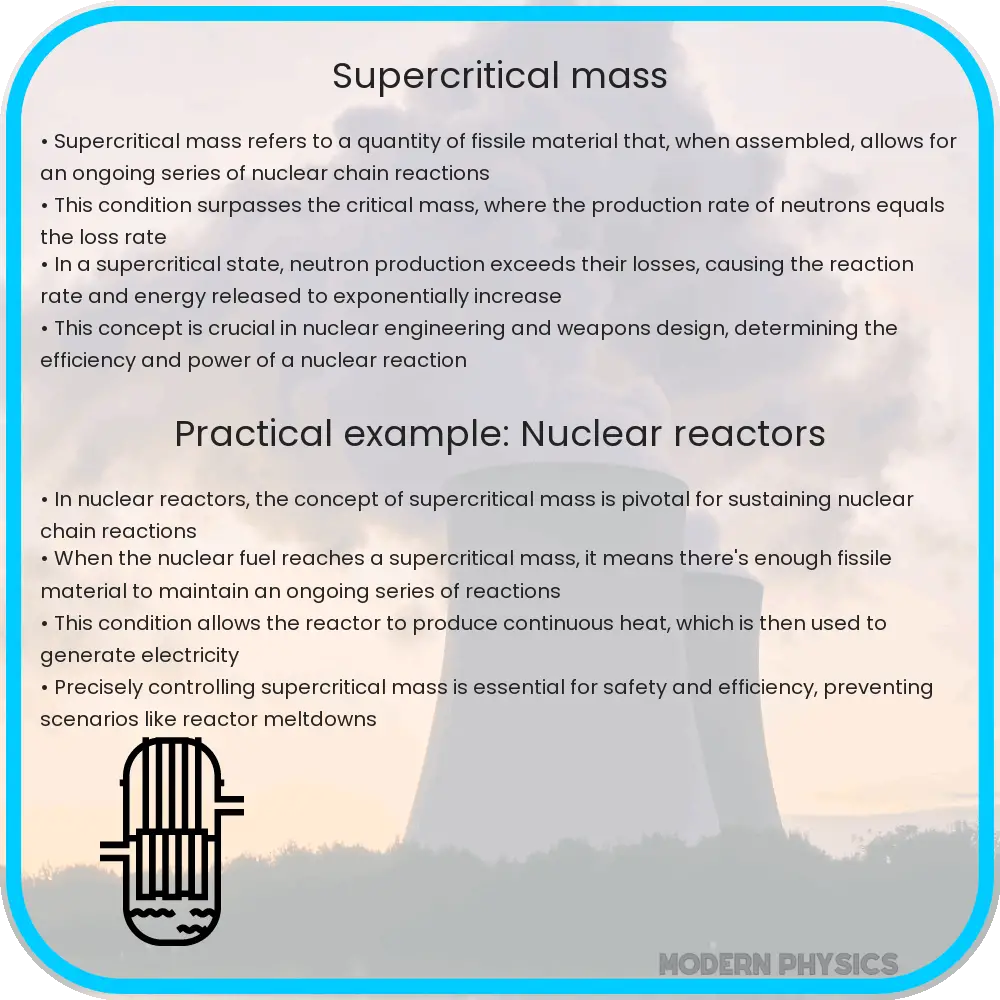
What is Supercritical Mass?
In the realm of nuclear physics, supercritical mass is a term that describes the minimum amount of fissile material needed to maintain a nuclear chain reaction under specific conditions. The concept is central to understanding how nuclear reactions are controlled, whether for energy production in nuclear reactors or the devastating explosive yield of nuclear weapons. But what exactly does it entail and why is it important?
A fissile material, such as uranium-235 or plutonium-239, undergoes fission when a neutron strikes its nucleus, splitting it into two or more smaller nuclei along with releasing more neutrons and a significant amount of energy. These newly released neutrons can then initiate further fission events, potentially leading to a chain reaction. The capacity of fissile material to sustain this chain reaction depends on its mass and the arrangement which influences the likelihood of neutrons striking other fissile nuclei.
Understanding Criticality
The notion of criticality is crucial to comprehending supercritical mass. Criticality can be understood in three states:
- Subcritical: A mass of fissile material is subcritical if it is not sufficient to sustain a chain reaction. In this state, neutrons produced by fission are likely to escape or not result in subsequent fissions, gradually causing the reaction to peter out.
- Critical: A critical mass is the exact amount of fissile material needed to sustain a chain reaction at a steady rate. In this state, each fission event causes an average of one more, maintaining a stable level of energy output.
- Supercritical: When the mass of fissile material exceeds the critical mass, it becomes supercritical. This situation enables a growing number of fission events, leading to an increasing reaction rate and escalating energy release.
The measure of criticality can be quantified using a factor known as k-effective (keff), where:
- If keff < 1, the system is subcritical.
- If keff = 1, the system is critical.
- If keff > 1, the system is supercritical.
Implications of Supercritical Mass in Nuclear Reactors
In nuclear reactors, controlling the transition between these states of criticality is essential for safe and effective operation. Reactors are designed to operate slightly above critical (supercritical) to start up and increase power output, but control mechanisms, such as neutron-absorbing control rods, are used to adjust the keff and maintain a stable, controlled environment.
When a reactor is made supercritical, the nuclear chain reaction accelerates, and the rate of energy production increases. This process must be closely monitored and controlled to prevent overheating and potential meltdowns, like the infamous incidents at Chernobyl or Fukushima. Modern reactors are equipped with numerous safety systems designed to automatically shutdown reactions if unsafe conditions are detected.
Implications of Supercritical Mass in Nuclear Weapons
In the context of nuclear weapons, achieving a supercritical mass is crucial for creating a large explosion. Unlike nuclear reactors, which aim for controlled reactions, a weapon is designed to reach supercriticality almost instantaneously. This is typically achieved by using conventional explosives to forcefully bring together subcritical masses of fissile material into a supercritical configuration.
This rapid transition to supercriticality in a weapon unleashes an immense amount of energy in a very short time, resulting in an explosion. The exact mechanics and designs of these weapons are highly classified, but the underlying science is based on the principles of supercritical mass and the control (or lack thereof) of nuclear chain reactions.
Safe Handling and Ethical Considerations
The management of supercritical mass carries not only technical but also significant ethical and safety implications. The risk associated with handling materials capable of achieving supercritical mass demands stringent safety protocols in nuclear facilities. From mining and refining fissile materials to their transportation, storage, and eventual disposal, each step must be carried out with the highest security standards to prevent accidental or intentional misuse.
Moreover, the ethical considerations surrounding nuclear technology are profound. The debate between the benefits of nuclear energy—as a potent, low-carbon energy source—and the potential for catastrophic events or weaponization continues to shape global nuclear policies. Ensuring the peaceful use of nuclear technology challenges engineers, scientists, and policymakers alike to innovate safer reactor designs and non-proliferation measures.
Conclusion
Understanding supercritical mass is fundamental to both the operation of nuclear reactors and the design of nuclear weapons. The transition from subcritical to critical, and ultimately to supercritical states, is a nuanced process that must be carefully controlled to harness the benefits of nuclear energy while mitigating its risks. As we advance, the continued development of safer nuclear technologies and robust ethical guidelines remains essential. By appreciating the intricacies of supercritical mass, we can better comprehend the vast potential and significant responsibilities inherent in nuclear technology.