
Explore the advantages and future of superconducting switches, offering high efficiency, speed, and reliability for next-gen electrical engineering.
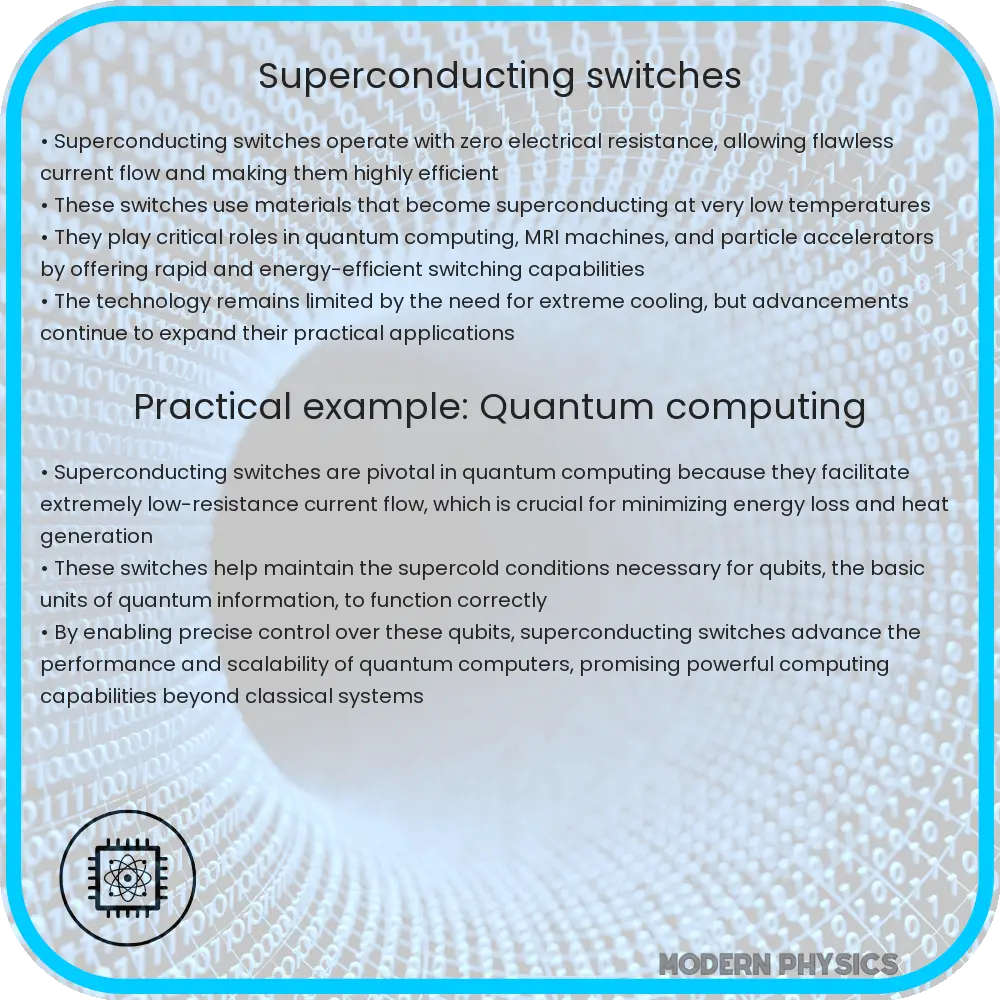
Introduction to Superconducting Switches
Superconducting switches represent a groundbreaking advancement in electrical engineering, offering unparalleled efficiency, speed, and reliability. These devices leverage the unique properties of superconductors — materials that can conduct electricity without resistance when cooled below a critical temperature. This characteristic allows for nearly lossless energy transmission, significantly reducing the power consumption compared to traditional semiconductor-based switches.
Principles of Superconductivity
At the heart of superconducting switches is the phenomenon of superconductivity. This occurs when materials such as niobium, lead, or yttrium barium copper oxide (YBa2Cu3O7) are cooled below their critical temperatures, typically close to absolute zero (-273.15°C). At these temperatures, the electrical resistance drops to zero, and the material expels its internal magnetic field, a property known as the Meissner effect. This enables the creation of superconducting circuits that can carry electric current indefinitely without energy loss.
Advantages of Superconducting Switches
- High Efficiency: By eliminating electrical resistance, superconducting switches significantly reduce energy losses. This makes them incredibly efficient, particularly in applications requiring large amounts of power, such as grid distribution systems or magnetic resonance imaging (MRI) machines.
- High-Speed Operations: Superconductors can switch states in a fraction of a microsecond, far surpassing the speed of conventional switches. This rapid switching capability is crucial for high-speed computing and signal processing applications.
- Enhanced Reliability: Without the wear and tear associated with resistance and heat generation, superconducting switches are more reliable and have longer lifespans than their traditional counterparts.
The integration of superconducting switches into modern technology promises a revolution in how we manage and utilize electrical power. Whether in computing, medical imaging, or energy distribution, the potential applications of these switches are vast and varied, pushing the boundaries of what is possible in electrical and electronic engineering.
Challenges and Solutions in Superconducting Switch Technology
Despite their advantages, superconducting switches face several challenges. The most significant is the requirement for extreme cooling, as superconductivity occurs at temperatures near absolute zero. This necessitates sophisticated and costly cryogenic systems, which can be a barrier to widespread adoption. Additionally, the durability of superconductors in varying operational environments and their integration into existing electrical systems pose practical challenges.
However, ongoing research aims to overcome these hurdles. Advances in materials science have led to the discovery of high-temperature superconductors, which operate at higher, more practical temperatures, although still significantly below room temperature. Innovations in cooling technology and materials engineering are also making superconducting systems more feasible and cost-effective.
Future Prospects and Applications
The potential applications for superconducting switches extend far beyond current uses. In the future, they could revolutionize fields such as quantum computing, where superconducting circuits are integral to the development of quantum bits, or qubits. Additionally, superconducting switches could enhance the capabilities of renewable energy systems by enabling more efficient transmission of electricity over long distances, thus reducing energy losses and improving grid stability.
Moreover, the aerospace and defense industries may benefit from the high efficiency and reliability of superconducting switches, as they can significantly improve the performance of radar, communication systems, and even propulsion technologies.
Conclusion
Superconducting switches stand at the forefront of electrical engineering innovation, offering a glimpse into a future where electricity can be used more efficiently, reliably, and speedily. While challenges such as cooling requirements and material durability remain, the relentless pace of research and technological advancements continues to address these issues, bringing the widespread application of superconducting switches ever closer to reality. As these technologies mature, they promise to transform a range of industries, from healthcare to computing, and to play a crucial role in the transition to more sustainable energy systems. The journey of superconducting switches from laboratory curiosities to pivotal components in modern technology exemplifies the transformative power of engineering and science.