
Explore the efficiency, scalability, and diverse applications of granular superconductors, uncovering their potential in technology and industry.
Introduction to Granular Superconductors
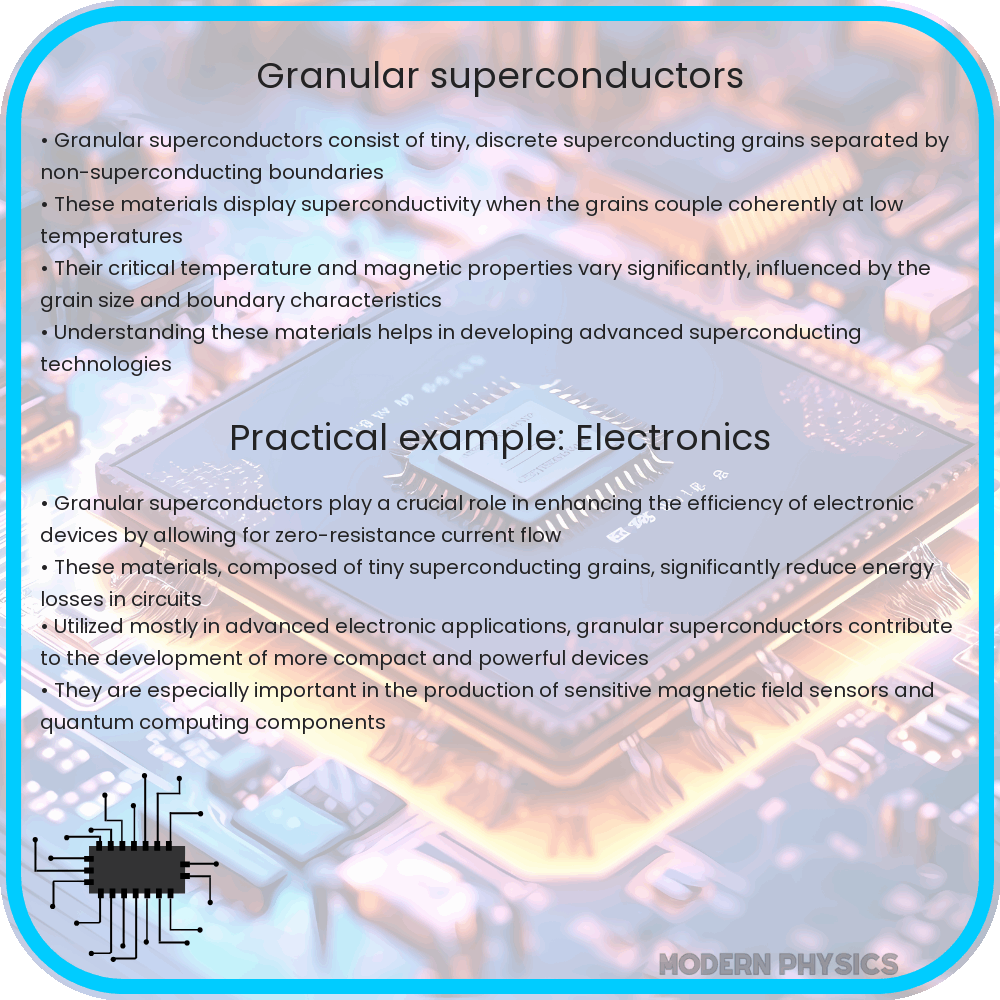
Granular superconductors represent a fascinating area of research within the field of materials science, offering a unique blend of quantum mechanics and macroscopic phenomena. Unlike their monolithic counterparts, granular superconductors are composed of small, discrete superconducting grains embedded within a non-superconducting matrix. This structure significantly influences their electrical and thermal properties, making them a subject of intense study and interest.
Efficiency of Granular Superconductors
The efficiency of granular superconductors is primarily gauged by their ability to conduct electricity without resistance at temperatures below their critical temperature (Tc). The granular structure plays a crucial role in their efficiency. The Josephson Junctions between the grains can carry supercurrents via tunneling, which allows for the preservation of superconductivity across the composite material. However, the granularity can introduce weak links, leading to a lower critical current density compared to bulk superconductors. Advances in fabrication techniques are continuously improving the connectivity between grains, enhancing the overall efficiency of these materials.
Scalability of Granular Superconductors
Scalability is a vital factor for the practical application of superconducting materials. Granular superconductors are particularly appealing in this regard due to their ease of fabrication and potential for integration into various devices and systems. Their scalability is largely dependent on the synthesis methods, such as chemical vapor deposition (CVD) or powder metallurgy, which allow for the production of large-scale superconducting films or wires. Despite challenges such as maintaining uniformity and superconducting properties over large areas, recent developments have shown promising results.
Use Cases of Granular Superconductors
- Medical Imaging Devices: Granular superconductors are used in MRI machines due to their high magnetic field sensitivity and low noise levels.
- Energy Storage: Superconducting Magnetic Energy Storage (SMES) systems utilize granular superconductors for efficient energy storage and instant energy release.
- Quantum Computing: The unique properties of granular superconductors are exploited in quantum computing for creating qubits and other components.
Challenges and Future Directions
Despite their potential, granular superconductors face several challenges that need to be addressed to fully harness their capabilities. One of the main issues is the inhomogeneity within the granular structure, which can lead to variations in superconducting properties and affect overall performance. Additionally, understanding the dynamics of the superconducting grains and their interactions remains a complex problem, requiring sophisticated theoretical models and experimental techniques.
Future research is expected to focus on optimizing the synthesis and processing methods to improve the uniformity and connectivity of the superconducting grains. There is also a growing interest in exploring new materials and compositions that can operate at higher temperatures and in more extreme environments. This could expand the applicability of granular superconductors to a broader range of technologies and industries.
Conclusion
Granular superconductors represent a key area of advancement in the field of superconductivity, offering unique properties and potential for a wide range of applications. Their efficiency, scalability, and versatility in various use cases, from medical imaging to energy storage and quantum computing, underscore their significance. However, to realize their full potential, continued research and development are necessary to overcome the existing challenges and enhance their performance. As the understanding of these complex materials grows, so too will their impact on technology and society, paving the way for innovative solutions to some of the most pressing challenges in energy, healthcare, and computing.