
Explore the fascinating world of Superconductor-Insulator Transitions (SITs): their theory, applications, recent advances, and future implications.
The Intriguing World of Superconductor-Insulator Transitions
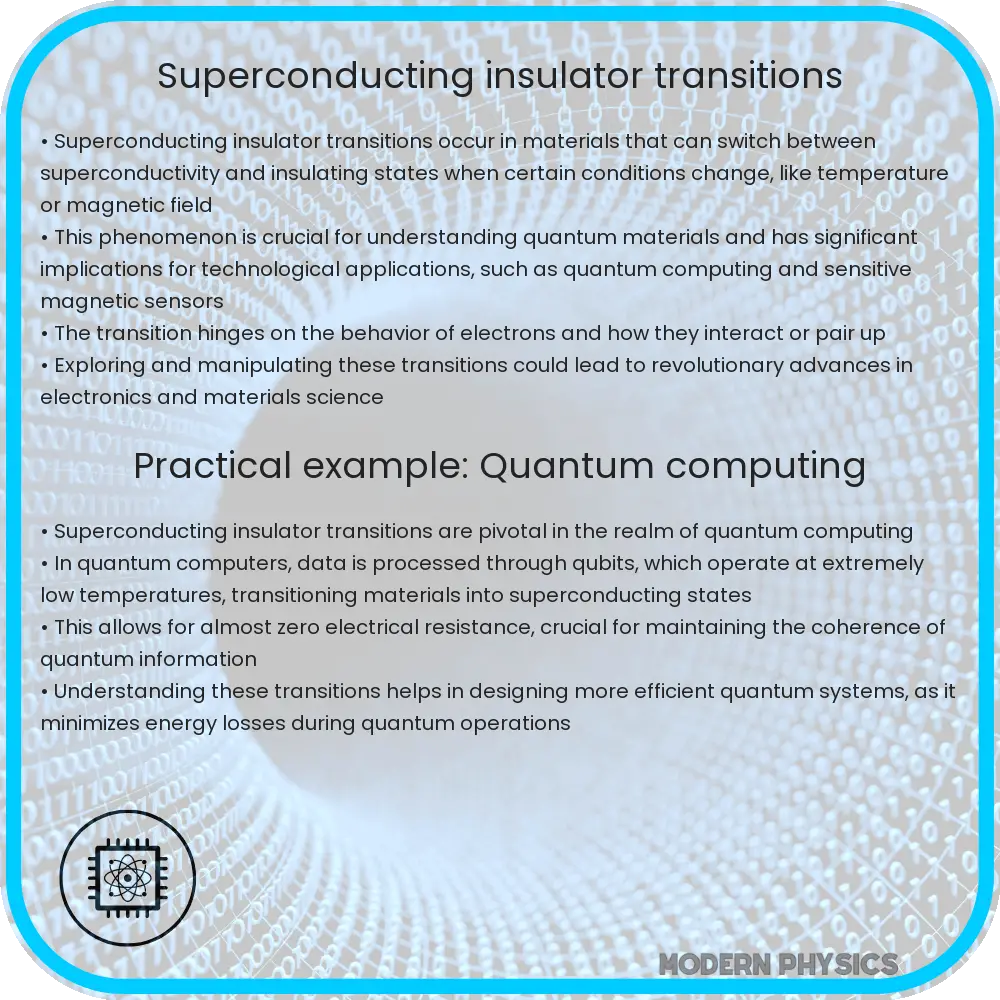
Superconductor-Insulator Transitions (SITs) represent a fascinating phase transition in condensed matter physics, where a material can switch between superconducting and insulating states. This phenomenon is crucial for understanding the dual nature of quantum materials and for developing advanced technological applications.
Theoretical Underpinnings
The theory behind SITs revolves around the competition between electron localization and electron pairing. In superconductors, electrons form Cooper pairs due to attractive interactions, enabling them to move without resistance. Conversely, in insulators, electrons are localized, preventing current flow. The transition between these states is influenced by factors such as disorder, magnetic field, and electron density, making SITs an area ripe for exploration.
Key Uses and Applications
- Quantum Computing: SIT materials can be used to create qubits, the fundamental building blocks of quantum computers. Their ability to switch between two distinct quantum states is essential for quantum information processing.
- Superconducting Electronics: Utilizing SITs in electronic devices can lead to ultrafast, energy-efficient electronics, revolutionizing fields from computing to telecommunications.
- Sensors and Detectors: The extreme sensitivity of the superconducting-insulating transition to external factors makes SIT materials ideal for sensitive magnetic field detectors and bolometers.
Recent Advances
Recent research has focused on unraveling the microscopic mechanisms behind SITs and exploring new material systems. Advances in nanotechnology and materials science have enabled the precise manipulation of the conditions leading to SITs, opening up new avenues for both fundamental research and practical applications. Notably, the discovery of SITs in two-dimensional materials like graphene has sparked significant interest due to their potential scalability and integration into existing technologies.
Challenges and Future Directions
The exploration of Superconductor-Insulator Transitions (SITs) is not without its challenges. One of the primary obstacles is the need for extreme conditions, such as very low temperatures and high magnetic fields, to observe and manipulate these transitions. Additionally, the inherent disorder and variability in material properties can complicate the understanding and reproducibility of SITs. Despite these challenges, ongoing research aims to find ways to control and exploit these transitions under more practical and accessible conditions.
Innovative Materials and Techniques
One promising avenue of research is the synthesis of new materials and structures, such as heterostructures and nanocomposites, which may exhibit SITs under less extreme conditions. Moreover, advancements in imaging and spectroscopy techniques are providing deeper insights into the quantum behaviors underpinning SITs, allowing for more targeted and effective manipulation of these transitions.
Implications for Technology and Science
The potential applications of SITs extend beyond the current uses in quantum computing and superconducting electronics. As our understanding improves, we could see the development of new superconducting materials that operate at higher temperatures, leading to widespread technological impacts. Moreover, studying SITs contributes to the broader understanding of quantum phase transitions and the interplay between different quantum states, offering profound insights into the fabric of our universe.
Conclusion
The study of Superconductor-Insulator Transitions represents a pivotal frontier in condensed matter physics and materials science. While challenges remain, the potential technological and scientific rewards are immense. As researchers continue to unravel the complexities of SITs, we can anticipate significant advancements in quantum technologies and a deeper understanding of quantum materials. The journey into the realm of SITs is not just about uncovering new phases of matter but also about harnessing these phenomena for the next generation of technological innovations.