
Explore the superconductor-insulator transition: key mechanisms, theories, experimental insights, and future applications in technology and quantum computing.
Understanding the Superconductor-Insulator Transition
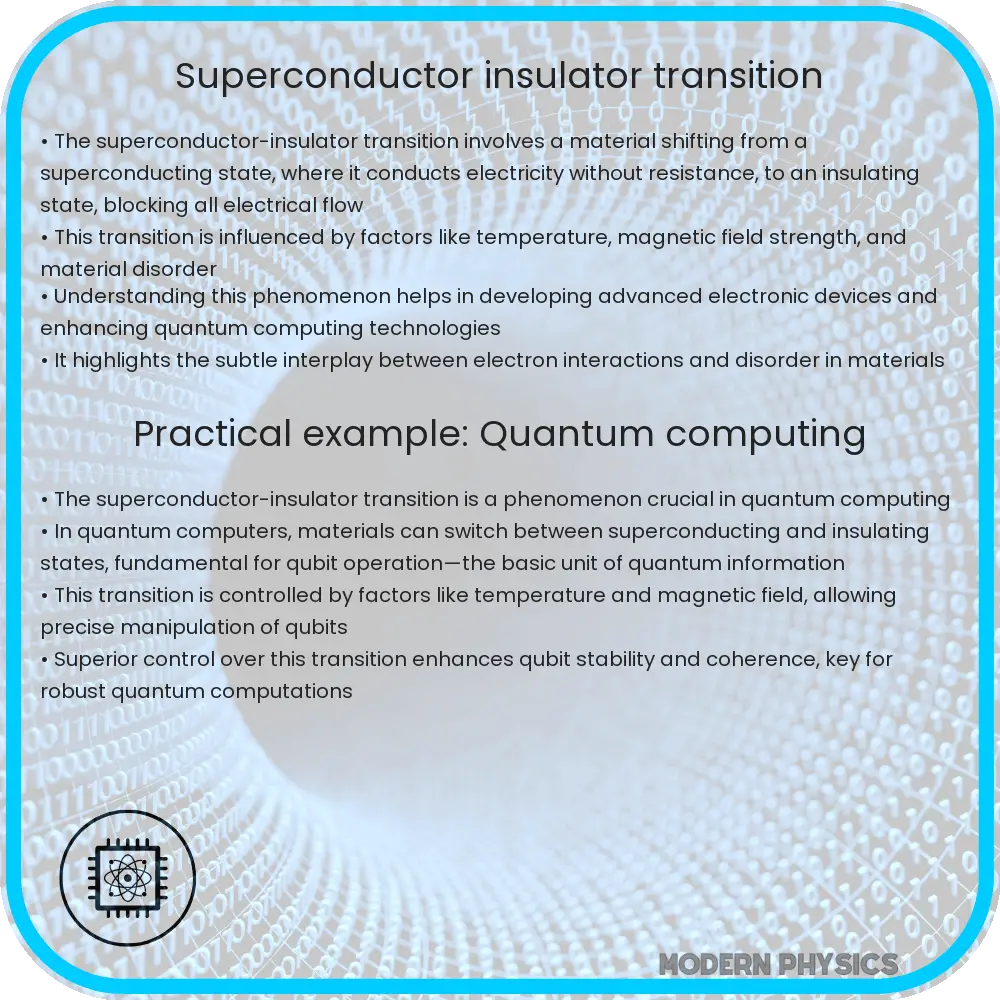
The superconductor-insulator transition (SIT) is a quantum phase transition that occurs in certain materials as they change from a superconducting state, where they conduct electricity without resistance, to an insulating state, where they cannot conduct electricity at all. This transition is driven by changes in external parameters such as magnetic field, carrier density, or disorder. Understanding the mechanisms and theory behind this transition is crucial for the development of new materials and technologies.
Key Mechanisms Behind the Transition
Several key mechanisms contribute to the superconductor-insulator transition:
- Disorder and Localization: Increasing disorder in a material can lead to the localization of Cooper pairs (pairs of electrons bound together at low temperatures), hindering their movement and leading to insulating behavior.
- Electron-Electron Interactions: Strong interactions between electrons can suppress superconductivity, leading to insulating behavior. These interactions can be tuned by changing the thickness of the superconducting film or by applying an external magnetic field.
- Magnetic Field Effects: Applying an external magnetic field can destroy the superconducting state by breaking apart Cooper pairs or by aligning electron spins in a way that opposes superconductivity.
Theoretical Framework
The theory of the superconductor-insulator transition involves several competing models that attempt to explain the observed phenomena:
- Bose-Hubbard Model: This model considers the transition as a competition between kinetic energy, favoring superconductivity, and potential energy, favoring insulation. The balance between these energies determines the state of the material.
- Dirty Boson Model: In this approach, disorder plays a central role. The model explores how localized Cooper pairs interact and form an insulating glass state, contrasting with the delocalized state necessary for superconductivity.
- Quantum Phase Fluctuations: This theory suggests that quantum fluctuations of the superconducting phase can lead to the destruction of superconductivity and the emergence of insulating behavior.
These models highlight the complex interplay between disorder, interactions, and quantum fluctuations in driving the superconductor-insulator transition.
Experimental Observations and Applications
Experimental studies of the superconductor-insulator transition have provided valuable insights into this complex phenomenon. Techniques such as resistance measurements, magnetic susceptibility, and tunneling spectroscopy have been employed to study the transition in various materials. Observations often reveal a critical point where the system switches from superconducting to insulating behavior, influenced by external parameters such as magnetic field intensity and material thickness.
Furthermore, the SIT is not only a subject of theoretical interest but also of practical significance. Materials that can be tuned between superconducting and insulating states have potential applications in quantum computing, where they can be used to create qubits, the basic units of quantum information. Additionally, understanding the SIT can help in the development of novel superconducting materials and devices with improved performance and energy efficiency.
Challenges and Future Directions
Despite significant progress, challenges remain in fully understanding and controlling the superconductor-insulator transition. One major challenge is the development of materials with tunable properties that allow for precise control over the transition. Additionally, the interplay between disorder, electron correlations, and quantum fluctuations is complex and requires further theoretical and experimental investigation.
Future research will likely focus on discovering new materials and tuning parameters that can provide more insight into the SIT. Moreover, advancements in nanotechnology and materials science may enable the development of novel superconducting devices with applications in electronics, sensing, and quantum information technology.
Conclusion
The superconductor-insulator transition represents a fascinating interplay of quantum mechanics, materials science, and technology. By exploring the mechanisms behind the SIT, scientists and engineers can unlock new possibilities in material design and quantum devices. Although challenges remain, the continued study of this quantum phase transition promises to advance our understanding of the microscopic world and pave the way for future technological innovations.