
Explore the breakthroughs and applications of superconducting graphene, a material set to revolutionize technology with its enhanced efficiency and potential.
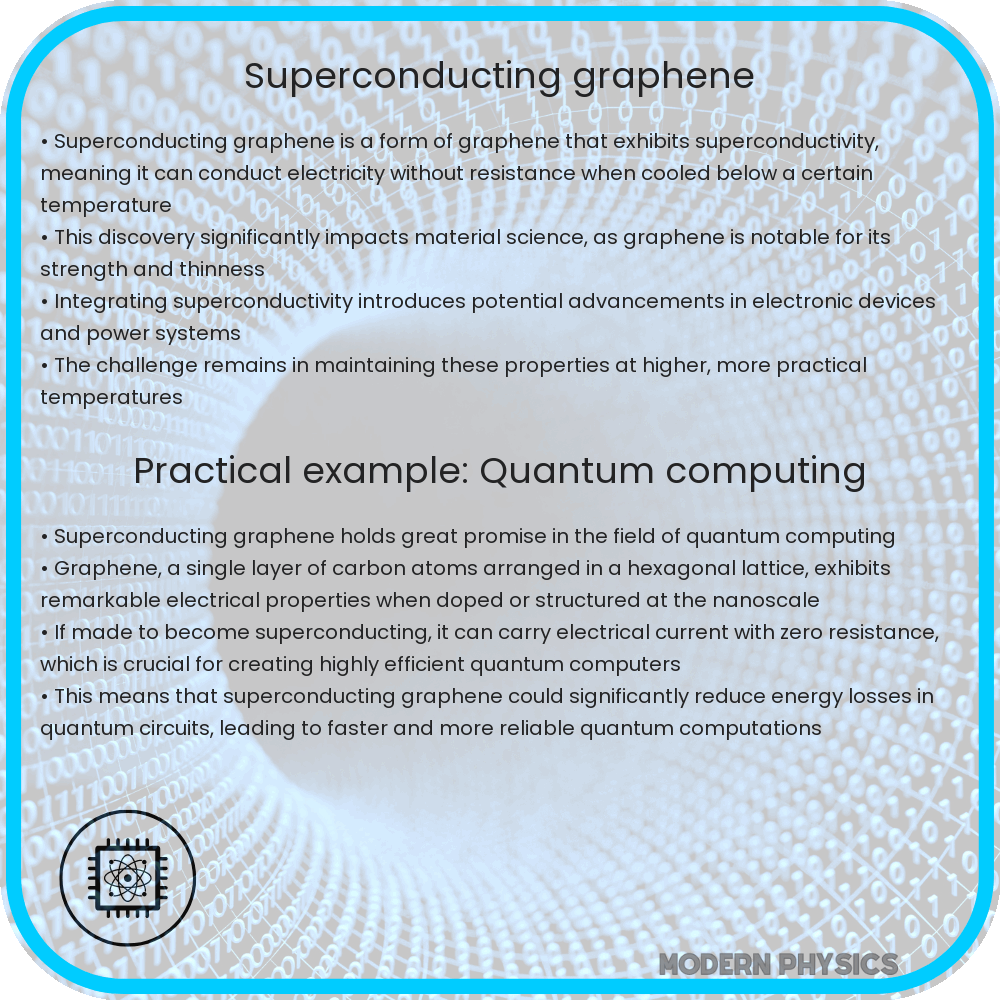
Superconducting Graphene: A Revolutionary Breakthrough
Superconducting graphene has emerged as a groundbreaking advancement in the field of materials science, offering a new horizon for efficiency and technological innovation. This novel material, a derivative of graphene, retains the latter’s remarkable properties—such as exceptional strength, flexibility, and conductivity—while also exhibiting superconductivity at low temperatures.
Understanding Superconductivity in Graphene
Superconductivity is a quantum mechanical phenomenon where a material can conduct electricity without resistance, leading to zero energy loss. This property is typically observed in certain materials at very low temperatures. However, the discovery of superconductivity in graphene has been a significant development due to its potential to operate at higher temperatures compared to traditional superconductors.
Graphene, a single layer of carbon atoms arranged in a hexagonal lattice, is renowned for its superior electrical, thermal, and mechanical properties. When doped with other elements such as lithium (Li+) or calcium (Ca2+), graphene has been found to exhibit superconducting properties under specific conditions. The mechanism behind this involves the pairing of electrons, known as Cooper pairs, which allows them to move without electrical resistance.
Efficiency and Potential Applications
The introduction of superconducting graphene paves the way for numerous applications across various fields. In electronics, it promises the development of ultra-fast, energy-efficient devices, potentially revolutionizing computer chips and integrated circuits. Furthermore, in the realm of renewable energy, superconducting graphene could lead to significant advancements in the efficiency of power transmission lines, reducing energy losses and supporting the global shift towards sustainable energy sources.
Additionally, this material holds great promise for the medical field, particularly in magnetic resonance imaging (MRI) technologies. The enhanced efficiency and sensitivity provided by superconducting graphene could lead to faster, more precise imaging techniques, improving diagnostics and patient care.
Superconducting Graphene: A New Horizon in Material Science
Superconducting graphene represents a significant leap forward in the realm of materials science, blending the extraordinary properties of graphene with the fascinating aspects of superconductivity. Graphene, a single layer of carbon atoms arranged in a two-dimensional honeycomb lattice, has captivated scientists and engineers alike due to its exceptional strength, thermal conductivity, and electronic properties. The advent of superconducting graphene opens up a new chapter, promising to revolutionize various technological fields.
Breakthroughs in Superconducting Graphene
The journey towards superconducting graphene has been marked by significant scientific endeavors. Initially, graphene was not inherently superconducting, which led researchers to seek methods to induce this property. The breakthrough came when scientists discovered that doping graphene with certain elements or placing it in contact with superconducting materials could induce superconductivity. This process involves altering the electronic properties of graphene, enabling it to carry electric current with zero resistance under specific conditions.
Efficiency and Advancements
The efficiency of superconducting graphene is measured by its critical temperature (Tc), the temperature below which it exhibits superconductivity. Although traditional superconductors require extremely low temperatures, advancements in superconducting graphene aim to increase Tc to more practical and accessible levels. This has significant implications for energy transmission, magnetic sensing, and quantum computing, as the efficiency gains could lead to substantial reductions in energy loss and operational costs.
Applications and Future Prospects
Superconducting graphene holds the potential to revolutionize multiple sectors. In electronics, it could lead to the development of ultra-fast, low-power computers and advanced sensors. In the energy sector, it offers the promise of lossless power transmission, which could transform the efficiency of electrical grids worldwide. Moreover, in the field of medical technology, superconducting graphene could enhance the capabilities of magnetic resonance imaging (MRI) machines, providing clearer and more detailed images.
The future of superconducting graphene is incredibly promising, with ongoing research focused on optimizing its superconducting properties and integrating them into practical applications. As the scientific community continues to unravel the mysteries of this remarkable material, the potential for groundbreaking technological advancements appears limitless. The intersection of graphene’s unique properties with superconductivity may well pave the way for a new era in material science, with wide-ranging implications for technology, energy, and beyond.
Conclusion
In summary, the development of superconducting graphene marks a monumental step forward in the quest for advanced materials that could redefine modern technology. Its unique combination of strength, conductivity, and now superconductivity, positions it as a key player in the future of scientific and technological innovation. As researchers continue to push the boundaries of what’s possible, the applications for superconducting graphene could extend far beyond what we currently imagine. The journey from theoretical possibility to practical application is underway, promising a future where the limitations of today’s materials are left far behind.