
Explore the significance of the Strehl ratio in determining optical system performance, from clarity and peak values to advancements in imaging quality.
Understanding the Strehl Ratio: A Key Indicator of Optical System Performance
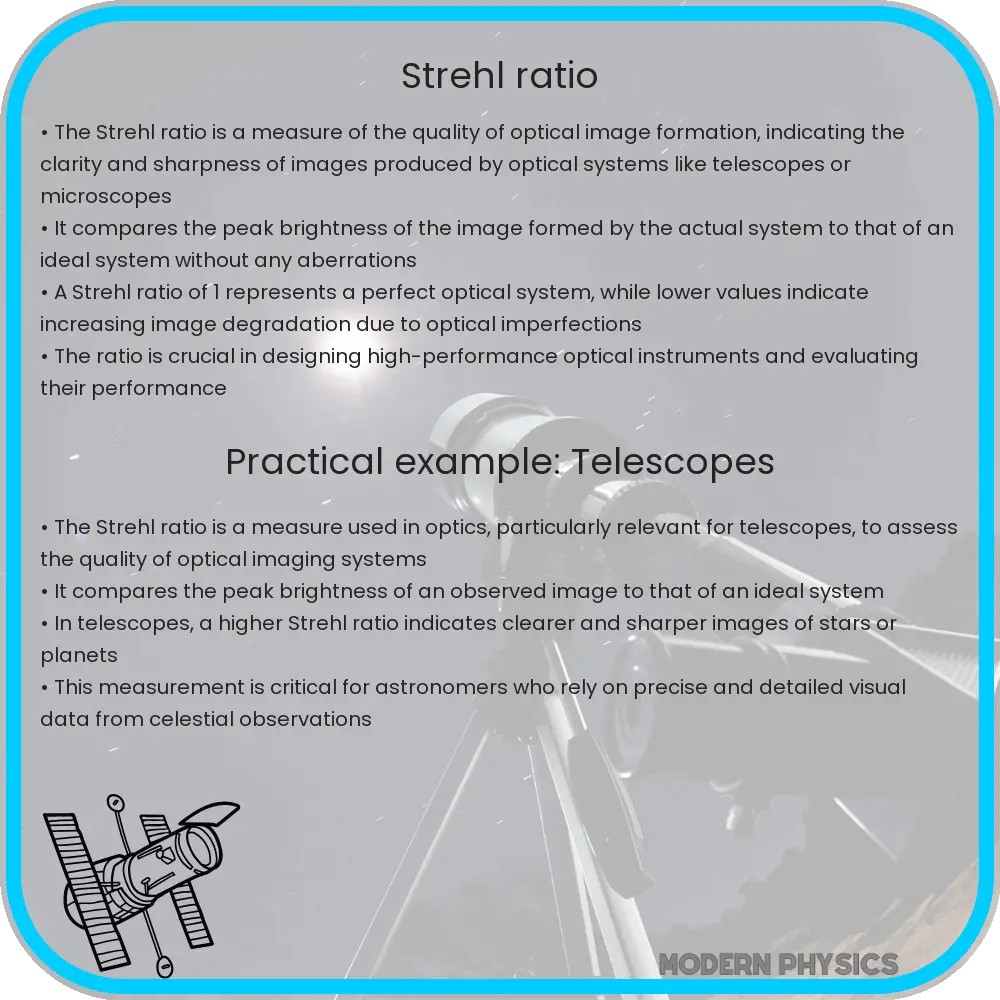
The Strehl ratio is an essential metric used in optics to describe the quality of an optical system. It compares the peak intensity of an image formed by an optical system under test to the peak intensity of an image formed by a perfect system without aberrations. This comparison is expressed as a decimal or percentage, where a value closer to 1 or 100% indicates a system with excellent optical quality.
Clarity and Peak Value in Optical Imaging
At the heart of the Strehl ratio’s importance is its direct relationship with the clarity and peak value of the images produced. Optical systems, whether for telescopes, microscopes, or cameras, aim to deliver images with high resolution and sharpness. The Strehl ratio quantifies how closely the system approaches the theoretical limit of perfection. A higher Strehl ratio signifies that an optical system can produce images with superior clarity, allowing for finer details to be seen and measured.
Imaging Quality and Its Implications
The quality of imaging is paramount in applications ranging from astronomical observations to microscopic analysis in biology. The Strehl ratio provides a concise summary of an optical system’s performance, taking into account all types of aberrations, including spherical, astigmatism, coma, and others. By evaluating the Strehl ratio, optical designers and engineers can identify and correct flaws in optical systems, leading to improvements in image quality.
Moreover, the Strehl ratio is particularly valuable because it offers a single number that reflects the complex interplay of various factors affecting optical quality. This simplifies the task of comparing different optical systems or configurations. However, it’s important to note that while a high Strehl ratio is indicative of good optical performance, it is not the only metric to consider. Other factors, such as the modulation transfer function (MTF), also play a crucial role in determining the overall quality of an optical system.
In summary, the Strehl ratio is a critical parameter for assessing the performance of optical systems, with direct implications for the clarity, peak value, and overall quality of imaging. Understanding and optimizing the Strehl ratio can lead to significant advancements in optical technology and its applications.
Optimizing Optical Performance Through the Strehl Ratio
Optimizing an optical system to achieve a high Strehl ratio involves careful design and engineering. This process includes selecting the appropriate materials, refining the shape and alignment of optical elements, and incorporating advanced coatings to minimize losses and aberrations. Advanced computational tools and techniques, such as wavefront sensing and adaptive optics, play a crucial role in diagnosing and correcting aberrations, thereby enhancing the Strehl ratio.
For instance, in telescopic systems used for astronomical observations, adaptive optics technology adjusts the shape of a mirror in real-time to compensate for atmospheric turbulence, significantly improving the system’s Strehl ratio. Similarly, in microscopy, specially designed objective lenses can correct for aberrations inherent in the specimen or the imaging medium, yielding clearer and more detailed images.
The Role of the Strehl Ratio in Modern Optics
The significance of the Strehl ratio extends beyond traditional optical systems. In the realm of laser optics, for example, a high Strehl ratio is crucial for focusing light to the smallest possible spot, maximizing the intensity and precision of laser cutting, engraving, and medical procedures. Similarly, in the field of optical communications, optimizing the Strehl ratio of lenses and mirrors used in fiber optic networks enhances signal clarity and transmission efficiency.
Furthermore, the quest for higher Strehl ratios drives innovation in optical design and manufacturing. It encourages the development of new materials and nanofabrication techniques that can produce optical elements with unprecedented precision and performance. As a result, the Strehl ratio not only serves as a benchmark for existing systems but also as a goalpost for the future of optical engineering.
Conclusion
The Strehl ratio is more than just a measure of optical performance; it is a testament to the sophistication and precision achievable in modern optics. By providing a clear, quantitative assessment of an optical system’s ability to produce high-quality images, the Strehl ratio serves as an invaluable tool for designers, engineers, and researchers. It facilitates the development of optical systems that push the boundaries of clarity, resolution, and efficiency.
As we continue to explore the universe, delve into the microscopic world, and expand the capabilities of optical technology, the Strehl ratio will remain a pivotal guide. It not only helps in evaluating and improving current optical systems but also inspires the next generation of innovations that will transform how we see and interact with the world around us.