
Explore the Hartmann Test’s role in enhancing optical lens quality, precision, and clarity. Learn how it shapes advancements in optics and technology.
Understanding the Hartmann Test: A Guide to Precision, Clarity, and Lens Quality in Optics
The Hartmann test, a pivotal tool in the field of optics, offers a comprehensive method for evaluating the quality and performance of lenses and optical systems. This non-invasive test allows for the precise measurement of aberrations that can affect image clarity, ensuring that lenses meet the highest standards of precision and quality.
The Principles of the Hartmann Test
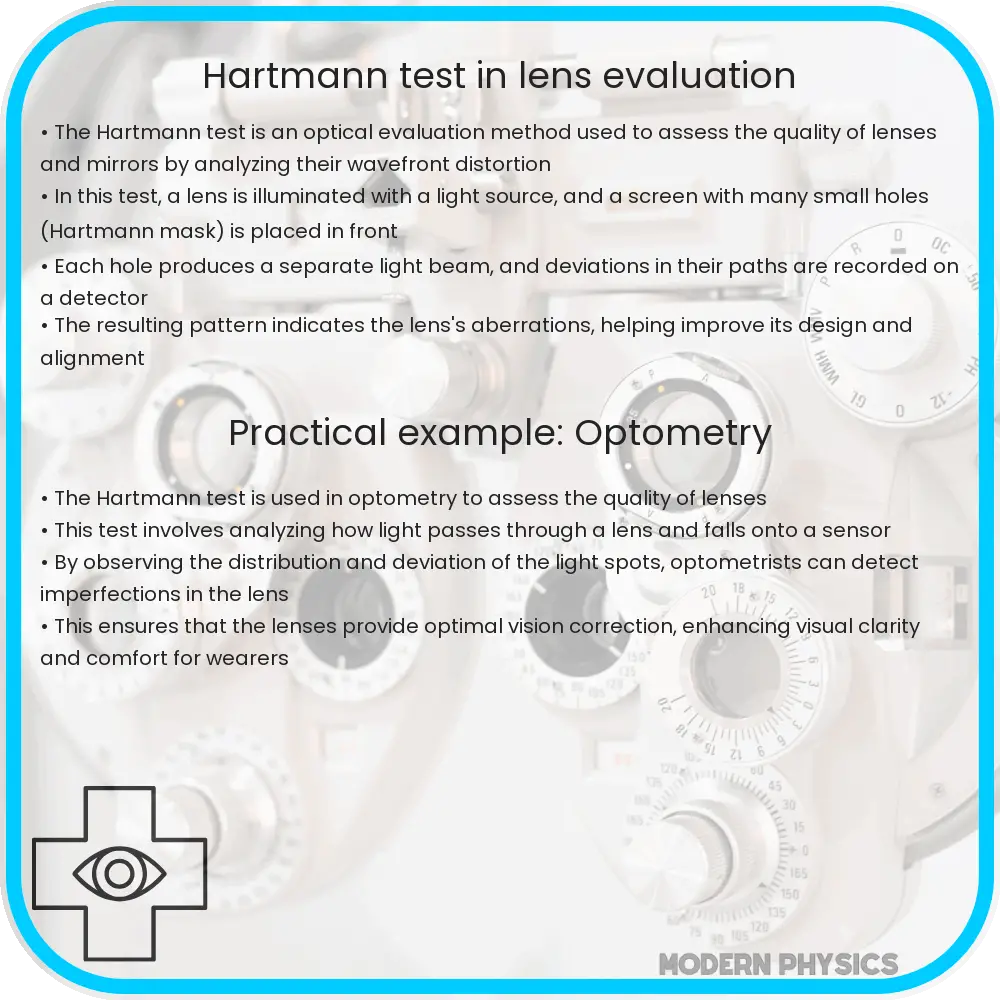
At its core, the Hartmann test involves projecting a series of light rays through the lens or optical system being tested. A screen with a pattern of small holes, known as a Hartmann mask, is placed in front of the lens. As light passes through the lens and the mask, it creates a pattern of spots that are captured on a sensor or photographic plate behind the lens. Analyzing the displacement of these spots from their expected positions allows for the detection of optical aberrations.
Key Benefits of the Hartmann Test
- Precision: The Hartmann test provides accurate measurements of lens aberrations, including spherical, coma, astigmatism, and field curvature, among others. This level of precision is crucial for applications requiring high-quality imaging, such as in astronomy, microscopy, and photography.
- Clarity: By identifying and quantifying aberrations, the Hartmann test helps in the optimization of lens design and manufacturing processes. This ensures that the final optical products deliver clear and sharp images.
- Lens Quality Assurance: The test is an essential part of quality control in lens manufacturing, ensuring that each product meets strict standards before reaching the consumer.
Applications of the Hartmann Test
The versatility of the Hartmann test makes it invaluable in numerous fields. It is extensively used in the development of telescopes, cameras, and corrective lenses, enabling advancements in technology and science. Its non-destructive nature also allows for the testing of delicate optical components without risk of damage.
The application of the Hartmann test extends beyond quality assurance, playing a critical role in the research and development of new optical technologies. By providing detailed insights into lens performance, it facilitates the creation of innovative solutions that push the boundaries of what is possible in optics.
Advancements and Modern Adaptations of the Hartmann Test
With technological advancements, the Hartmann test has evolved, leading to the development of the Hartmann-Shack sensor. This modern iteration enhances the original test’s capabilities, allowing for faster and more detailed analysis of wavefront aberrations. The Hartmann-Shack sensor is now a cornerstone in adaptive optics, used in fields ranging from ophthalmology to astronomical telescopes, to correct in real-time the aberrations detected in optical systems.
Implementing the Hartmann Test
The implementation of the Hartmann test in lens manufacturing and quality control involves several steps. Initially, a carefully designed Hartmann mask is placed in the path of light entering the optical system. The resulting spot pattern is then analyzed using sophisticated software that calculates the deviation of each spot from its ideal position. This data provides a comprehensive map of the optical system’s aberrations, informing adjustments needed to optimize performance.
Limitations and Considerations
While the Hartmann test is invaluable for assessing and improving lens quality, it is not without its limitations. The accuracy of the test can be affected by factors such as the alignment of the optical system and environmental conditions. Additionally, interpreting the results requires expertise in optics, as the data must be carefully analyzed to distinguish between different types of aberrations and their impact on image quality.
Conclusion
The Hartmann test remains a fundamental tool in the field of optics, offering unmatched precision in the evaluation of lens quality and optical performance. Its evolution, marked by the integration of modern technology like the Hartmann-Shack sensor, has expanded its applications, making it indispensable in both research and industry. Despite its complexity and the need for expert analysis, the benefits of the Hartmann test in ensuring the production of high-quality optical components are undeniable. As optical technologies continue to advance, the Hartmann test will undoubtedly play a crucial role in driving innovations and maintaining the highest standards of clarity and precision in optical products.