
Explore the mysteries of stellar winds, their effects on the cosmos, and the latest research in astrophysics, uncovering the dynamic forces shaping our universe.
Understanding Stellar Wind: Unraveling the Mysteries of the Cosmos
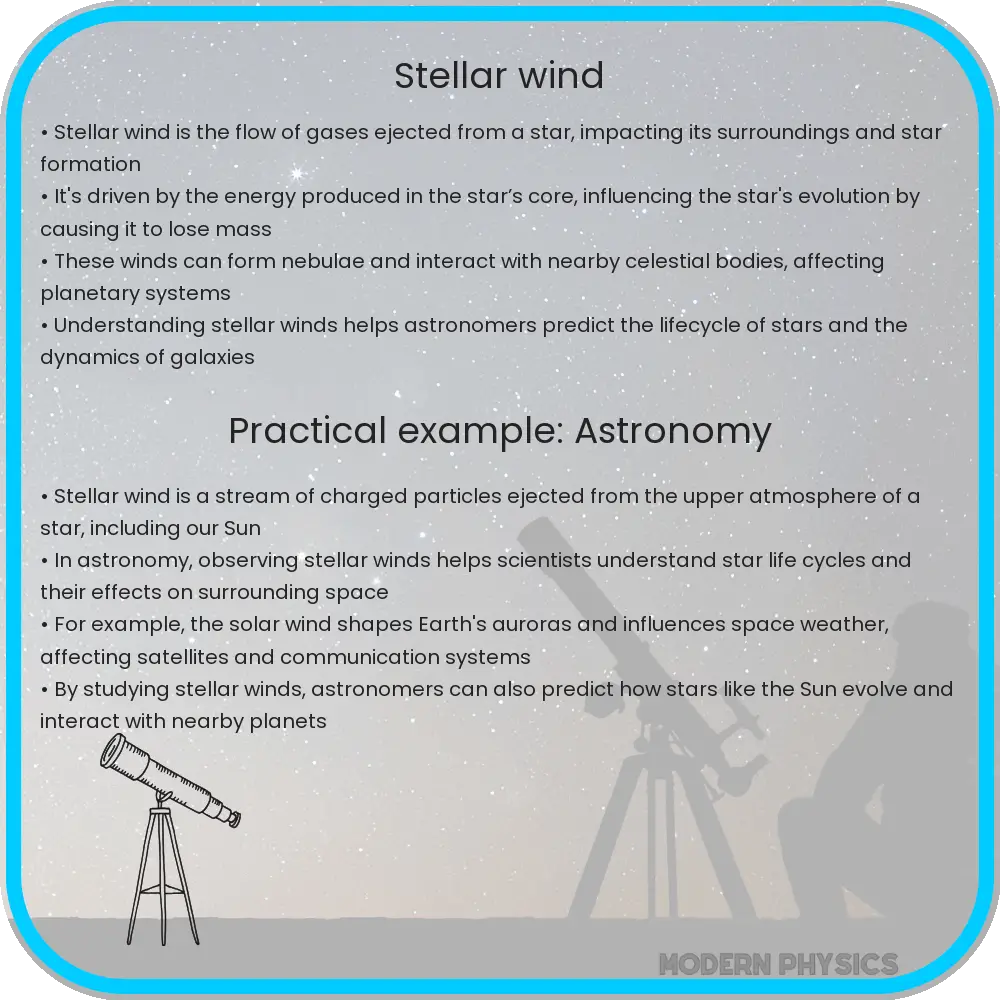
Stellar wind, a phenomenon integral to the lifecycle of stars, plays a crucial role in the dynamics of the cosmos. Originating from the upper atmosphere of stars, these winds are streams of charged particles, primarily electrons and protons, that are ejected from the star’s surface. This continuous flow of material extends into the surrounding space, shaping the interstellar medium and influencing the evolution of nearby celestial bodies.
Composition and Mechanisms
The composition of stellar winds is largely determined by the star’s characteristics. For main-sequence stars like our Sun, the wind consists mostly of hydrogen and helium, with traces of heavier elements. The solar wind, a well-studied example, is propelled by thermal energy from the corona, the outermost layer of the solar atmosphere. The temperature here can exceed 1 million Kelvin, providing the necessary energy for particles to overcome the Sun’s gravitational pull.
Effects on the Solar System and Beyond
The impact of stellar winds extends far beyond their originating stars. In our Solar System, the solar wind interacts with planetary magnetic fields, atmospheres, and even the heliosphere, the bubble-like region of space dominated by the solar wind. This interaction can lead to phenomena such as auroras and the shaping of planetary magnetospheres. Moreover, stellar winds can strip away planetary atmospheres, influencing the habitability of exoplanets orbiting other stars.
Research and Exploration
Astrophysicists employ a variety of methods to study stellar winds, from direct spacecraft measurements in our Solar System to remote sensing techniques for stars light-years away. Observations from telescopes and space missions, combined with theoretical models, help scientists understand the driving mechanisms of these winds and their effects on cosmic structures. This research not only unravels the intricacies of stellar behavior but also aids in our understanding of galaxy evolution and the conditions necessary for life.
Challenges in Studying Stellar Winds
Despite significant advances, studying stellar winds presents numerous challenges. The vast distances and the intricate nature of these phenomena make direct observation and measurement difficult. Furthermore, the variability of stellar winds, influenced by changes in stellar activity and magnetic fields, adds layers of complexity to their study. Advanced simulation models and innovative observational techniques are continuously developed to overcome these obstacles and provide deeper insights into stellar wind dynamics.
The Future of Stellar Wind Research
The future of stellar wind research is promising, with upcoming telescopes and space missions poised to offer unprecedented views of these enigmatic phenomena. Instruments like the James Webb Space Telescope and the Parker Solar Probe are expected to provide new data on the physical properties of stellar winds and their effects on the interstellar medium. These advances will enable more accurate predictions about the impact of stellar winds on planetary systems, including our own, and contribute to our understanding of the universe’s fundamental processes.
Conclusion
Stellar wind research is a vital field in astrophysics, offering crucial insights into the life cycles of stars and the dynamics of the cosmos. Understanding these winds allows scientists to piece together the intricate puzzle of celestial phenomena, from the formation of stars to the evolution of galaxies. As technology advances, the mysteries of stellar winds continue to unfold, bringing us closer to a comprehensive understanding of the universe’s many wonders. The ongoing exploration and study of stellar winds not only enrich our knowledge of astrophysics but also underscore the interconnectedness of all cosmic entities.