
Explore the fascinating world of stellar bow shocks: how stars create cosmic waves in space, their formation, impacts, and significance in understanding the universe’s dynamics.
Introduction to Stellar Bow Shocks
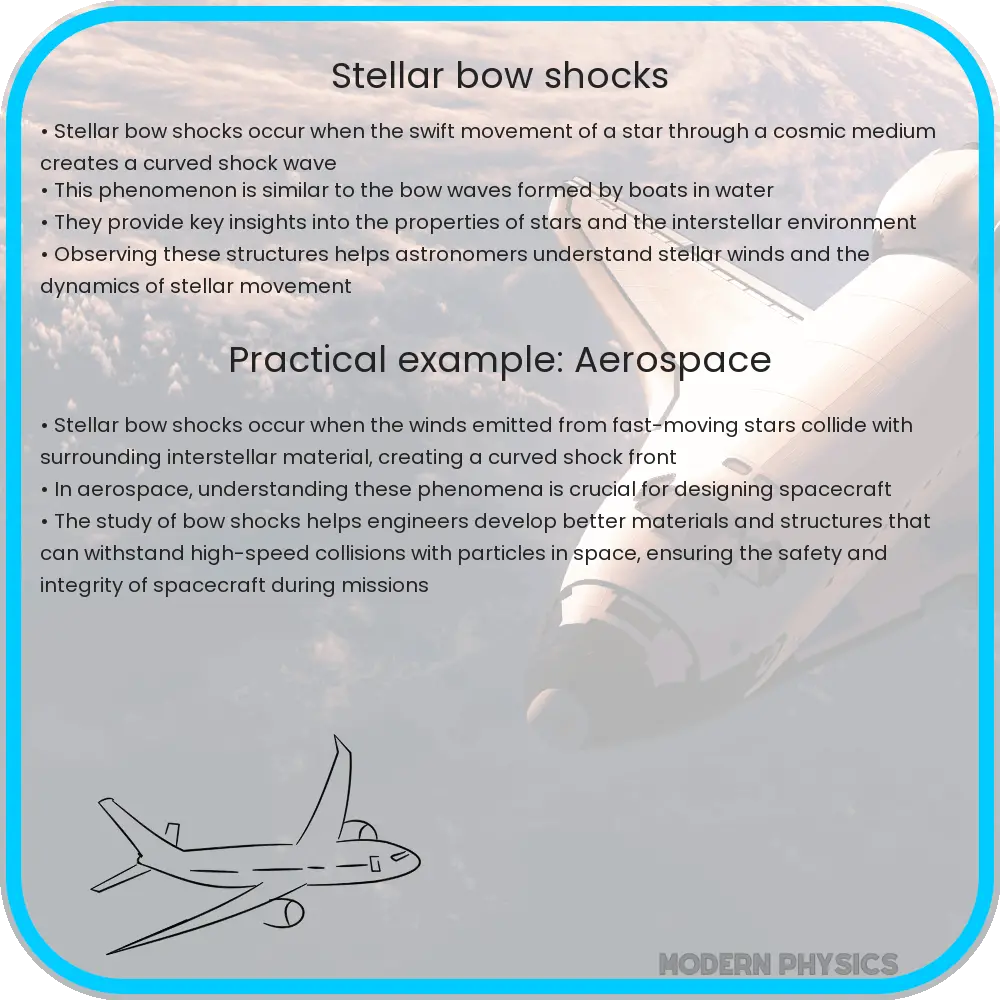
Stellar bow shocks represent a remarkable phenomenon in the cosmos, where the swift movement of a star through the interstellar medium (ISM) creates a distinct, wave-like structure ahead of the star. This structure, similar to the bow wave formed by a ship moving through water, manifests due to the interaction between the star’s stellar wind and the surrounding ISM. Understanding these structures offers insights into the life cycle of stars, the properties of the interstellar medium, and the dynamics of cosmic dust and gas.
Formation of Stellar Bow Shocks
The formation of a stellar bow shock begins when a star travels through the ISM at a velocity significantly higher than the local sound speed. This movement results in the compression of interstellar gas and dust in front of the star, creating a curved shock front. The shape and size of this shock front are influenced by factors such as the star’s velocity, the density of the ISM, and the strength of the star’s stellar wind—a stream of charged particles emitted by the star.
The process can be visualized through the analogy of a boat moving through water: as the boat speeds forward, water piles up in front of it, forming a wave that curves around its bow. Similarly, as a star moves through the ISM, its stellar wind pushes against interstellar material, forming a bow shock that delineates the boundary between the star’s influence and the ISM.
Impact of Stellar Bow Shocks
Stellar bow shocks have significant implications for the astrophysical community. They not only sculpt the interstellar landscape, creating unique, observable structures but also act as natural laboratories for studying the interaction between stellar winds and the ISM. These interactions play a crucial role in the life cycle of stars and the evolution of galaxies. By examining the properties of bow shocks, astronomers can infer the velocity and direction of a star’s movement, the properties of its wind, and the density of the surrounding interstellar medium.
Moreover, stellar bow shocks influence the distribution and composition of interstellar dust and gas. As the shock front travels through space, it can collect, compress, and heat the interstellar material, leading to various chemical and physical processes that affect the composition of the ISM.
Research and Observations
Advancements in astronomical observations and technology have propelled the study of stellar bow shocks. Telescopes equipped with infrared, X-ray, and radio detectors enable astronomers to observe these phenomena in different wavelengths, providing a comprehensive view of their structure and composition. Observational data combined with theoretical models allow researchers to simulate the conditions leading to the formation of bow shocks and to predict their effects on the surrounding interstellar medium.
One of the challenges in studying stellar bow shocks lies in the diversity of their appearances. Depending on the star’s speed, wind properties, and the ISM density, bow shocks can vary widely in size, shape, and brightness. This variability offers an opportunity to study the wide range of interactions between stars and their environments but also requires careful interpretation of observational data.
Future Directions in Stellar Bow Shock Research
The study of stellar bow shocks is an evolving field, with future research poised to address many unanswered questions. Upcoming space missions and ground-based telescopes are expected to provide higher resolution images and spectra, enabling deeper insights into the physical processes governing bow shocks. Additionally, interdisciplinary studies combining astrophysics, chemistry, and fluid dynamics are likely to enhance our understanding of these cosmic phenomena.
Another promising area of research involves the study of bow shocks around runaway stars—stars that move through the galaxy at unusually high speeds. Investigating these stars and their associated bow shocks can provide valuable information about their origins, trajectories, and the dynamic processes occurring in their stellar winds.
Conclusion
Stellar bow shocks are not merely spectacular cosmic occurrences; they are windows into the fundamental processes shaping our universe. By studying these phenomena, scientists can gain insights into the lifecycle of stars, the dynamics of the interstellar medium, and the complex interactions between different cosmic elements. As observational techniques improve and theoretical models advance, our understanding of stellar bow shocks will continue to grow, further illuminating the intricate tapestry of our galaxy.