
Explore the fascinating world of stellar maser emission, uncovering its role in astrophysics, star formation, and cosmic measurement in our comprehensive guide.
Unraveling the Mysteries of Stellar Maser Emission
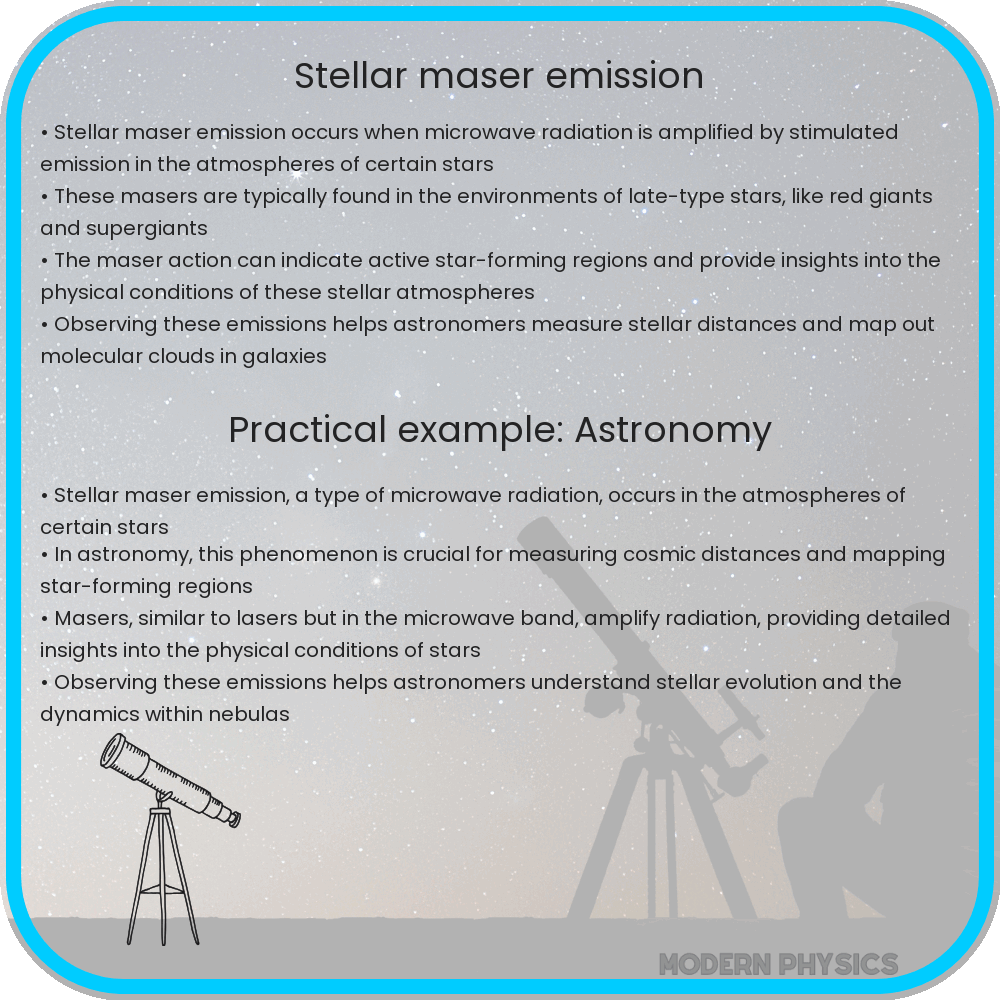
Stellar maser emission represents one of the most intriguing phenomena in the field of astrophysics. These naturally occurring microwave amplification by stimulated emission of radiation, or masers, challenge our understanding of cosmic events and structures. Unlike their terrestrial counterparts, the lasers, masers in space are not man-made but occur naturally under specific astrophysical conditions.
Understanding Stellar Masers
Stellar masers are found in the environments around late-type stars, particularly in regions where new stars are born or where stars end their life cycle. They are typically associated with molecular clouds, circumstellar envelopes, and the jets of young stellar objects. These masers are fueled by the energy from the star and the surrounding gas, emitting intense and highly focused beams of microwave radiation. The most common molecules found in stellar masers include water (H2O), silicon monoxide (SiO), and hydroxyl radicals (OH).
Significance in Astrophysics
The study of stellar masers provides valuable insights into the astrophysical processes occurring in the universe. By observing maser emissions, astronomers can gather information about the velocity, density, and temperature of the interstellar medium. This data is crucial for understanding the dynamics of star formation, stellar evolution, and the end stages of stellar life, such as the formation of planetary nebulae and supernovae remnants.
Signals from the Cosmos
One of the most fascinating aspects of stellar masers is their role as cosmic beacons. Due to their bright and narrow emission lines, masers can be observed across vast distances in space, making them excellent tools for measuring cosmic scales and structures. They are pivotal in the study of galactic dynamics and the mapping of our own Milky Way. Furthermore, the precise measurements provided by masers are instrumental in refining our understanding of fundamental cosmic parameters, such as the Hubble constant, which measures the rate at which the universe is expanding.
Mysteries and Challenges
Despite their utility, stellar masers continue to pose significant challenges to astrophysicists. One of the primary mysteries is the exact mechanism that leads to the amplification of maser emissions in stellar environments. While the basic principles of maser action are understood, the specific conditions and processes that give rise to intense maser activity in space remain subjects of ongoing research. Additionally, the variability of maser emissions, which can change dramatically over short periods, adds another layer of complexity to their study.
Future Prospects in Maser Research
The future of maser research is bright, with advancements in radio astronomy and space-based telescopes offering new avenues for exploration. Upcoming missions and improvements in interferometry techniques promise higher resolution and more sensitive observations. This will not only enhance our understanding of maser mechanisms but also provide deeper insights into the structure and evolution of the cosmos. Furthermore, interdisciplinary approaches combining data from different astronomical phenomena and tools are expected to unravel the intertwined processes that govern stellar and galactic evolution.
Conclusion
Stellar maser emission stands as a testament to the complex and dynamic nature of the universe. These cosmic phenomena serve as powerful tools for probing the depths of space, offering glimpses into the life cycles of stars and the mechanics of our galaxy. While challenges remain in fully understanding the intricacies of maser emissions, the continued study of these celestial beacons holds the promise of unlocking further secrets of the cosmos. As technology and methodologies advance, the mysteries of stellar masers will gradually yield to the relentless pursuit of knowledge, illuminating the dark corners of the universe and enriching our understanding of the celestial tapestry that surrounds us.