
Explore the mysterious world of Pulsational Pair-instability Supernovae, massive cosmic events shaping the universe, their origins, predictions, and impact on cosmic evolution.
Understanding Pulsational Pair-instability Supernovae
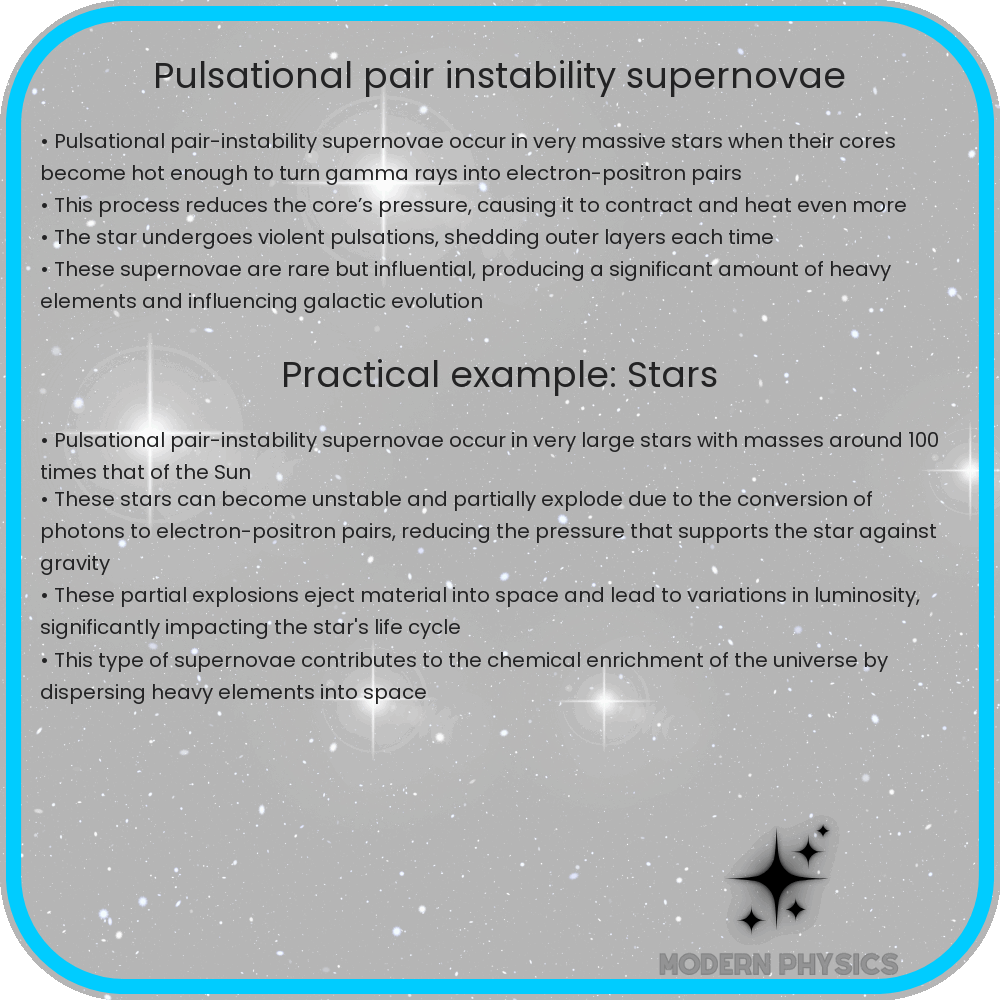
Pulsational Pair-instability Supernovae (PPISNe) represent one of the most extreme and rare events in the universe. They occur in very massive stars, typically over 100 times the mass of the Sun, and are characterized by a series of explosive events prior to the star’s ultimate collapse. Understanding PPISNe is crucial for astrophysics, as they contribute to the chemical enrichment of the universe and provide insights into the properties of massive stars.
Origins and Characteristics
The origin of PPISNe lies in the very heart of massive stars, where extreme conditions lead to the production of electron-positron pairs from gamma-ray photons. This process reduces the internal pressure supporting the star against gravity, causing it to contract. If the core temperature reaches sufficiently high levels, it can trigger explosive nuclear burning, releasing vast amounts of energy and leading to a pulsational ejection of the star’s outer layers. This process can repeat multiple times, causing a series of eruptions observed as pulsations before the final supernova explosion.
Predictions and Modeling
Predicting the behavior of PPISNe involves complex computational models that simulate the internal dynamics of massive stars. These models must account for various physical processes, including nuclear fusion reactions, radiation transport, and the formation of electron-positron pairs. By adjusting parameters such as star mass, metallicity, and rotation, scientists can simulate different scenarios and compare them with observations to refine their understanding of these colossal events.
Role in the Universe
PPISNe play a significant role in the cosmos. They are thought to be responsible for the production of heavy elements, contributing to the chemical diversity of the universe. The energy released by these explosions can trigger the formation of new stars and influence the evolution of nearby galaxies. Additionally, studying PPISNe can provide valuable information about the final stages of stellar evolution and the limits of star stability.
Challenges in Studying PPISNe
Despite their significance, studying PPISNe presents substantial challenges. These events are extremely rare and occur over timescales that can range from years to millennia, making direct observation difficult. Furthermore, the extreme distances at which these supernovae occur limit the detail that can be observed with current telescopic technology. Consequently, much of what we know comes from theoretical models and indirect observations, such as the detection of unusual chemical abundances in ancient, distant galaxies.
Recent Discoveries and Future Directions
In recent years, advances in telescopic technology and computational modeling have led to increased detection and understanding of PPISNe. Astronomers have identified several candidate events, providing crucial data to refine theoretical models and predictions. Future telescopes, such as the James Webb Space Telescope, are expected to provide even more detailed observations of these rare phenomena. Additionally, ongoing developments in computational astrophysics promise to enhance the accuracy and scope of PPISNe simulations, offering deeper insights into their mechanics and impacts on the cosmic landscape.
Conclusion
Pulsational Pair-instability Supernovae are among the most powerful and enigmatic events in the universe, offering a unique window into the life cycles of the most massive stars. Despite the challenges associated with their study, recent advances in observational and computational astrophysics have led to significant progress in understanding these extraordinary events. As technology advances, we can expect to uncover more about PPISNe, further illuminating the complex processes that shape our universe. The continued study of these supernovae not only enriches our understanding of stellar evolution but also provides essential insights into the history and composition of the cosmos, highlighting the interconnectedness of all cosmic phenomena.