
Explore the essentials of sputtering deposition, its types, advantages, and applications in industries like electronics and renewable energy.
Understanding Sputtering Deposition
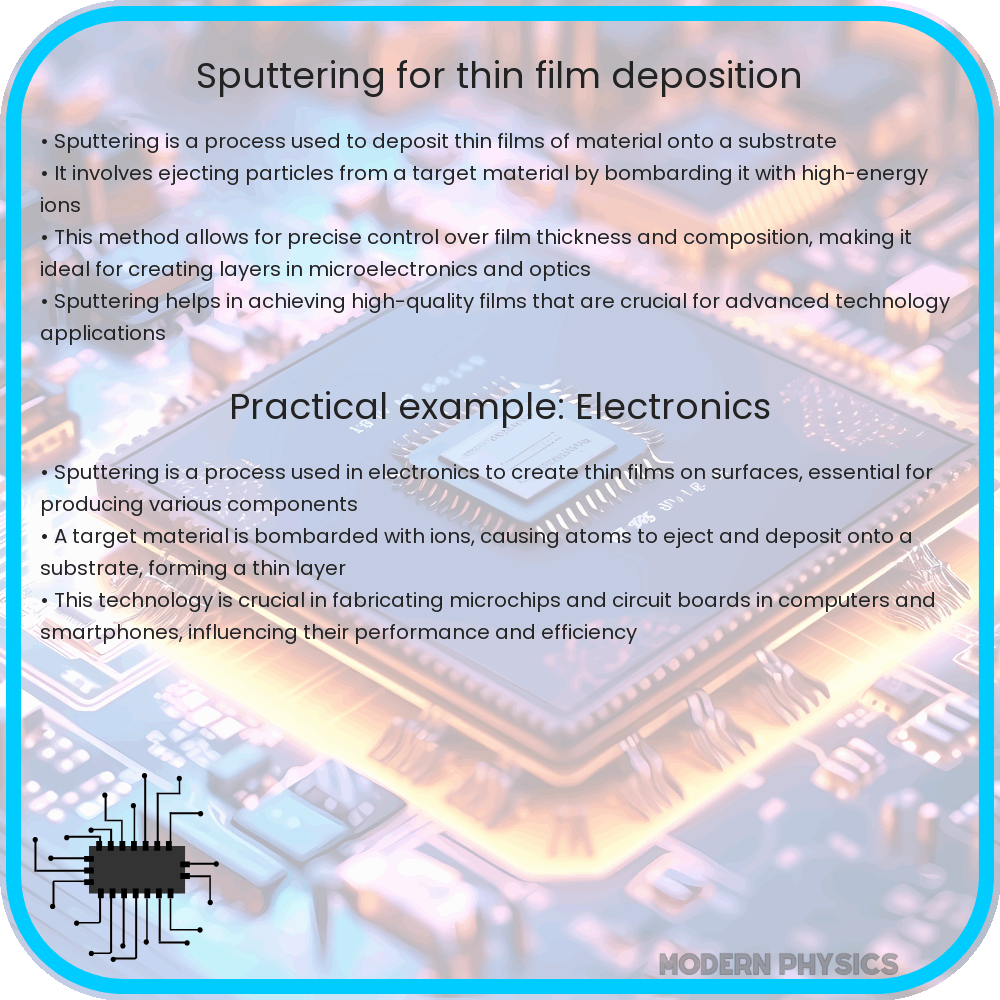
Sputtering deposition is a pivotal technique in the field of thin film coating technology, renowned for its precision, uniformity, and adaptability. It involves the ejection of material from a target, or “sputter target,” which then deposits onto a substrate to form a thin film. This process is fundamental in various applications, including semiconductor fabrication, solar panels, and the production of flat-panel displays.
The Mechanics of Sputtering
The sputtering process begins in a vacuum chamber, where a gas, typically argon, is ionized into plasma. The positive ions from the plasma are accelerated towards the negatively charged target material. Upon impact, atoms from the target material are ejected and propelled towards the substrate, forming a thin, uniform layer. The energy and momentum transfer during this process are governed by the principles of classical mechanics, ensuring precise control over the film’s growth and properties.
Types of Sputtering Deposition
- DC Sputtering: Employed for conductive materials, direct current (DC) sputtering facilitates a continuous flow of electrons, enabling consistent material deposition.
- RF Sputtering: For insulating materials, radio frequency (RF) sputtering is utilized, accommodating the deposition of non-conductive materials by oscillating the electrical charge.
- Magnetron Sputtering: This advanced form enhances the process by introducing magnetic fields to confine plasma, boosting the efficiency and quality of the deposition.
Key Advantages
Sputtering deposition offers several advantages, making it a preferred method in thin film technology. Its precision allows for the deposition of extremely thin layers, critical for microelectronics and nanotechnology. The process ensures uniformity, resulting in coatings of consistent thickness and quality across large areas. Moreover, its adaptability means it can be applied to a wide range of materials, including metals, insulators, and polymers.
Understanding the fundamentals and variations of sputtering deposition enables industries to tailor the process to meet specific requirements, ensuring optimal performance and efficiency in their products.
Challenges and Solutions in Sputtering Deposition
Despite its numerous advantages, sputtering deposition faces certain challenges. These include the need for high-quality vacuum environments, target material wastage, and the potential for film imperfections such as pinholes and non-uniform thickness. To address these issues, continuous advancements in sputtering techniques and equipment are being made. For instance, the development of high-purity target materials and improved vacuum technology enhances the overall quality and efficiency of the deposition process.
Applications of Sputtering Deposition
Sputtering deposition has a wide range of applications across various industries. In the electronics sector, it is used for the manufacturing of integrated circuits, memory devices, and LCD screens. The automotive industry employs sputtering for creating durable, reflective coatings on headlights and other components. Additionally, in the realm of renewable energy, sputtering is instrumental in producing thin-film solar cells, contributing to the advancement of sustainable energy solutions.
Future Prospects
The future of sputtering deposition holds promising advancements. Researchers are exploring new materials and methodologies to enhance the process’s efficiency and adaptability. Innovations such as dynamic sputtering targets and environmentally friendly processes are set to redefine the standards of thin film deposition. As technology progresses, the applications of sputtering deposition are expected to expand, opening new avenues for innovation in various fields.
Conclusion
Sputtering deposition stands out as a cornerstone technique in the fabrication of thin films, offering unmatched precision, uniformity, and versatility. Despite facing challenges, ongoing research and technological advancements continue to refine and expand its capabilities. The method’s broad applicability and potential for innovation make it a critical component in the advancement of modern technology. As we move forward, the continuous evolution of sputtering deposition techniques will undoubtedly play a pivotal role in shaping the future of materials science and engineering.