
Explore the precision and applications of Speckle Pattern Analysis for material deformation, strain measurement, and surface analysis across various fields.
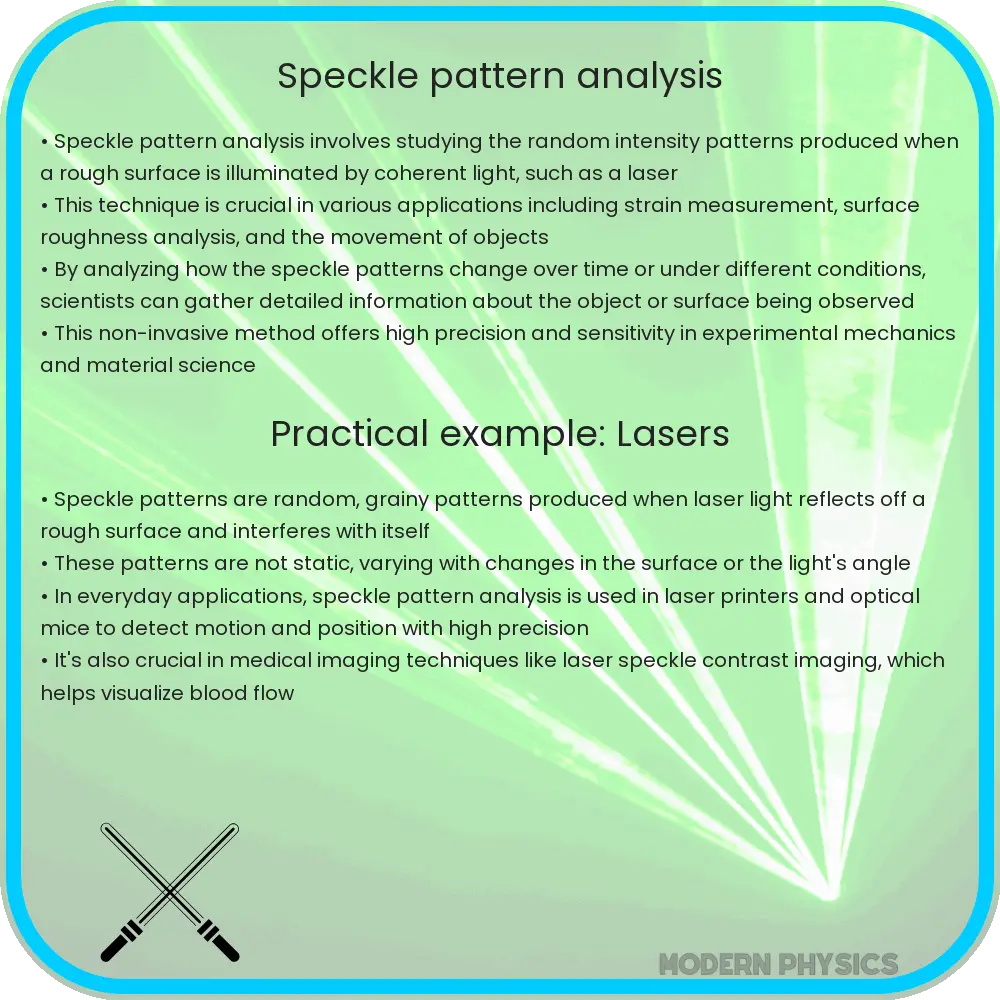
Understanding Speckle Pattern Analysis
Speckle Pattern Analysis is a sophisticated technique employed in various scientific and engineering disciplines to measure the deformation, strain, and surface roughness of materials. This method leverages the unique speckle patterns produced by the interference of coherent light, such as that from a laser, when it scatters off a rough surface. The intricate details of these speckle patterns provide valuable information about the surface characteristics and changes occurring under different conditions.
Accuracy in Speckle Pattern Analysis
The accuracy of speckle pattern analysis is paramount, as it directly influences the reliability of the measurements obtained. Several factors affect the precision of this technique, including the quality of the imaging system, the coherence of the light source, and the algorithm used for analyzing the speckle patterns. Advanced algorithms, such as Digital Image Correlation (DIC) and Laser Speckle Contrast Analysis (LASCA), have been developed to enhance the accuracy and resolution of the measurements. These algorithms are capable of detecting minute changes in the speckle pattern, allowing for highly precise analysis of deformations, strains, and surface textures.
Applications of Speckle Pattern Analysis
Speckle pattern analysis finds application in a wide range of fields. In the realm of material science, it is used for testing material properties under stress and for non-destructive evaluation of components. Biomedical engineering benefits from speckle analysis in assessing blood flow and tissue deformation, providing insights into cardiovascular health and the mechanical properties of biological tissues. Additionally, in mechanical engineering, it assists in the study of structural components under load, helping to predict failure points and optimize designs.
Methods of Speckle Pattern Analysis
There are various methods employed in speckle pattern analysis, each suited to specific types of measurements and applications. The most common include:
- Electronic Speckle Pattern Interferometry (ESPI): A technique for measuring displacement and strain at a high resolution.
- Speckle Pattern Photography: Used for capturing static changes in the speckle pattern due to deformation.
- Dynamic Speckle Analysis: Applies to the study of time-varying processes, such as drying paint or curing processes.
Choosing the appropriate method depends on the specific requirements of the application, including the scale of measurement, the nature of the surface being analyzed, and the environmental conditions.
Is this conversation helpful so far?
Enhancing Accuracy and Resolution in Speckle Pattern Analysis
To further enhance the accuracy and resolution of speckle pattern analysis, researchers and engineers employ several advanced techniques. Calibration of the imaging system is crucial for minimizing systematic errors. Utilizing high-resolution cameras and optimizing the wavelength and coherence length of the laser source also contribute significantly to improving the quality of speckle pattern measurements. Moreover, the development of sophisticated image processing algorithms and machine learning models has opened new avenues for automating and refining the analysis, leading to faster and more accurate interpretations of the speckle patterns.
Challenges and Future Directions
Despite its wide application and the advancements in technology, speckle pattern analysis faces challenges. These include sensitivity to environmental conditions, such as vibrations and temperature fluctuations, which can affect the stability of the speckle patterns. Furthermore, the interpretation of speckle data requires significant expertise, particularly in complex or dynamic measurements. To address these challenges, ongoing research focuses on developing more robust analysis techniques and improving the algorithms for noise reduction and data interpretation. The integration of artificial intelligence and deep learning is particularly promising for automating the analysis and enhancing the capability to handle complex and dynamic speckle patterns.
Conclusion
Speckle pattern analysis is a powerful tool in the field of precision measurement and material analysis, offering unparalleled insights into the micro and macro deformations, strains, and surface characteristics of a wide variety of materials. Its applications span across material science, biomedical engineering, and mechanical engineering, demonstrating its versatility and effectiveness. With the continuous advancements in imaging technology, computational algorithms, and understanding of speckle dynamics, speckle pattern analysis is set to become even more accurate, reliable, and applicable to a broader range of scientific and industrial tasks. The ongoing development of this technique underscores the importance of interdisciplinary collaboration in pushing the boundaries of what can be measured and understood about the physical world around us.