
Explore the Soret Effect and its role in thermodynamics and transport phenomena, covering principles, applications, and future research trends.
Soret Effect: Understanding Thermodynamic Principles and Transport Phenomena
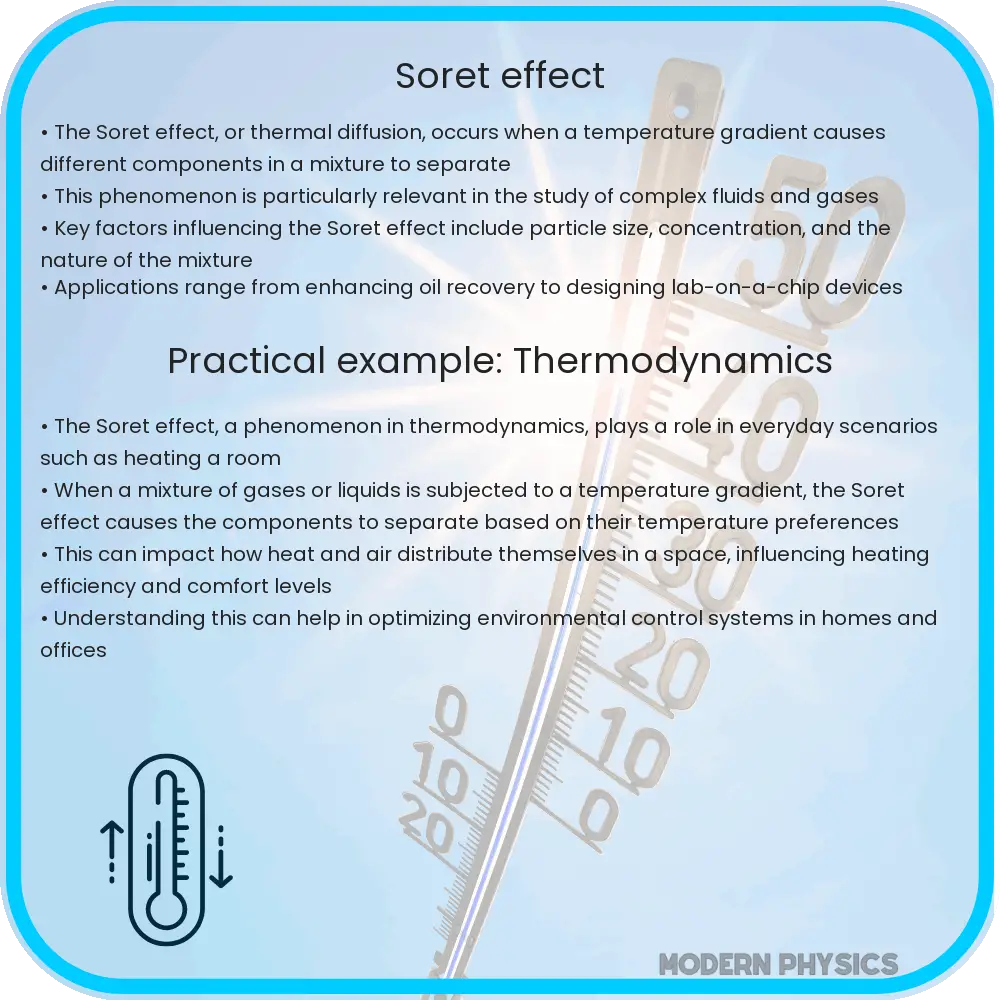
The Soret Effect, also known as thermal diffusion, is a fascinating phenomenon in the realm of thermodynamics and transport phenomena. It describes the motion of particles in a mixture caused by a temperature gradient. This effect is particularly significant in the study of non-equilibrium thermodynamics, where systems are not in thermal equilibrium. The Soret Effect has practical implications in various fields including material science, biology, and environmental engineering.
Basic Principles of the Soret Effect
At the heart of the Soret Effect lies the principle that temperature differences within a mixture can induce a concentration gradient. This is contrary to the more commonly observed phenomenon where concentration differences drive heat flow. In a mixture of two or more substances, when subjected to a temperature gradient, the lighter or smaller particles tend to move towards the cooler region, while the heavier or larger particles move towards the warmer region. This movement is due to the kinetic energy differences between the particles caused by the temperature variance.
The quantitative description of the Soret Effect is often expressed through the thermal diffusion ratio, \( K_T \), which is defined as:
-
\( K_T = \frac{D_T}{D} \)
Here, \( D_T \) is the thermal diffusion coefficient, and \( D \) is the usual diffusion coefficient. The thermal diffusion ratio is a dimensionless number that provides insight into the magnitude of the Soret Effect in a given system.
Applications of the Soret Effect
The Soret Effect has diverse applications in various scientific and industrial fields. For instance, in the petroleum industry, it plays a crucial role in the recovery of hydrocarbons from oil reservoirs. Understanding how components of crude oil move in response to temperature gradients can optimize extraction processes. In environmental engineering, the Soret Effect is essential in understanding how pollutants disperse in the atmosphere or oceans, particularly under varying temperature conditions.
Moreover, in the field of biology, the Soret Effect is instrumental in studying the behavior of cells and proteins under thermal stress. It helps in understanding the migration of molecules within cells and can be vital in drug delivery research.
Challenges and Future Directions in the Study of the Soret Effect
Despite its widespread applications, the study of the Soret Effect presents several challenges. One significant challenge is the accurate measurement of thermal diffusion coefficients, especially in complex mixtures. These coefficients are sensitive to various factors such as temperature, pressure, and the nature of the mixture components. Advanced experimental techniques, such as laser-induced fluorescence and holographic interferometry, are being developed to improve the precision of these measurements.
Another challenge lies in the theoretical understanding of the Soret Effect. The current theoretical models are often based on simplifications that may not accurately represent all real-world scenarios. Therefore, there is a continuous need for the development of more comprehensive models that can better predict the behavior of mixtures under thermal gradients.
Conclusion
The Soret Effect is a critical phenomenon in thermodynamics and transport phenomena, offering deep insights into the behavior of mixtures under temperature gradients. Its applications span across various industries, from oil recovery to environmental management and biotechnology. The ongoing advancements in experimental techniques and theoretical models are enhancing our understanding of this complex phenomenon, promising more efficient and innovative applications in the future.
As research continues to unravel the intricacies of the Soret Effect, it stands as a testament to the interconnectedness of physical principles in understanding and manipulating the natural world. Its study not only contributes to the fundamental science of thermodynamics but also paves the way for practical solutions to some of the most challenging problems in industry and environmental management. The Soret Effect, therefore, remains a pivotal area of study, driving forward the frontiers of science and technology.